
Sheppard Air Instrument Flight Rating (IFR) Practice Test Practice Exam
$69.00
- Buy to unlock unlimited access to all Quiz questions and Answers in this Quiz.
- After purchase you can print a PDF of the whole quiz at any point. The PDF will contain the questions and the correct answers.
About this Exam
The Instrument Flight Rating (IFR) is a qualification that allows a pilot to fly aircraft in low visibility conditions, relying primarily on their instruments rather than outside visual references. It is a critical certification for safe flight and is required for many commercial pilot positions. The Sheppard Air preparation program is a highly regarded, strategic tool designed specifically to help pilots master the vast and complex question bank of the actual FAA IFR knowledge test. It is primarily used by aspiring commercial pilots and those looking to significantly enhance their piloting skills and safety.
Ready to test your knowledge?
Buy Now to Access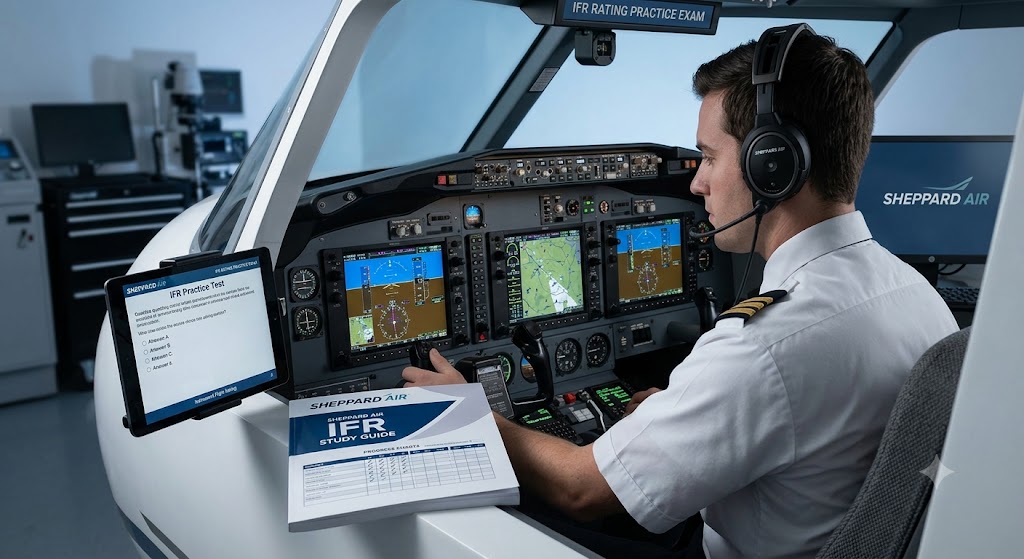
Additional Information
What the Course Entails and Exam Details
Sheppard Air’s IFR prep isn't a comprehensive ground school in the traditional sense; rather, it is an accelerated study method focused intently on the questions that may appear on the actual FAA Instrument Rating written exam. The program's core goal is to enable you to recognize question patterns, understand the underlying logic, and recall correct answers efficiently.
The program typically provides you with a massive, current database of potential FAA questions, categorized by topics specified in the FAA airman certification standards (ACS). These topics include:
Aviation Weather: Understanding weather systems, forecasts, and interpreting charts.
Regulations and Procedures: Master the Code of Federal Regulations (CFRs) for IFR operations, Airman's Information Manual (AIM) procedures, and Air Traffic Control (ATC) communication.
Aircraft Instruments: Detailed knowledge of gyroscopic, pitot-static, and navigation instruments and systems.
IFR Navigation: Proficiency in dead reckoning, using navigation systems, and interpreting IFR enroute and approach procedure charts.
Flight Planning and Decision Making: Preparing for IFR flights, alternate planning, and emergency procedures.
Sheppard Air typically provides software or access to these questions, often with specific study modes (practice only, instant feedback, memory aids) and strategies that encourage repetition and systematic learning of the most likely exam items. The program is not a substitute for understanding the actual flying and knowledge, but is a powerful tool to secure that crucial passing grade on the written test.
What to Expect in the Final Exam
While Sheppard Air is your study method, the actual final exam is the FAA Instrument Rating (Airplane or Helicopter, though the structure is similar) Knowledge Test. Here are the core details of what to expect when you take the real test:
Format: The exam consists of objective, multiple-choice questions. Each question is independent.
Number of Questions: The Instrument Rating—Airplane and Instrument Rating—Helicopter tests each contain 60 questions.
Time Limit: You are allowed 2 hours and 30 minutes (2.5 hours) to complete the entire exam.
Passing Score: The minimum passing score is 70 percent. You must answer at least 42 out of 60 questions correctly.
Authorized Materials: You are generally allowed to use a flight computer (e-6B or digital equivalent) and a basic calculator. The testing center will provide scratch paper. Check current FAA guidelines or with your test center for any specific restrictions.
Validation Questions: The FAA sometimes includes unscored "validation questions" to test new material. These will not affect your final score.
No Tricks, Just Rigor: The FAA aims to test critical IFR knowledge. The questions can be dense and highly detailed, which is where careful study of the vast material pays off.
How to Study and Exam Centers
Using Sheppard Air effectively requires dedication and a specific approach. Follow these strategies for success:
Effective Sheppard Air Study Methods:
Follow the Strategy: Sheppard Air often provides a specific study schedule and method (e.g., specific repetition patterns, utilizing memory aids). Adhere to their recommendations.
Systematic Review: Work through the entire question bank. Don't skip difficult questions. Ensure you see every single potential question and understand the correct answer.
Practice Modes: Utilize all study modes the program offers. Work through categories, then practice random questions, and finally, take practice exams to build your stamina and time management skills.
Focus on Weaknesses: Review questions you got wrong or guessed on. Understand why you were incorrect and why the other answer is right.
Use Memory Aids and Hints: Sheppard Air often provides useful memory hooks or tricks to remember tricky answers or specific details. Take advantage of them.
Simulate Exam Conditions: Towards the end of your prep, take practice tests with no notes and under a strict timer.
Take Practice Exams Often: Use the program's built-in testing features. Consistent high scores on practice exams are your strongest indicator of readiness.
Taking the Real FAA Knowledge Test:
Get Endorsed: Before you can schedule the actual test, you must receive an endorsement from an authorized flight instructor (CFI), certifying that you have completed the ground school (or home-study course) and are prepared for the knowledge test.
Schedule the Exam: Register and pay for the exam through an FAA-authorized testing partner. PSI Services is a major provider, and their website allows you to find authorized testing centers and book your slot. Many local flight schools and FBOs also host test centers.
Locate a Center: Utilize the registration process to find the most convenient physical testing location for you. These can be specific dedicated centers or designated computers within other aviation businesses.
Confirm Details: Arrive early with all required identification (government-issued photo ID, endorsement, and any required confirmation documents). Be familiar with the center's rules.
Job Opportunities from the Course
Successfully completing the IFR knowledge test and the subsequent Instrument Flight Rating (which requires additional flight training and a practical test, or checkride) unlocks crucial career paths. It is not generally a requirement for a standalone job but is a fundamental prerequisite for most advanced commercial piloting roles:
Airline Pilot (Regional & Major): An Instrument Rating is non-negotiable for airline transport pilot (ATP) certification and all airline hiring.
Commercial Charter Pilot (on-demand): Required for virtually all commercial charter and business jet operations.
Corporate Pilot: Essential for flying corporate executives and clients in various weather conditions.
Freight & Cargo Pilot: Necessary for scheduled and unscheduled cargo transport.
Flight Instructor (with additional certifications): To instruct instrument students (CFII), this rating is a necessary step. While an initial CFI is usually for visual flying, the ability to teach instruments is highly marketable.
Aerial Work Pilot (various): Some advanced aerial application, surveillance, or pipeline patrol positions operating IFR-capable aircraft may require the rating.
Emergency Medical Services (EMS) Pilot: Vital for piloting medical helicopters in all conditions.
Frequently Asked Questions
Reviews
5.0
Based on 0 reviews
Leave a Review
No reviews yet. Be the first to review!