
Single Camera Production Practice Exam
$69.00
- Buy to unlock unlimited access to all Quiz questions and Answers in this Quiz.
- After purchase you can print a PDF of the whole quiz at any point. The PDF will contain the questions and the correct answers.
About this Exam
This article provides a detailed study guide and practice test overview for the Single Camera Production – Film Terms examination. Designed for aspiring filmmakers, film students, and entry-level crew members, this certification or common course outcome evaluates understanding of the technical vocabulary, conceptual knowledge, and production methodologies intrinsic to single-camera production.
Ready to test your knowledge?
Buy Now to Access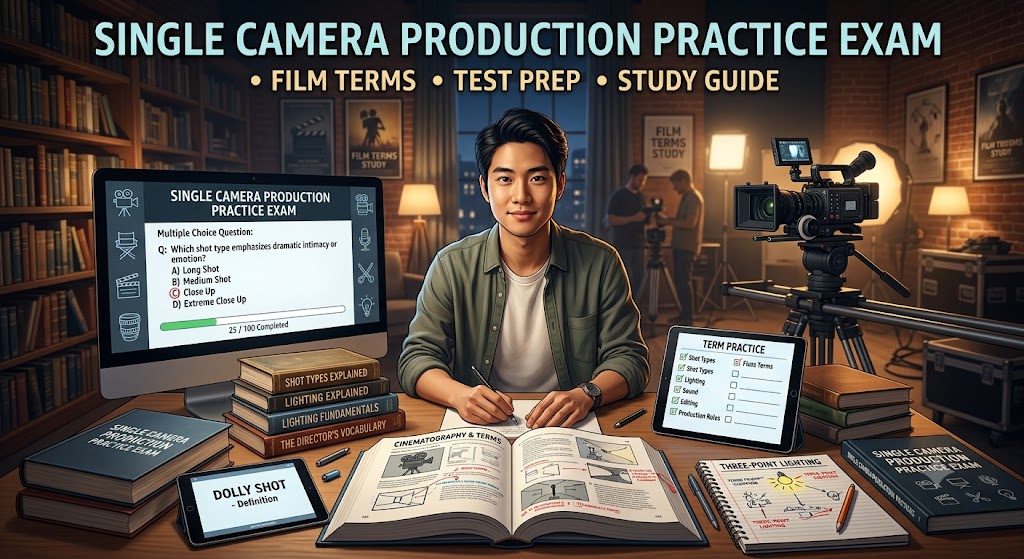
Additional Information
What the Course Entails and Exam Details
The course of study prepares individuals to understand the nuances of crafting visual stories using a single camera setup. Mastery of the accompanying film terms is essential for clear communication on set and in post-production. The curriculum typically covers, and the exam will test, knowledge across key categories, which often include:
Shot Types & Composition: Understanding and identifying the terminology for framing (e.g., Extreme Close Up, Medium Shot, Long Shot), composition rules (e.g., Rule of Thirds, Headroom), and camera movements (e.g., Pan, Tilt, Zoom, Dolly).
Camera & Lens Terms: Knowledge of aperture, shutter speed, ISO, focal length, depth of field, rack focus, and various camera parts.
Lighting Setups & Terminology: Recognizing foundational lighting concepts (e.g., Three-Point Lighting: Key, Fill, Back), light sources (natural vs. artificial), and relevant terms (e.g., High-Key, Low-Key, Contrast, Hard/Soft Light).
Sound Concepts: Understanding audio terminology for production sound (e.g., Boom Mike, Lavalier, Room Tone, Sound Mixer) and post-production audio (e.g., Foley, Diegetic/Non-Diegetic Sound, ADR).
Editing Techniques & Terms: Familiarity with common cuts (e.g., J-Cut, L-Cut, Jump Cut, Cross-Cutting, Match Cut), continuity editing, montage, and transition terms (e.g., Cut, Dissolve, Wipe).
Production & Equipment Vocabulary: General on-set communication, call sheets, script breakdown terminology, and common equipment usage (e.g., C-Stand, Slate, Clapperboard).
Crew Roles and Responsibilities (Terms focus): While jobs are detailed below, the test focuses on understanding the common terms for these roles on set (e.g., Gaffer, Key Grip, 1st AC, DP).
What to Expect in the Final Exam
While this is a study guide and a source for practice material, the eventual real-world Single Camera Production Film Terms Final Exam often follows a predictable pattern (the specifics will vary by institution and test version, so always check official guidelines):
Format: The exam typically employs Multiple Choice Questions (MCQs), likely making up the largest portion of the test, to assess recognition and definition recall. There may also be identification sections (e.g., identifying a specific shot type from an image) or short answer questions requiring definitions or explanations of concepts. Some practical or case-study based multiple-choice scenarios could be included.
Question Count: A real final exam often consists of 50 to 100 questions.
Time Limit: Expect a time constraint, generally between 60 and 120 minutes.
Passing Score: A passing score is typically set between 70% and 80%, depending on the program or certification criteria.
Specific Rules: In a formal testing environment, you can expect strict rules: typically no access to notes, books, or electronic devices other than the testing computer; potential requirement for visual/audio proctoring; no collaborative testing. This practice test allows more flexibility but mirrors the style of question you might encounter.
How to Study and Exam Centers
A comprehensive and deliberate study approach is key to success on any film production terms exam. Combine general film studies with active recall.
How to Study Effectively:
Leverage this Practice Test: Repeatedly take practice quizzes with varied questions (Multiple Choice, Identification). Analyze incorrect answers to pinpoint weak areas.
Create Digital Flashcards: Use apps or websites to build a custom deck of key film terms. Utilize spaced repetition for optimal memorization. Include terms from textbooks, lectures, and online film glossaries.
Watch and Analyze: Re-watch single-camera television shows and movies with a critical eye. Practice identifying shot types, lighting techniques, editing patterns, and specific terminology as they occur on screen.
Review Class Materials: Thoroughly go through your textbooks, lecture notes, and any relevant industry publications. Re-read sections related to single-camera techniques and production roles.
Form a Study Group: Discussing terms, quizzing each other, and explaining concepts can significantly reinforce your own understanding and expose different perspectives.
Create Your Own "Cheat Sheet" (for study only!): Write down key terms and concise definitions in your own words. The process of summarizing and writing helps consolidate information.
Simulate Exam Conditions: For final study sessions, take a timed, quiet practice test without notes to build stamina and identify remaining areas for focus.
Where and How to Take the Final Exam (Illustrative of typical certification/institution processes):
For this specific practice test, you likely have accessed it through an educational portal, an online study resource, or a provided document.
A real, final certification or course exam would require formal registration and be conducted under controlled conditions. This might be arranged through:
Educational Institutions: Many students take this as a culminating exam for a university, college, or film school course. These exams are typically scheduled and proctored by the school itself, either in physical classrooms or via the institution’s official online learning management system.
Authorized Schools/Testing centers: For certain specialized certifications not tied directly to a semester-long course, specific authorized training providers or educational testing centers might host the exam.
Commercial Testing Centers: In some cases, major standardized tests are administered through commercial testing centers like Pearson VUE or Prometric. Check your specific program details to see if this option applies.
Online Proctored Exam Portals: Many certifications offer online testing options. These typically require an internet connection, a webcam, and a microphone, with the exam being monitored in real-time by a live or automated online proctor to ensure academic integrity.
Job Opportunities from the Course
A strong grasp of single-camera production techniques and the ability to clearly communicate on a film set through proper terminology can open doors to numerous exciting career paths in the industry. These entry and mid-level roles, which can evolve into key creative positions, include:
Cinematographer (Director of Photography): The visionary responsible for the visual look, framing, and lighting. Progression often starts from lower camera or electric roles.
Camera Operator: Directly executes the camera movements and framing under the cinematographer’s guidance.
First Assistant Camera (1st AC): Manages focus and camera equipment logistics.
Gaffer: Head of the electric department, responsible for executing the lighting plan.
Key Grip: Head of the grip department, managing equipment for supporting cameras and shaping light.
Sound Mixer: The creative and technical head of production sound recording.
Boom Operator: Operates the microphone to capture dialogue on set.
Film Editor: Shapes the raw footage into a cohesive narrative in post-production.
Script Supervisor: Ensures continuity across all takes and scenes, an incredibly detail-oriented role.
Production Assistant: A vital entry-level position involved in diverse tasks, often a crucial stepping stone.
Director: A long-term career goal involving overall creative and performance leadership.
Frequently Asked Questions
Reviews
5.0
Based on 0 reviews
Leave a Review
No reviews yet. Be the first to review!