
Six Sigma Green Belt Practice Exam
$69.00
- Buy to unlock unlimited access to all Quiz questions and Answers in this Quiz.
- After purchase you can print a PDF of the whole quiz at any point. The PDF will contain the questions and the correct answers.
About this Exam
The Six Sigma Green Belt Certification is a prestigious credential designed for professionals who are ready to become experts in driving quality and process improvement within their organizations. This study guide and practice exam are tailored for individuals looking to validate their capability to lead and support Six Sigma projects, specifically those employing the DMAIC (Define, Measure, Analyze, Improve, Control) framework. This program is ideal for quality professionals, engineers, business analysts, manufacturing and operations managers, project leads, and any individual aiming to contribute significantly to organizational efficiency, cost reduction, and enhanced customer satisfaction. Earning a Green Belt demonstrates that you possess a disciplined approach to analyzing data, identifying root causes of inefficiency, and implementing effective, sustainable solutions, often serving as the vital connection between foundational Yellow Belt skills and advanced Black Belt leadership.
Ready to test your knowledge?
Buy Now to Access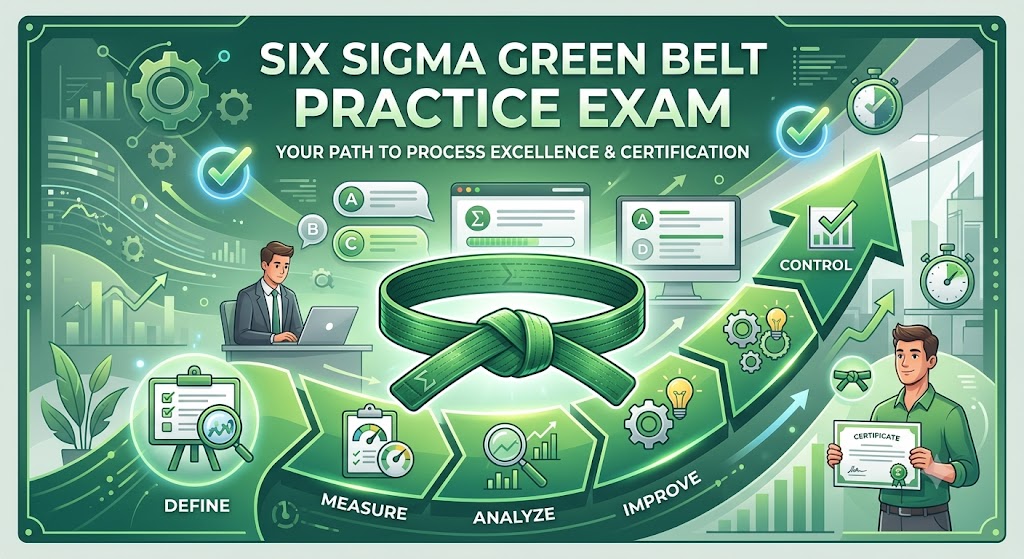
Additional Information
What the Course Entails and Exam Details
The standard Six Sigma Green Belt course is a robust journey that equips students with both foundational concepts and practical, data-driven methodologies. The curriculum centers heavily around the famous DMAIC methodology, grounding you in every phase:
Define Phase: Clearly articulating the problem, project scope, goals, and stakeholder requirements. You will learn about project charters and understanding the Voice of the Customer (VOC).
Measure Phase: Focusing on data collection, process mapping, establishing baseline performance, and basic statistical analysis. Key topics often include data collection plans, capability analysis, and Measurement System Analysis (MSA).
Analyze Phase: The core of problem-solving. This section deep dives into data interpretation, root cause analysis using charts and fishbone diagrams, and identifying the critical factors impacting performance.
Improve Phase: Developing and piloting creative, robust solutions. You will explore brainstorming, Design of Experiments (DOE) basics, and selecting optimal solutions.
Control Phase: Sustaining the gains. This phase covers Statistical Process Control (SPC) with control charts, mistake-proofing (Poka-Yoke), and developing standard operating procedures (SOPs).
Beyond these phases, the course builds core skills in team dynamic management, basic statistical software usage, and integrating Six Sigma with Lean principles for maximum process optimization. It’s a comprehensive toolkit for proactive problem-solving.
What to Expect in the Final Exam
The official Six Sigma Green Belt Certification exam is a comprehensive assessment that rigorously tests both your theoretical knowledge and your practical application of the concepts. While specific parameters may vary slightly among major certifying organizations, most exams consist entirely of multiple-choice questions. Typically, you can anticipate an exam duration that ranges from 3 to 4.5 hours, and you will need to answer approximately 100 to 110 questions. The questions are designed not only to test definitions but also to present hypothetical business scenarios requiring you to apply the appropriate Six Sigma tools and DMAIC steps. Passing scores generally sit between 70% and 75%, and you should confirm the exact passing mark with your specific certification body. In most cases, these are closed-book, proctored exams, meaning you are not permitted outside materials. However, many standardizing bodies will allow a simple scientific calculator during the test to assist with necessary calculations. The environment is designed to ensure the integrity of the credential and thoroughly measure your preparedness for Green Belt responsibilities.
How to Study and Exam Centers
Comprehensive preparation is vital for success. Start with a deep review of your original course material, making sure you understand the 'why' behind each tool, not just the 'how.' We highly recommend dedicating significant time to practice exams. Consistently engaging with a high-quality "Six Sigma Green Belt Practice Exam" is crucial to simulate the actual test environment, understand the framing of questions, and identify weak spots in your knowledge. Develop a disciplined study schedule, create your own flashcards for formulas and definitions, and try to apply the concepts to current projects at your workplace – practical application is the ultimate reinforcement. Consider joining study groups for collaborative learning. When you are ready to take the official exam, the testing is delivered through secure channels. You will typically register via online portals. These can range from online proctored exams you can complete from home under specific rules, to professional physical testing centers. Global providers like Pearson VUE or Prometric often have extensive networks of certified physical locations for a secure, in-person testing experience. Your specific certifying organization will provide detailed instructions on current delivery methods and locations.
Job Opportunities from the Course
Earning a Six Sigma Green Belt immediately opens doors to a wide range of career opportunities across nearly all sectors, as process excellence is universally valued. Certified professionals are high in demand for their demonstrated ability to tackle complex problems. Some common job titles and career paths this certification can unlock or enhance include:
Quality Engineer
Process Improvement Specialist
Operations Analyst / Operational Excellence Specialist
Continuous Improvement Coordinator
Manufacturing Engineer / Process Engineer
Project Manager / Project Engineer
Business Analyst
Quality Assurance Manager / Quality Control Lead
Logistics or Supply Chain Manager
Operational Excellence Lead / Lean Six Sigma Facilitator
Frequently Asked Questions
Reviews
5.0
Based on 0 reviews
Leave a Review
No reviews yet. Be the first to review!