
Six Sigma White Belt Certification Practice Exam
$69.00
- Buy to unlock unlimited access to all Quiz questions and Answers in this Quiz.
- After purchase you can print a PDF of the whole quiz at any point. The PDF will contain the questions and the correct answers.
About this Exam
The Six Sigma White Belt certification is the fundamental, introductory level of the world-renowned Six Sigma continuous improvement methodology. Designed for individuals who are completely new to the concept or seeking a basic understanding, this course and practice exam are ideal for employees across all levels—from frontline staff and supervisors to managers and project team members. This certification provides a vital overview of Six Sigma terminology, history, and basic tools, making it an excellent starting point for anyone interested in enhancing quality, reducing defects, and driving efficiency in their organization without the depth required for higher belts. Achieving your White Belt shows initiative and a basic alignment with a culture of quality.
Ready to test your knowledge?
Buy Now to Access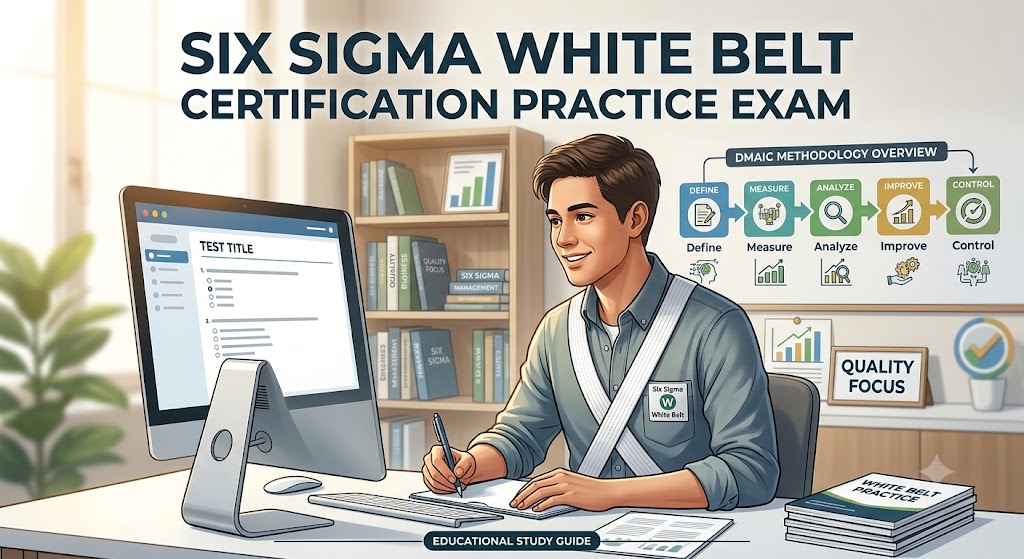
Additional Information
What the Course Entails and Exam Details
This foundational course is not just a direct path to the practice exam; it provides a structural understanding of the methodology. The syllabus typically covers:
Introduction to Six Sigma: The core philosophy, history, and key goals.
The DMAIC Methodology: A high-level overview of the Define, Measure, Analyze, Improve, Control phases.
Six Sigma Roles: Understanding the different belt levels (Yellow, Green, Black, Master Black Belt) and their responsibilities.
Basic Quality and Process Tools: Concepts like Process Maps, Fishbone Diagrams, and the Voice of the Customer (VOC).
Change Management: The importance of teamwork and supporting process improvement. Your practice exam is structured specifically to assess your knowledge in these fundamental areas. It will feature a series of questions—often in multiple-choice format—that test your understanding of key terminologies, definitions, and the initial, logical steps within the Six Sigma framework. Expect questions on defining the phases of DMAIC and identifying basic quality concepts.
What to Expect in the Final Exam
Upon completion of your study, you will proceed to the official Six Sigma White Belt Certification exam. While formats can vary by provider, candidates can typically expect the following standard features:
Format: The final exam is almost always multiple choice and conducted online.
Length: A White Belt exam is generally concise, often consisting of 20 to 50 questions.
Passing Score: Requirements can vary, but a passing score of 70% to 80% is common for this introductory level.
Time Limits: Candidates are typically given between 30 and 60 minutes to complete the exam. Some providers may even offer untimed exams at this level, though a reasonable time window is standard.
Rules: Due to the foundational nature of the White Belt, exams are often open-book or allow basic reference materials, focusing on conceptual understanding rather than strict memorization. Always verify the specific rules of your chosen certification body.
How to Study and Exam Centers
Preparing for the Six Sigma White Belt certification is a straightforward and highly achievable goal. Here are actionable strategies to succeed:
Review Core Materials: Engage thoroughly with the provided training materials, whether they are a self-paced online course, a guidebook, or internal training documents. Pay close attention to definitions, the DMAIC phases, and basic tools.
Leverage Practice Exams: Utilize multiple practice tests! These are invaluable for building familiarity with the question format, testing your knowledge retention, and identifying areas where you need further review. Analyze every incorrect answer to understand the correct concept.
Understand, Don't Memorize: Focus on the 'why' behind the concepts. Understand what each DMAIC phase achieves and the general value of quality management.
Create Terminology Flashcards: A lot of the White Belt exam centers on vocabulary. Flashcards are ideal for mastering the fundamental Six Sigma terms. Six Sigma White Belt exams are predominantly conducted online through authorized training and certification providers. There are no standard, centralized physical testing centers like Pearson VUE for this level. Most accredited organizations (such as the Council for Six Sigma Certification (CSSC), the International Association for Six Sigma Certification (IASSC), or various university professional development programs) will administer the exam through a secure online portal upon completion of their course or on-demand. Employers may also facilitate these courses and exams internally. Always confirm the accredited status of your chosen provider.
Job Opportunities from the Course
While the White Belt is an entry point, it signals a commitment to quality that employers value in various roles, particularly those with a continuous improvement component. The certification can unlock or enhance career paths and opportunities, without requiring tables here, such as:
Quality Assurance Assistant
Process Coordinator
Team Leader
Supervisor
Administrative or Operational Support (any role involving efficient processes)
Junior Project Manager (especially with other credentials)
Process Analyst (entry-level roles)
Supply Chain Support
Continuous Improvement Coordinator Earning your Six Sigma White Belt shows that you are ready to participate in, support, and communicate within a culture of process improvement
Frequently Asked Questions
Reviews
5.0
Based on 0 reviews
Leave a Review
No reviews yet. Be the first to review!