
Skeletal System A&P Practice Exam
$69.00
- Buy to unlock unlimited access to all Quiz questions and Answers in this Quiz.
- After purchase you can print a PDF of the whole quiz at any point. The PDF will contain the questions and the correct answers.
About this Exam
This article provides a comprehensive guide for anyone preparing to take a Skeletal System A&P Practice Test. This test is a critical evaluation component commonly found within broader Anatomy & Physiology courses. It is specifically designed for students pursuing careers in healthcare and wellness. This includes aspiring nurses, radiologic technologists, physical therapist assistants, surgical technologists, paramedics, and medical assistants. The purpose of this exam is to validate a student’s foundational understanding of the human skeleton, its composition, and its vital physiological roles before they advance to complex clinical training.
Ready to test your knowledge?
Buy Now to Access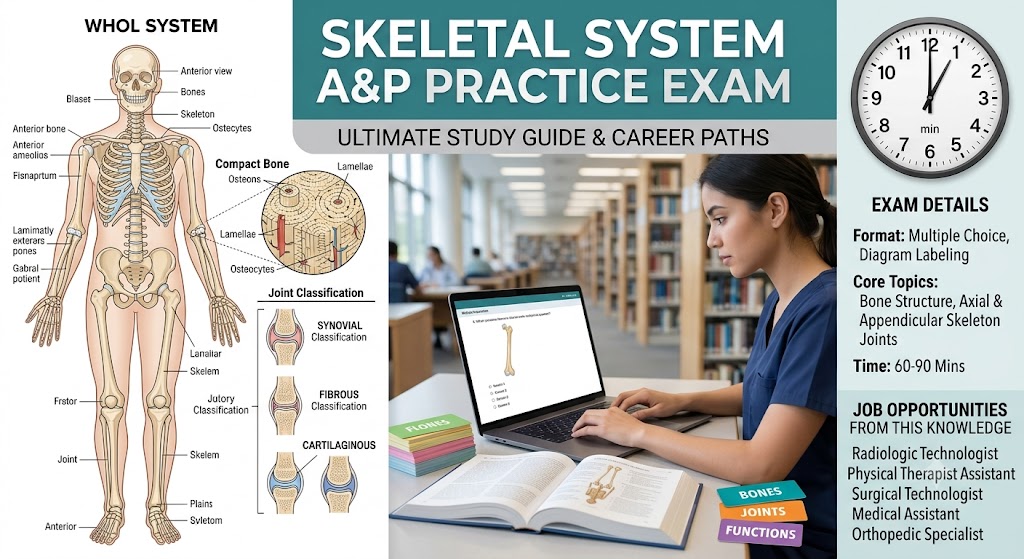
Additional Information
What the Course Entails and Exam Details
To succeed in this exam, students must master a wide range of topics concerning the body’s framework. The underlying course or study material generally covers several core domains.
First, students must understand the macroscopic and microscopic anatomy of bone tissue, including the roles of cells like osteoblasts, osteocytes, and osteoclasts. Second, they need a comprehensive knowledge of the five bone classifications: long, short, flat, irregular, and sesamoid. Third, the course details the major divisions of the skeleton, requiring students to distinguish between the Axial Skeleton (skull, vertebral column, thoracic cage) and the Appendicular Skeleton (limbs and girdles). Fourth, students must learn joint classification (fibrous, cartilaginous, synovial) and the types of movements they allow, such as flexion, extension, abduction, and adduction. Finally, the test covers the primary functions of the skeletal system, which include support, protection of vital organs, movement, mineral storage (calcium and phosphorus), and hematopoiesis (blood cell production).
What to Expect in the Final Exam
While the exact parameters depend on the institution offering the test, most Skeletal System A&P Practice Tests follow a similar pattern. The final exam format is predominantly multiple-choice, true/false, matching, and fill-in-the-blank questions. It also frequently includes diagram labeling, where you must correctly identify specific bones, markings, and joint types on an image of the human skeleton.
Passing score requirements vary but typically range from 70% to 80% to demonstrate competency. The time limit is generally strict, often allowing between 60 to 90 minutes for a test containing 50 to 100 questions. Regarding specific rules, these tests are often proctored, meaning they are either taken in a supervised testing center or via a secure lockdown browser that monitors your activity if taken online. You are rarely allowed to use outside resources, such as textbooks or notes.
How to Study and Exam Centers
Effective preparation requires an active and multifaceted study strategy. You should not simply re-read your textbook. Instead, utilize active recall by using flashcards to memorize the names of all 206 bones and their major markings. Practice diagram labeling extensively until you can identify every part of a skeleton, vertebra, and long bone without hesitation.
Additionally, take as many practice multiple-choice questions as possible. Analyze both your correct and incorrect answers to understand the rationale behind each question. Creating concept maps to link functions with specific bone types or joints can also be highly effective. For example, connect 'mineral storage' with the microscopic structure of a compact bone's matrix.
Exam centers for these practice tests are typically determined by the broader institution where you are enrolled. Many colleges and universities administer them through their internal learning management systems (LMS) or dedicated on-campus testing centers. For formal certifications, the exam may be hosted by established national testing portals such as Pearson VUE, or at authorized physical testing centers designated by a state licensing board or a professional certification organization.
Job Opportunities from the Course
While this specific practice test is not a terminal certification on its own, it is an indispensable milestone for securing the certifications required for a wide range of rewarding career paths. Mastery of this material is essential for the following professions:
Radiologic Technologist
Physical Therapist Assistant (PTA)
Occupational Therapy Assistant (OTA)
Surgical Technologist
Medical Assistant (CMA/RMA)
Orthopedic Technologist
Paramedic / Emergency Medical Technician (EMT)
Personal Trainer / Fitness Specialist
Frequently Asked Questions
Reviews
5.0
Based on 0 reviews
Leave a Review
No reviews yet. Be the first to review!