
SkillsUSA CNC Milling Practice Exam
$69.00
- Buy to unlock unlimited access to all Quiz questions and Answers in this Quiz.
- After purchase you can print a PDF of the whole quiz at any point. The PDF will contain the questions and the correct answers.
About this Exam
The SkillsUSA CNC Milling assessment is a premier technical skill competition and certification pathway designed for students enrolled in precision machining and manufacturing programs. This comprehensive evaluation is engineered to identify the nation's best future CNC milling specialists. It is tailored for students who have a strong foundation in machining theory and want to demonstrate their practical ability to plan, program, and execute complex milling operations using a 3-axis computer numerical control (CNC) machine. This rigorous test serves as a cornerstone of the SkillsUSA Championships, which culminate annually at the National Leadership and Skills Conference (NLSC).
Ready to test your knowledge?
Buy Now to Access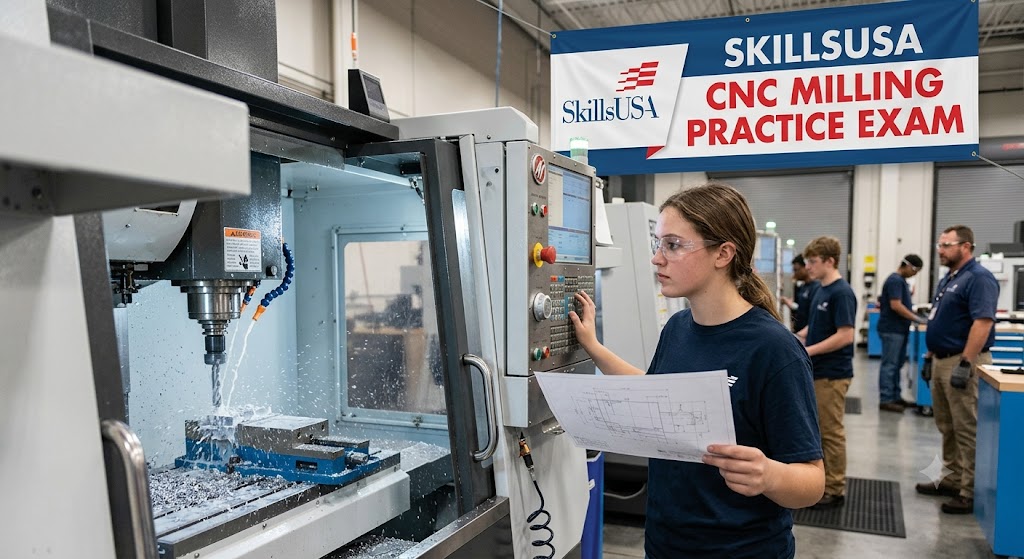
Additional Information
What the Course Entails and Exam Details
This examination evaluates a student's proficiency across a multi-faceted syllabus, grounding technical expertise in real-world application. To succeed, candidates must master a series of core technical standards, which typically include:
Blueprint Reading and GD&T: Interpreting technical drawings, understanding engineering symbols, and applying Geometric Dimensioning and Tolerancing (GD&T) principles.
Applied Mathematics: Performing calculations essential to CNC machining, such as speeds and feeds, program coordinates, trigonometric functions, and geometric problem-solving.
Precision Measurement (Metrology): Demonstrating accuracy in using micrometers, calipers, depth gauges, and other inspection tools to verify tolerances to within +/- .001 inch.
CNC Programming (Manual and CAM): Writing manual G-code and M-code programs (DIN/ISO standards) and utilizing Computer-Aided Manufacturing (CAM) software (such as Mastercam or Autodesk Fusion 360) to generate complex toolpaths, create solid models, and simulate part creation.
Machine Setup and Operation: Safely setting up a 3-axis CNC milling machine, establishing work and tool offsets, selecting correct cutting tools and holders, and troubleshooting program errors.
Safety and Employability Skills: Adhering to OSHA safety standards, including lockout/tagout procedures, proper chip handling, and personal protective equipment (PPE) usage. Candidates are often also required to take the SkillsUSA Professional Development Test, which assesses employability skills, communication, and teamwork.
What to Expect in the Final Exam
The SkillsUSA CNC Milling Final Exam is a multi-stage event designed to thoroughly test both theoretical knowledge and practical skill. Candidates should be prepared for the following components:
Written Knowledge Test: This segment typically consists of approximately 50 multiple-choice questions. It covers all technical standards, including applied mathematics, blueprint reading, GD&T, G-code theory, tool selection, and safety protocols. Time limits vary but are strictly enforced.
CAM Programming Phase: Candidates are given a part print and must use provided CAM software (e.g., Mastercam or Fusion 360) to create a process plan, program the part features, generate an NC program, and perform a virtual simulation to check for potential machine collisions or errors.
Skill Performance (Physical Test Project): The core of the exam is the hands-on practical. In a set timeframe (often several hours), you will be given a block of material, a tool list, and a detailed blueprint of a final part. You must physically set up the 3-axis CNC mill, establish all necessary offsets, load your verified program, and machine the part to the exact specifications, tolerances, and surface finish requirements.
Judging and Scoring: Scoring is meticulous. Judges use a comprehensive rubric that awards points for dimensional accuracy (measured by a CMM or precision tools), surface finish quality, conformity to the blueprint, quality control documentation, and safe, efficient machine operation. A pass or fail is determined not just by the final part, but by the entire process, including professional behavior.
How to Study and Exam Centers
Preparation is paramount for the SkillsUSA CNC Milling Exam. To optimize your study, consider these actionable strategies:
Master the Technical Standards: Obtain and thoroughly review the official SkillsUSA Championships Technical Standards for CNC Milling, which are available to professional members. This is your definitive roadmap.
Practice Manual G-Code: Do not rely solely on CAM software. You must be able to troubleshoot and edit G-code manually. Practice writing programs by hand to build a deep understanding of standard codes.
Gain CAM Proficiency: Use the specific CAM software (like Mastercam or Fusion 360) authorized for the competition. Become proficient in modeling, toolpath generation, and full machine simulation.
Hands-on Machine Time: Maximize your time on an actual 3-axis CNC mill. Practice the setup procedure repeatedly, from setting tool lengths to establishing work coordinates.
Review Math and Metrology: Drill on calculation speed and accuracy, and practice measuring complex part features with calibration-verified tools.
Exam Centers and How to Take the Exam: The path to the national SkillsUSA Championships starts locally. Students must first compete and place in regional and then state-level SkillsUSA competitions. Winners of the state events qualify to represent their state at the prestigious National Leadership and Skills Conference (NLSC), held annually in major cities like Atlanta. The physical test project always takes place in person at these conference locations, utilizing provided equipment. The written portion may be administered on-site or through authorized online portals in the weeks leading up to the main competition. For current practice exams, study guides, and registration, you should work closely with your SkillsUSA chapter advisor at your high school or college.
Job Opportunities from the Course
A SkillsUSA CNC Milling certification and competition record are highly valued by employers, signaling that you possess not just technical ability, but also a commitment to professional excellence and a proven capacity to perform under pressure. This path unlocks diverse and high-demand career opportunities, including:
CNC Machine Operator
CNC Machinist
CNC Programmer
Manufacturing Technician
Quality Control (QC) Inspector
Tool and Die Maker
Application Engineer
CNC Shop Foreman / Supervisor
Frequently Asked Questions
Reviews
5.0
Based on 0 reviews
Leave a Review
No reviews yet. Be the first to review!