
SkillsUSA Crime Scene Practice Exam
$69.00
- Buy to unlock unlimited access to all Quiz questions and Answers in this Quiz.
- After purchase you can print a PDF of the whole quiz at any point. The PDF will contain the questions and the correct answers.
About this Exam
The SkillsUSA Crime Scene Investigation (CSI) competition is a dynamic and challenging team-based event designed for high school and college students enrolled in law enforcement or public safety programs. It's much more than just a theoretical exam; it’s a rigorous test of practical skills and knowledge applied in a simulated real-world scenario. While the full competition often includes a large practical component, this study guide focuses on preparing for the written knowledge test and providing a foundation for overall practice. Students in relevant career and technical education (CTE) programs are the target audience, learning the critical, meticulous skills required for effective forensic investigation.
Ready to test your knowledge?
Buy Now to Access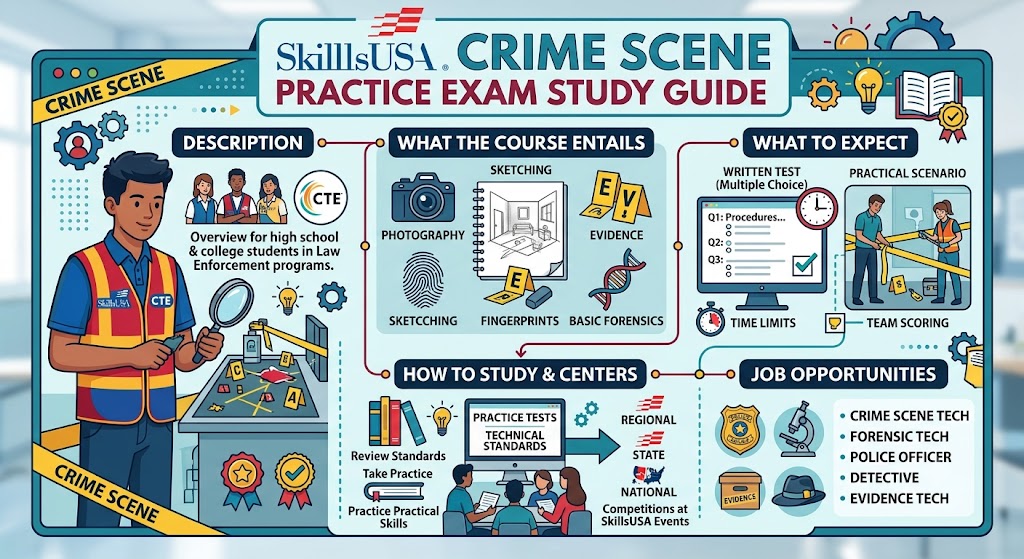
Additional Information
What the Course Entails and Exam Details
Preparing for the SkillsUSA CSI event means building expertise in a wide array of investigative techniques. You will need to master theoretical knowledge as well as practical application. Key topics and skills include:
Crime Scene Management: Securing the scene, ensuring integrity, and maintaining control.
Crime Scene Photography: Understanding lighting, angles, and proper documentation.
Sketching and Note-Taking: Accurate measurement, drawing to scale, and detailed reporting.
Evidence Recognition and Collection: Identification of critical evidence types and correct procedures.
Chain of Custody: Meticulous tracking and legal documentation of evidence.
Fingerprinting and Latent Print Recovery: Searching for, developing, and preserving prints.
Forensic Biology and Chemistry Concepts: Understanding basic principles of DNA, blood, and chemical analysis.
Ethics and Legal Standards: Knowledge of constitutional rights, search warrants, and ethical conduct.
The knowledge portion, often delivered as a written test (sometimes digitally), assesses your comprehension of these theoretical and procedural aspects. It forms a significant part of the overall scoring.
What to Expect in the Final Exam
The primary component for which a "Practice Test" is designed is usually the written knowledge test, although some regions may have slightly different structures. In the actual SkillsUSA competition:
1. Written Knowledge Test: This part typically consists of multiple-choice questions covering all the core topics listed above. It has a set time limit (e.g., 60 minutes) and is designed to gauge your understanding of theory and procedural rules. This is likely what you will encounter in a "practice test".
2. Practical Crime Scene Scenario: This is a comprehensive hands-on exercise where your team will physically process a simulated crime scene. Judges evaluate your team's coordination, technique, meticulousness, and final documentation (photos, sketches, evidence logs). This part has its own extensive rubric and time constraints.
Note: Scoring for both parts is compiled, with high scores determining the winners (gold, silver, bronze) in local, regional, state, and potentially national events. There isn't typically a single pass/fail line, but higher scores are needed to advance. Practice resources help you familiarize yourself with the type of questions and typical areas of focus in the written portion.
How to Study and Exam Centers
How to Study:
Review Official Technical Standards: The national SkillsUSA organization releases the official standards each year, detailing the requirements and skills tested for each competition. This is your primary study guide.
Study Recommended Resources: SkillsUSA often lists recommended textbooks or study materials. Look for resources specific to criminal investigation and forensics.
Practice Practical Skills: While focusing on the written test, reinforcing practical skills in class with your instructor and teammates solidifies understanding and aids written test recall. Work together on simulated scenarios.
Take Practice Tests and Quizzes: Utilize resources like this practice test, online educational portals, quizlet sets (look up criminal justice/CSI terms), and previous year's materials to get comfortable with the exam format and typical questions. Simulate exam conditions (time limits, no help) during your practice.
Form a Study Team: Collaborate with your competition teammates to discuss concepts, test each other, and practice hands-on skills.
Exam Centers and Competition Locations:
Local Chapters: Initial competitions and often the primary study and practice happen within your own school’s SkillsUSA chapter.
Regional/District Competitions: Winners from local chapters advance to larger-scale regional events. The written test might be given online beforehand or on-site.
State Leadership & Skills Conferences: Winners from regions compete for state titles and the opportunity to advance nationally. Both the practical scenario and the written knowledge test are key parts of this event.
National Leadership & Skills Conference (NLSC): Gold medalists from state competitions advance to the national championships. This large event is usually held in June in a major U.S. city (such as Atlanta). Written tests are typically taken on-site at a designated testing area.
Practice exams are taken in your own preparation time and location. The actual written and practical exams happen at the specific physical locations determined by the SkillsUSA event (e.g., at the conference venue). There are no general, independent testing centers like Pearson VUE for this competition—it is all managed within the SkillsUSA competition structure. Your school’s advisor is your best source for specific details regarding dates and locations for each level of competition.
Job Opportunities from the Course
Successfully competing in or even practicing for the SkillsUSA Crime Scene Investigation competition provides a strong foundation and demonstrates critical skills. This experience can open doors to various career paths in the fields of criminal justice and forensic science. The hands-on experience and validated knowledge are highly valued by employers.
Potential job titles and career paths include:
Crime Scene Technician
Forensic Science Technician
Evidence Technician
Police Officer
Detective
State or Federal Investigator
Medical Examiner or Coroner Investigator
Private Investigator
Crime Scene Analyst
Criminalist
Frequently Asked Questions
Reviews
5.0
Based on 0 reviews
Leave a Review
No reviews yet. Be the first to review!