
SkillsUSA TV/Video Production Practice Exam
$69.00
- Buy to unlock unlimited access to all Quiz questions and Answers in this Quiz.
- After purchase you can print a PDF of the whole quiz at any point. The PDF will contain the questions and the correct answers.
About this Exam
The SkillsUSA TV/Video Production competition is a challenging, multi-faceted event designed for high school and college students enrolled in television and video production programs. This exam and the associated practical competition test the essential skills required for a career in this dynamic field. Successful participants demonstrate proficiency in the full production cycle, from concept to final product, alongside critical employability skills like teamwork and deadline management. It is not just an academic exercise; it's a real-world simulation aimed at identifying the industry's next generation of skilled professionals. Preparation often involves using official study materials and taking part in a comprehensive practice test to assess readiness.
Ready to test your knowledge?
Buy Now to Access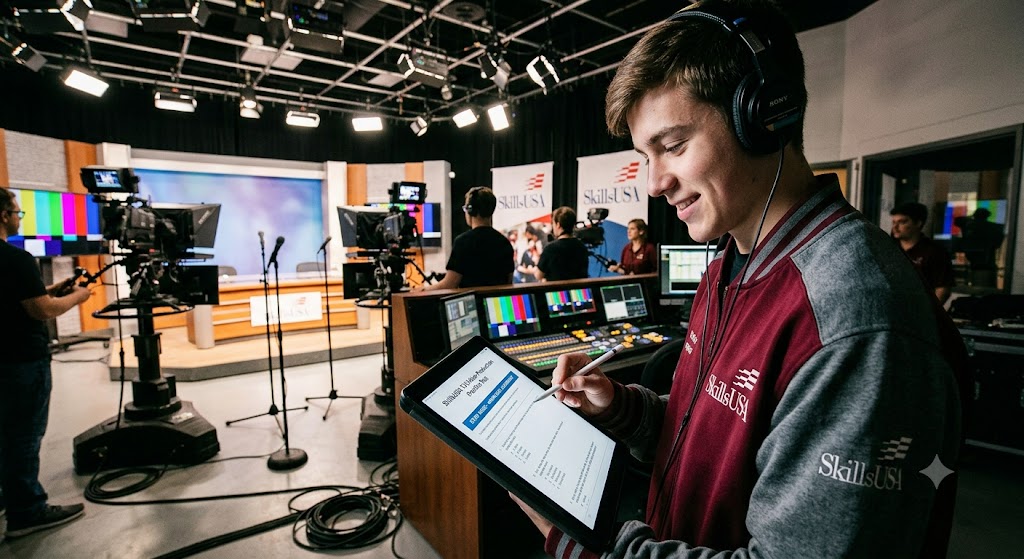
Additional Information
What the Course Entails and Exam Details
The course and exam cover the complete spectrum of video production. Students must understand and apply principles in pre-production, including scriptwriting, storyboarding, and project planning. During production, knowledge of camera operations (lenses, composition, moves), lighting design (color temperature, instruments), and audio recording (microphone types, acoustics, connectors) is essential. The final stage, post-production, requires mastery of non-linear editing systems, software proficiency, editing techniques, and rendering processes. The entire process also emphasizes adherence to professional ethics, safety protocols, and industry standards, including specific file formats and technical specifications. The SkillsUSA standards provide a detailed roadmap of the technical competencies expected.
What to Expect in the Final Exam
The full SkillsUSA TV/Video Production final event is typically not a single test, but a multi-part assessment composed of both a knowledge performance and a skill performance. The knowledge performance is frequently delivered as one or more multiple-choice written exams, often covering technical knowledge of production terms, techniques, and the general SkillsUSA professional development and employability framework. This section tests the fundamental concepts and the industry standards.
The more significant portion is often the skill performance. This is a practical, team-based competition where a team of students is given a specific prompt, objective, or theme within a set timeframe. They must plan, script, storyboard, shoot, and edit a short video production, often under 60 or 90 seconds. Their work is then judged by industry professionals on creativity, technical quality, adherence to the prompt, effective use of camera, audio, and lighting, and general professionalism, including documentation like storyboards and resumes. For the "SkillsUSA TV/Video Production Practice Test," students should expect practice versions of the written multiple-choice knowledge assessments and scenario-based questions that prepare them for the real thing. Passing scores and timing are generally defined in the official competition guidelines for each competition level (state, national).
How to Study and Exam Centers
Preparation for the SkillsUSA TV/Video Production exam requires a blended approach. Students should study the official SkillsUSA Technical Standards for Television (Video) Production, which detail all expected competencies. Textbooks, curriculum materials from their educational program, and official SkillsUSA study guides or practice tests are crucial. Teamwork is paramount; practice with potential teammates on all production phases under simulated time constraints. Hone specific technical skills in shooting, editing (using common software like Premiere Pro or Final Cut), audio mixing, and scriptwriting.
How to Take the Test and Exam Centers: The specific written and professional development assessments are sometimes taken online via a proctored student portal or sometimes in person during the competition weekend at a designated testing area. The practical, team-based skill performance takes place during the SkillsUSA competitions themselves. These competitions begin at the local level (classrooms/schools), and advance to state, regional, and national conferences. These events are often held at large convention centers, schools, or other facilities that can accommodate the multiple-day events. The SkillsUSA organization website and your local chapter advisor are the primary sources for exact details on registration, testing formats, and the specific locations for all competition components.
Job Opportunities from the Course
A strong performance in SkillsUSA and the experience gained from the TV/Video Production program can open doors to various career paths. While the primary outcome is professional development and recognition, this program unlocks pathways to the following jobs in the entertainment, news, and corporate sectors:
Video Editor
Camera Operator
Audio Technician
Producer
Scriptwriter
Broadcast Journalist
Multimedia Content Creator
Production Assistant
Director (Various Levels)
Lighting Designer
Gaffer
Grip
Multimedia Producer
Visual Effects (VFX) Assistant (with additional skills)
Content Marketer
Frequently Asked Questions
Reviews
5.0
Based on 0 reviews
Leave a Review
No reviews yet. Be the first to review!