
SkillsUSA Welding Practice Exam
$69.00
- Buy to unlock unlimited access to all Quiz questions and Answers in this Quiz.
- After purchase you can print a PDF of the whole quiz at any point. The PDF will contain the questions and the correct answers.
About this Exam
The SkillsUSA Welding competition is a prestigious event designed to recognize the best vocational welding students in the country. It is open to both high school and college/postsecondary students who are enrolled in career and technical education programs. This intensive competition evaluates students' knowledge of welding theory, safety, and blueprint reading, alongside their hands-on ability to perform high-quality welds. By preparing for the SkillsUSA Welding Practice Test, you are building the foundation needed to showcase your elite skills and jumpstart a rewarding career in the welding industry. This isn't just a test; it's a launchpad for your professional future in a critical trade.
Ready to test your knowledge?
Buy Now to Access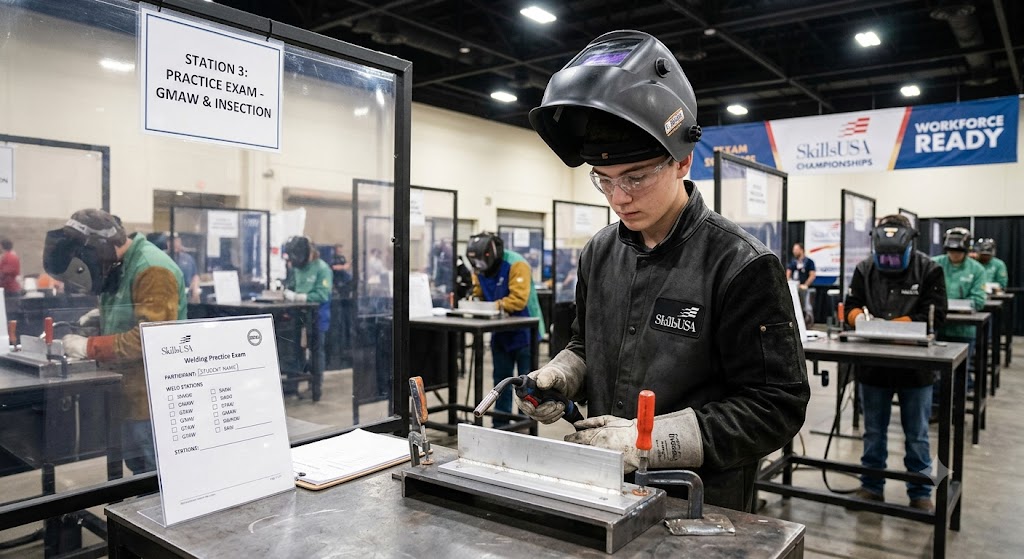
Additional Information
What the Course Entails and Exam Details
This "course," in essence, is the culmination of a welding student’s educational program. It covers a broad spectrum of industry-standard skills and knowledge. Key areas include comprehensive knowledge of the American Welding Society (AWS) symbols and standards, blueprint reading for welders, safety practices, and visual inspection techniques. The competition requires proficiency in major welding processes: Shielded Metal Arc Welding (SMAW), Gas Metal Arc Welding (GMAW), Gas Tungsten Arc Welding (GTAW), and Flux-Cored Arc Welding (FCAW). Competitors must demonstrate their capability by performing welds on various joints (e.g., V-groove, fillet) on different materials, such as steel and aluminum, in multiple positions (e.g., flat, vertical, overhead). Additional skills like oxy-fuel cutting and measuring are also commonly assessed. The overall competition is typically a multi-day event composed of both a written examination and several practical skill stations.
What to Expect in the Final Exam
The full SkillsUSA Welding competition is designed to be a realistic test of trade proficiency. The written component of the exam is a comprehensive knowledge test, often delivered in a multiple-choice format, lasting approximately 60 to 90 minutes. It covers safety (based on OSHA and AWS guidelines), welding theory, welding symbols, blueprint reading, and math related to the trade. The practical portion of the competition is intense and typically accounts for the majority of the total score. It requires competitors to move through a series of hands-on welding stations. At these stations, you will receive blueprints and welding procedure specifications to complete specific welding projects. These projects might include welding a 1-inch V-groove steel plate in the 3G or 4G position, an aluminum project, or an oxy-fuel cutting and layout station. Judges are industry experts who score based on the AWS D1.1 (Steel) and AWS D1.2 (Aluminum) Structural Welding Codes. Each segment must be completed within a strict time limit, requiring you to be both accurate and efficient.
How to Study and Exam Centers
Preparation is the absolute key to success in the SkillsUSA Welding competition. Begin by downloading and thoroughly reviewing the current SkillsUSA Technical Standards, as these outline the specific skills and knowledge for your competition year. Make heavy use of SkillsUSA Welding practice tests and sample quizzes to familiarize yourself with the written exam format and the depth of knowledge required. For the practical portion, there is no substitute for "hood time." Spend as much time as possible in the workshop practicing all major welding processes on the exact types of joints and in the positions you will encounter in the competition. Practice visual inspection of your own welds using AWS standards and gauges.
Registering to compete begins at the local level within your high school or college chapter. Competitors must advance sequentially through local, regional, and state-level competitions. The winners from each state-level event then qualify for the national competition, held annually at the SkillsUSA National Leadership & Skills Conference (NLSC) at a major convention venue, such as Atlanta or Louisville. Your school’s advisor is your best source for exact competition dates and registration procedures for your area.
Job Opportunities from the Course
Successfully preparing for and competing in the SkillsUSA Welding event demonstrates to employers that you possess both the advanced knowledge and the refined physical skills to excel as an entry-level welder and beyond. This pathway unlocks significant career opportunities in diverse sectors, including manufacturing, construction, energy, and transportation. Here are just a few job titles that the training and validation from this process unlock:
Certified Welder (CW)
Combination Welder
Fabricator
Pipeline Welder
Welding Inspector (CWI pathway)
Robotic Welding Operator
Shop Foreman
Weldment Fabricator
Frequently Asked Questions
Reviews
5.0
Based on 0 reviews
Leave a Review
No reviews yet. Be the first to review!