
Skincare Specialist Certification Practice Exam
$69.00
- Buy to unlock unlimited access to all Quiz questions and Answers in this Quiz.
- After purchase you can print a PDF of the whole quiz at any point. The PDF will contain the questions and the correct answers.
About this Exam
The Skincare Specialist Certification is a professional credential designed for aspiring estheticians and beauty professionals who wish to specialize in the art and science of skin health. This certification validates a candidate's proficiency in analyzing skin types, performing various facial treatments, understanding skincare ingredients, and maintaining rigorous safety and sanitation standards. It is ideal for individuals looking to begin a career in salons, spas, or medical environments, as well as for those wishing to expand their skill set within the beauty industry. This examination tests both the theoretical knowledge and the practical applications required to provide professional skincare services.
Ready to test your knowledge?
Buy Now to Access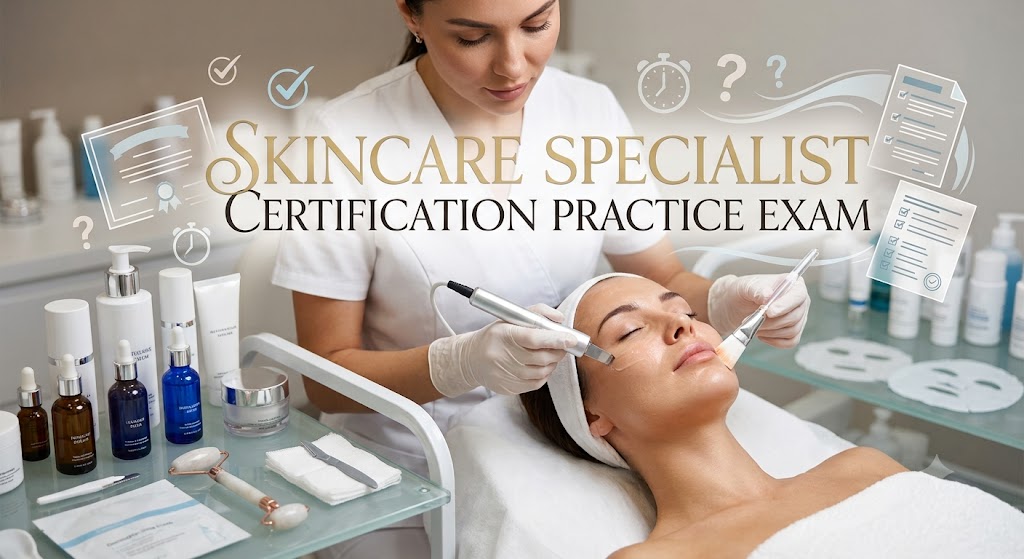
Additional Information
What the Course Entails and Exam Details
A comprehensive course leading to this certification typically covers a wide array of topics, combining theory with hands-on training. The exam details reflect this dual focus.
Key subject areas and skills covered in the coursework include:
Skin Anatomy and Physiology: Understanding the structure, functions, and various types of skin (oily, dry, combination).
Skin Diseases and Disorders: Recognizing common skin conditions, infections, and knowing when to refer a client to a medical professional.
Facial Treatments and Modalities: Mastery of various procedures, including deep cleansing, exfoliation (manual and chemical peels), extraction techniques, and the application of masks.
Product Chemistry and Ingredients: Understanding the science behind skincare formulations and how to select products based on client needs.
Safety, Sanitation, and Infection Control: Strict adherence to health regulations and sterilization protocols for tools and equipment.
Client Consultation and Analysis: Effectively assessing a client's skin and goals to create customized treatment plans.
Business Practices and Ethics: Understanding the professional aspects of a skincare business, including client retention and ethical conduct.
What to Expect in the Final Exam
The final examination for the Skincare Specialist Certification generally consists of two primary components to ensure a holistic evaluation of the candidate's capabilities:
A. Written (Theory) Examination:
This portion is usually in a multiple-choice format, taken either on a computer or with paper and pencil. It assesses your knowledge of skincare theory, terminology, sanitation, anatomy, and regulations. Candidates typically have a set time limit (e.g., 90 minutes to 2 hours) to complete this section. A minimum passing score (often between 70% and 75%) is required to pass the written component.
B. Practical (Hands-on) Examination:
This critical part of the exam requires candidates to demonstrate their technical skills in a live or simulated environment. Candidates must perform specific procedures (such as a basic facial, extraction, or massage) in front of an evaluator or proctor. Scoring is based on precision, technique, safety, and hygiene. Proper setup, execution, and client safety are paramount.
The exact breakdown of topics, the number of questions, time limits, and the specific procedures required in the practical exam can vary significantly depending on the certifying body or the state licensing board.
How to Study and Exam Centers
Achieving certification requires diligent preparation for both the theoretical and practical aspects. Here are effective strategies for success:
Study Strategies for the Written Exam:
Utilize Official Study Guides: Rely on the textbooks and materials recommended by the certifying organization or your training program.
Take Practice Tests: Consistent practice with sample questions and simulated exams is crucial to become familiar with the question formats and time constraints.
Create Flashcards: Use flashcards for key terms, skin disorders, muscle names, and specific product ingredients.
Preparation for the Practical Exam:
Hands-on Practice: Practice every single procedure required by the exam on models, classmates, or friends. Repetition is key to building confidence and speed.
Simulate Exam Conditions: Set up a clean station and practice performing treatments within the allotted time frames, adhering strictly to sanitation protocols.
Exam Centers:
The location and process for taking the exam depend on whether you are seeking a national certification or a state license.
Authorized Schools: Many cosmetology and esthetician schools are approved testing sites for their students.
State Board Testing Centers: For licensure, examinations are typically administered at designated state testing facilities.
Third-Party Testing Services: Major providers such as Pearson VUE, PSI, or Prometric may host the computer-based theory portion of the exam.
Online Proctored Exams: Some certifying bodies offer the option to take the written
Job Opportunities from the Course
Obtaining a Skincare Specialist Certification opens the door to a diverse and rewarding range of career paths within the growing beauty and wellness industries.
Qualified professionals can pursue numerous job opportunities, including:
Licensed Esthetician / Aesthetician
Medical Esthetician (working under the supervision of a dermatologist or plastic surgeon)
Salon or Spa Manager / Owner
Skincare Product Representative / Educator for professional brands
Eyebrow and Eyelash Specialist
Makeup Artist specializing in skin preparation
Mobile Skincare Specialist / Freelance Professional
Wellness Center Skincare Therapist
Destination Spa or Cruise Ship Esthetician
Frequently Asked Questions
Reviews
5.0
Based on 0 reviews
Leave a Review
No reviews yet. Be the first to review!