
Skull and Sinuses Practice Exam
$69.00
- Buy to unlock unlimited access to all Quiz questions and Answers in this Quiz.
- After purchase you can print a PDF of the whole quiz at any point. The PDF will contain the questions and the correct answers.
About this Exam
The Skull and Sinuses Practice Exam is designed as a foundational assessment tool for students and early-career professionals in the medical, nursing, and diagnostic imaging fields. This practice module focuses specifically on the intricate anatomy and key imaging landmarks of the human skull and its complex paranasal sinuses. It aims to evaluate understanding of essential bones, sutures, foramina, and the air-filled cavities that are critical for various medical diagnostic processes. Whether you are a radiologic technologist in training, a medical student reviewing anatomy, or a nurse specializing in head and neck procedures, this practice exam serves as a robust tool to test and refine your knowledge before challenging final assessments or entering a professional clinical environment.
Ready to test your knowledge?
Buy Now to Access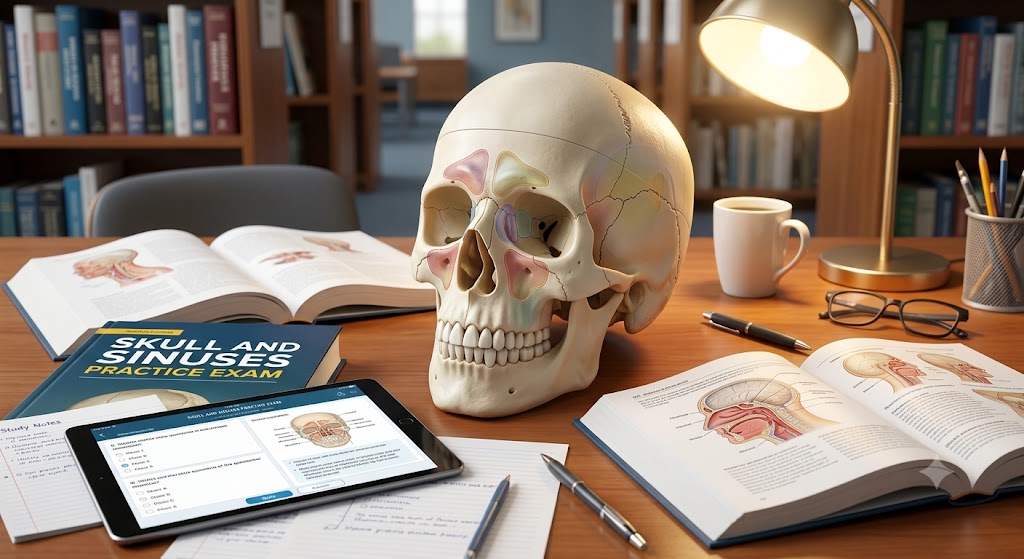
Additional Information
What the Course Entails and Exam Details
As a targeted study resource, the hypothetical preparation "course" associated with this practice exam is a concentrated dive into specific head anatomy. You will learn:
The names, locations, and structural characteristics of the 8 cranial bones (Frontal, Parietal, Temporal, Occipital, Sphenoid, Ethmoid).
The 14 facial bones (Maxillae, Zygomatic, Lacrimal, Nasal, Inferior Nasal Conchae, Palatine, Vomer, Mandible).
The complex sutures and articulations that connect these bones (Coronal, Sagittal, Lambdoid, Squamous).
Key landmarks and foramina that are vital for vascular and nerve passage.
Detailed anatomy of the four pairs of paranasal sinuses (Frontal, Maxillary, Ethmoid Air Cells, Sphenoid) and their drainage pathways.
Fundamental concepts of diagnostic imaging, common anatomical views (e.g., AP/PA Axial, Lateral, Waters method), and how positioning affects image clarity in a clinical context.
Exam Details (Illustrative Structure): While specific institution and board exam structures will vary, a practice exam of this nature typically mimics professional formats. You can generally expect questions to be derived from the foundational anatomical knowledge listed above, and the exam might be administered through a structured online platform as a tool to measure preparation rather than a formal, official board examination. Please ensure you confirm the exact details, timing, and passing criteria with your specific academic or professional body.
What to Expect in the Final Exam
When you proceed from practice to your formal examination (be it an end-of-course test, a professional licensure component, or a specialized certification module), you should anticipate a comprehensive assessment that demands more than simple recall.
Format: Modern exams often utilize a variety of question formats to test deep understanding. This can include:
Multiple-Choice Questions (MCQs): Testing knowledge application and scenario-based decisions.
Image Identification and Labeling: Pinpointing specific bones, sinuses, or landmarks on detailed diagrams and realistic diagnostic images (X-rays, CT scans).
Case Studies: Applying anatomical knowledge to real-world clinical or imaging scenarios.
True/False and Drag-and-Drop: Varied methods to confirm key concepts.
Passing Score: Requirements can vary widely. Aim for a high level of mastery in your practice – potentially exceeding an 80% passing threshold in individual practice modules to ensure readiness for a diverse range of formal exam structures. Always consult your program or board for specific passing score details.
Time Limits: To simulate professional pressure, exams are often timed. Your final exam could ranges from 60 minutes to several hours, depending on the number of questions and the overall test structure. Learn to manage your time effectively during practice.
Rules and Proctoring: Official exams are strictly proctored, whether in a physical center or via a secure online service. Ensure you understand all guidelines regarding materials, breaks, and identification before test day.
How to Study and Exam Centers
Preparation is the cornerstone of success. Here are actionable strategies and information on where you may ultimately take your final exam:
Study Strategies:
Utilize High-Quality Resources: Rely on reputable anatomy textbooks, detailed atlases, and accredited educational websites.
Visual Aids Are Key: Leverage anatomical models (both physical and high-resolution 3D virtual ones), skeletal charts, and real diagnostic images. Practice labeling blank diagrams and identifying structures on actual scans.
Active Learning:
Create detailed flashcards (digital and physical) for every major bone, sinus, suture, and foramen.
Use mnemonics to remember the order of sinuses or bone groups.
Teach a peer or study group – explaining complex anatomy is an excellent way to consolidate your own understanding.
Simulate Exam Conditions: Take the Skull and Sinuses Practice Exam repeatedly. Replicate the timed environment of the formal test. Review both correct and incorrect answers thoroughly.
Focus on Clinical Relevance: Connect anatomical structures to common medical conditions (e.g., sinusitis, facial fractures, vascular issues). This will make the information more meaningful and easier to recall.
Exam Centers and Formats: The location and method for taking your final exam depend entirely on the nature of the assessment.
Online Portals & Learning Management Systems: Many academic programs use secure internal portals or common platforms for course-specific exams.
Pearson VUE and Prometric Centers: Large-scale professional certification and licensure exams are frequently administered at specific, secure, physical testing centers globally.
Institutional Test Centers: Some universities, colleges, and medical schools have dedicated physical testing facilities.
Authorized Schools/Programs: Certain course completions or practice assessments are only valid when administered through specific accredited educational institutions.
Always confirm the authorized method and location for your specific final exam with the relevant testing authority or academic advisor. Do not rely solely on general assumptions.
Job Opportunities from the Course
A strong command of skull and sinuses anatomy is a valuable asset across numerous rewarding healthcare career paths. Completion of relevant coursework and success in associated exams can open doors to positions such as:
Radiologic Technologist / Radiographer
Computed Tomography (CT) Technologist
Magnetic Resonance Imaging (MRI) Technologist
Diagnostic Imaging Specialist
X-ray Aide / Radiography Assistant
Registered Nurse (specifically within radiology, oncology, or head and neck specialties)
Medical Assistant
Anatomical Pathology Technician / Mortuary Assistant (with appropriate additional qualification)
Surgical Technologist (assisting in neurosurgery or ENT procedures)
Healthcare Education / Tutor (after further academic and professional experience)
Medical Scribe
Research Assistant (focusing on head/neck anatomy or imaging)
Frequently Asked Questions
Reviews
5.0
Based on 0 reviews
Leave a Review
No reviews yet. Be the first to review!