
SrA BTZ Practice Exam
$69.00
- Buy to unlock unlimited access to all Quiz questions and Answers in this Quiz.
- After purchase you can print a PDF of the whole quiz at any point. The PDF will contain the questions and the correct answers.
About this Exam
The Senior Airman (SrA) Below‑The‑Zone (BTZ) program is a highly competitive, early promotion opportunity for exceptional Airmen First Class (A1C) in the US Air Force. This program allows high-performing Airmen to potentially promote to the rank of Senior Airman six months ahead of the standard timeline. It is designed for Airmen who consistently demonstrate performance, potential, and professionalism above their current grade, standing out from their peers. The "Practice Exam" here represents a comprehensive preparation guide, simulating the multifaceted evaluation process that Airmen encounter. It's not a single test in a conventional sense, but a simulation and guide to the entire rigorous evaluation board and records review that determines who will achieve early promotion.
Ready to test your knowledge?
Buy Now to Access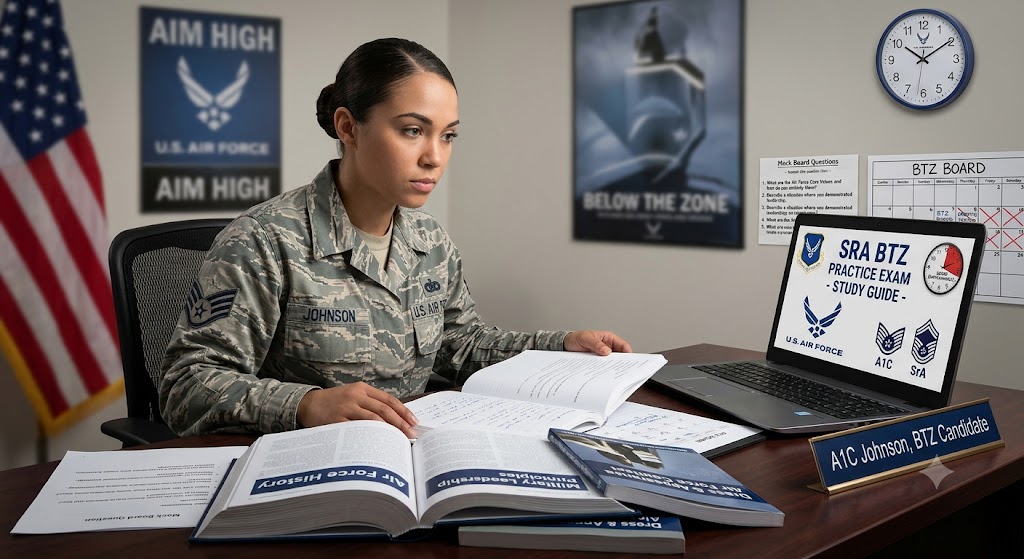
Additional Information
What the Course Entails and Exam Details
Preparing for BTZ isn't like taking a typical class. The "course" of action for success in BTZ involves the cumulative impact of an Airman's daily duty performance, professional development, and dedication to Air Force standards. Success isn’t achieved by cramming a single syllabus but through a sustained record of achievement and readiness. Core areas and skills covered and evaluated in this "course" of preparation include:
Job Performance and Primary Duties: Achieving exceptional results, innovation, and leadership in your assigned career field.
Physical Fitness: Maintaining a current, passing (and ideally excellent) score on the Air Force physical fitness assessment.
Whole Airman Concept: Demonstrated commitment to Air Force Core Values, military professionalism, dress and appearance standards, and active participation in community service, education, and professional development courses (e.g., ALS-equivalents, technical training).
Military General Knowledge: Thorough understanding of Air Force history, structure, mission, creed, core values, customs and courtesies, current events, and relevant military regulations.
Communication and Interview Skills: Ability to articulate ideas clearly, confidently, and professionally during a formal interview.
The "exam" details, therefore, are the components of the evaluation process itself: the quality of your record and your performance in the interview.
What to Expect in the Final Exam (Board)
In the context of BTZ, your "final exam" is the formal promotion board. This is not a multiple-choice or written assessment. You can expect a professional, serious atmosphere where a panel of Senior Non-Commissioned Officers (SNCOs) and potentially commissioned officers will evaluate your entire profile. This evaluation typically consists of:
Records Review (the "Package"): A critical look at your official performance reports (EPRs/AF1206), decoration citations, fitness history, and military record summary. The quality of your accomplishment bullets and the overall strength of your record are paramount. Your commander’s strong recommendation is also a key factor.
The Formal Interview (the Board): You will appear before the board members in your full service dress uniform. They will ask a variety of questions. These questions can range from situational scenarios ("What would you do if...") and technical knowledge questions related to the Air Force (e.g., Air Force history, current affairs, military regulations) to questions about your personal achievements, goals, and leadership experiences. The formatting is a structured interview, simulating a performance assessment, not a standardized test.
Scoring and Rules: The board members will score you based on your performance in the interview and the strength of your records. The scoring criteria are set by the Air Force and the specific base/unit conducting the board. It is highly competitive, and selected Airmen are typically within the top 15% of the total eligible population. Strict adherence to proper military customs and courtesies, addressing board members correctly, and maintaining a professional demeanor are essential rules of engagement for this final "test."
How to Study and Exam Centers
Since the BTZ "test" isn't standardized, studying is about preparing across multiple fronts. Actionable study strategies include:
Maintain Peak Performance: The best "study" is to be an exemplary Airman every single day. Build a track record of high achievement, seek out responsibility, and consistently perform at a Senior Airman level or higher.
Know Your Stuff: Deeply study Air Force general knowledge. Resources include the Air Force Handbook, official Air Force websites, and resources focused on military history, creed, core values, current events, and your specific career field standards. There are many unofficial study guides, flashcards, and Q&A resources online, but prioritize official guidance and verified information.
Practice Mock Boards: Seek out opportunities to participate in mock BTZ boards. Ask your supervisors, First Sergeants, or other leadership to hold practice sessions where they ask you realistic questions, evaluate your posture and communication, and provide constructive feedback on your service dress and demeanour.
Polish Your Record: Regularly review your records and ensure they accurately reflect your achievements. Maximize opportunities for awards, decorations, and professional development.
Prepare Your Dress: Ensure your uniform (typically service dress) is immaculate and strictly adheres to Air Force regulations well in advance.
Exam Centers: The "exam centers" for the BTZ board are not external testing centers like Pearson VUE. The board will be conducted at a professional, designated location, typically a conference or board room on your assigned Air Force base or unit. Your chain of command will notify you of the specific location, date, and time for your appearanc. You should seek guidance on online portals or unit-specific informational resources for preparation advice and specific local procedures.
Job Opportunities from the Course
Successfully navigating the BTZ process results in promotion to the rank of Senior Airman (SrA, E-4) six months early. This promotion unlocks numerous career benefits and sets the stage for future advancement:
Rank of Senior Airman (SrA): Achieving this rank is a significant milestone, bringing increased responsibility, authority, and pay.
Increased Responsibility and Leadership Opportunities: SrA often serve as trainers for newer Airmen, assume more complex technical tasks, and may begin taking on supervisorial roles within their work centers.
Preparation for Non-Commissioned Officer (NCO) Roles: Attaining SrA is the final step before the competitive promotion cycle for Staff Sergeant (SSgt, E-5) and higher NCO ranks. The experience gained as a Senior Airman is crucial preparation for supervisory and leadership positions in the enlisted force.
Eligibility for Additional Training and Programs: Senior Airmen may become eligible for specific technical certifications, leadership courses, special duty assignments, and educational opportunities that further advance their careers within the Air Force and prepare them for future success in both military and civilian roles.
Enhanced Career Progression: An early promotion to SrA through BTZ can positively impact future promotion timelines and career competitiveness within the highly structured enlisted force structure.
Frequently Asked Questions
Reviews
5.0
Based on 0 reviews
Leave a Review
No reviews yet. Be the first to review!