
Study Guide: National Patient Safety Goals Practice Exam
$69.00
- Buy to unlock unlimited access to all Quiz questions and Answers in this Quiz.
- After purchase you can print a PDF of the whole quiz at any point. The PDF will contain the questions and the correct answers.
About this Exam
The National Patient Safety Goals (NPSGs) are a set of critical benchmarks established by The Joint Commission to improve patient safety within healthcare organizations. This program identifies specific areas of concern in healthcare delivery and outlines evidence-based solutions to prevent major sources of patient harm. A National Patient Safety Goals Practice Test is designed for current and aspiring healthcare professionals, including nurses, physicians, pharmacists, medical assistants, and administrative staff working in accredited facilities. This guide helps you assess your understanding of these essential standards and prepares you for mandatory institutional training, quality assurance roles, or specialized certifications.
Ready to test your knowledge?
Buy Now to Access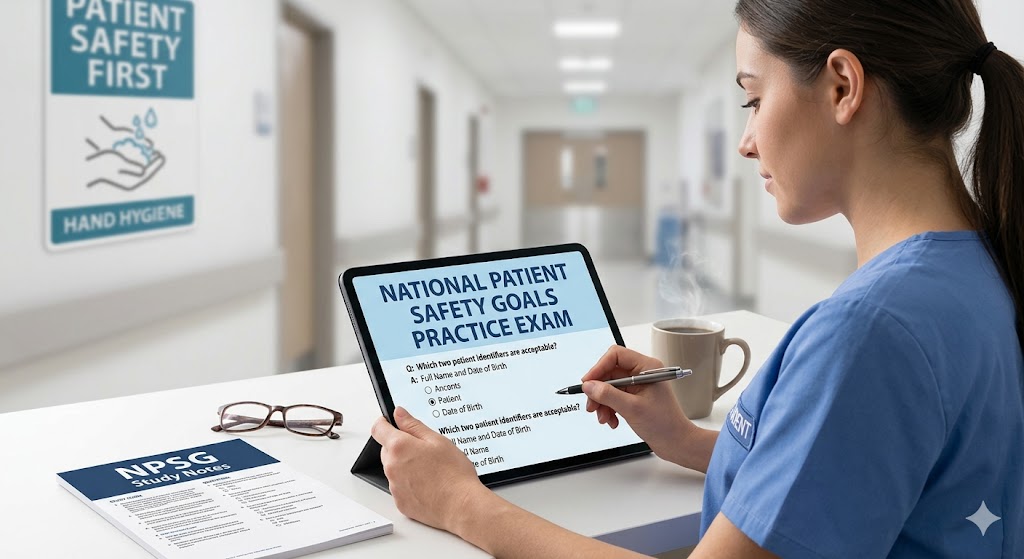
Additional Information
What the Course Entails and Exam Details
The study material and subsequent practice test cover the core domains defined by The Joint Commission's NPSGs, which are updated annually to reflect current safety data. You will be expected to master concepts related to the foundational goals, which typically include:
Accuracy of Patient Identification: Using at least two patient identifiers before administering medications, blood products, or procedures.
Effectiveness of Staff Communication: Techniques for reporting critical results of tests and diagnostic procedures to the right licensed caregiver in a timely manner.
Safety of Medication Use: Labeling all medications and solutions; practices for reducing harm from anticoagulant therapy; and the critical process of medication reconciliation.
Harm Reduction from Clinical Alarm Systems: Strategies to ensure alarms are managed effectively and are not missed or ignored.
Healthcare-Associated Infection (HAI) Prevention: Adherence to standard hand hygiene guidelines (CDC/WHO) and evidence-based practices to prevent specific infections, such as those related to central lines, surgery, and catheters.
Identification of Patient Safety Risks: Specifically focusing on identifying patients at high risk for suicide and conducting environmental risk assessments.
Prevention of Mistakes in Surgery: Understanding and applying the "Universal Protocol," which includes pre-procedure verification, site marking, and a "time-out" before the procedure.
What to Expect in the Final Exam
A final exam or assessment on National Patient Safety Goals is generally structured as a multiple-choice examination. This format is designed to test your recall of the specific goals, your ability to apply safety principles to clinical scenarios, and your understanding of the rationale behind each goal. While a specific "practice test" score doesn't have a standardized passing rate, in a professional or academic setting, a passing score is often set high (e.g., 80% to 100%) to demonstrate competency. The exam may be timed, with a limit typically ranging from 30 to 60 minutes. Specific rules vary by institution, but they always emphasize academic integrity and adherence to official definitions.
How to Study and Exam Centers
To succeed on this test, your primary resource should be the current year’s National Patient Safety Goals chapters directly from The Joint Commission's website. We recommend a structured study approach:
Goal-by-Goal Breakdown: Study each NPSG individually, focusing on the "Elements of Performance" that describe the exact actions a healthcare organization must take.
Use Scenario-Based Questions: Practice tests are the most effective way to prepare. Look for scenario-based questions that ask, "What is the correct action in this clinical situation to meet NPSG X?"
Leverage Official Joint Commission Resources: Use their implementation guides, frequently asked questions (FAQs), and official webinars.
There is no single, external national center that administers a "National Patient Safety Goals Practice Test." These assessments are typically taken in one of the following ways:
Institutional Learning Management Systems (LMS): Most hospitals and clinics administer these tests as mandatory, internal online training.
Part of a Larger Certification: While not a standalone exam, NPSGs are a major component of the study material and testing for the Certified Professional in Healthcare Quality (CPHQ) certification.
Job Opportunities from the Course
A strong understanding of the National Patient Safety Goals, verified by a passing score on related assessments, is highly valued across the healthcare spectrum. Mastering this knowledge can distinguish you and open doors to specialized career paths, including:
Patient Safety Coordinator
Quality Improvement Analyst
Risk Management Officer
Healthcare Compliance Specialist
Clinical Nurse Leader
Hospital Administrator
Chief Quality Officer
Accreditation Specialist (e.g., Joint Commission survey readiness)
Frequently Asked Questions
Reviews
5.0
Based on 0 reviews
Leave a Review
No reviews yet. Be the first to review!