
TAMU ANSC108 Animal Science Lab Practice Exam
$69.00
- Buy to unlock unlimited access to all Quiz questions and Answers in this Quiz.
- After purchase you can print a PDF of the whole quiz at any point. The PDF will contain the questions and the correct answers.
About this Exam
Welcome to your comprehensive study guide for the Texas A&M University (TAMU) ANSC108 General Animal Science Laboratory final practice exam.
This guide is specifically designed for undergraduate students enrolled in ANSC108 who are preparing for their comprehensive laboratory final.
The course serves as a foundational component for Animal Science majors and those pursuing related fields, providing hands-on experience and practical application of theoretical concepts learned in lectures.
This practice material is intended to reinforce key concepts, laboratory procedures, and animal management skills essential for academic success and future careers in the animal industry.
Ready to test your knowledge?
Buy Now to Access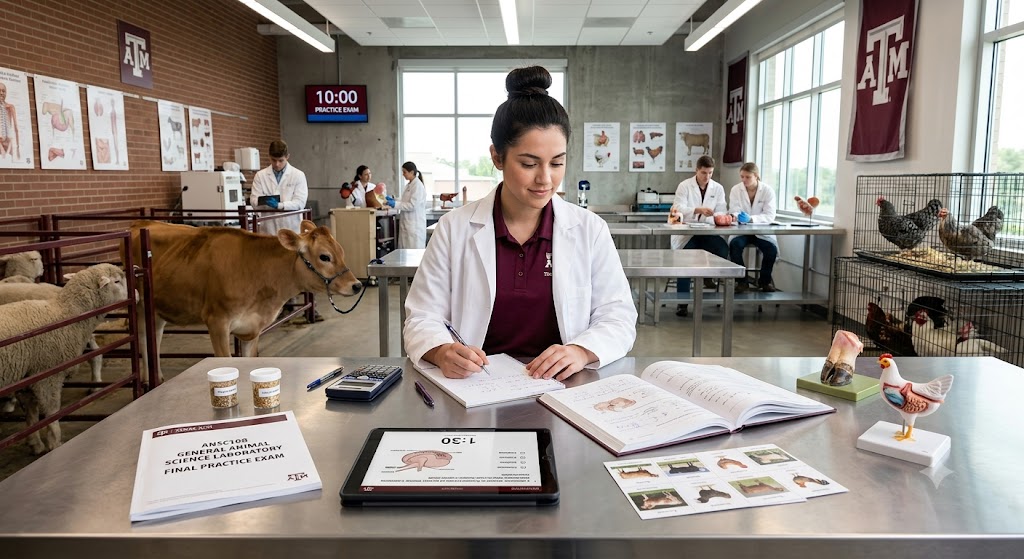
Additional Information
What the Course Entails and Exam Details
ANSC108 is a core laboratory course that introduces students to the diverse aspects of the animal science industry.
The curriculum covers fundamental principles across various livestock species, including beef and dairy cattle, swine, sheep, goats, horses, and poultry.
Students develop essential skills in animal handling, restraint, and safety protocols necessary for working with different species.
Key focus areas include comparative anatomy and physiology, where students identify major skeletal structures and organ systems.
The course delves into animal nutrition, teaching students how to identify common feedstuffs and understand digestive physiology.
Students are introduced to reproductive management, including the identification of reproductive organs and basic principles of artificial insemination.
Genetic principles, breed identification, and evaluation of animal performance and products (meat, milk, fiber) are also integral components of the syllabus.
The practice final exam is comprehensive, requiring students to synthesize information from the entire semester and apply practical knowledge to problem-solving scenarios.
What to Expect in the Final Exam
The ANSC108 final exam is designed to assess both conceptual understanding and practical proficiency.
While formats may vary by semester, students should be prepared for a comprehensive exam that may include a combination of written and practical components.
The written section typically consists of multiple-choice questions, true/false statements, matching, and short-answer questions.
These questions evaluate knowledge of breed identification, feedstuff classification, reproductive physiology, and animal management principles.
The practical or "station-based" component requires students to move through various stations within the laboratory facility.
At each station, students may be required to identify anatomical structures on models or specimens, classify feed samples, or demonstrate understanding of management tools.
Questions regarding livestock evaluation, biosecurity protocols, and industry terminology are also common.
Students generally have a set time limit to complete the exam, and a passing score is determined based on the grading scale outlined in the course syllabus.
Strict adherence to laboratory safety guidelines and ethical animal handling procedures is expected throughout the examination.
How to Study and Exam Centers
Effective preparation for the ANSC108 final requires a multi-faceted study approach.
Begin by thoroughly reviewing all laboratory manuals, handouts, and lecture notes provided throughout the semester.
Focus on mastering breed identification by creating flashcards with images and key characteristics of each species and breed covered.
Practice identifying different feedstuffs and reviewing their nutritional properties and roles in animal diets.
Utilize diagrams to study the anatomy and physiology of reproductive and digestive systems, ensuring you can identify major organs and their functions.
फॉर्मing study groups with classmates is highly beneficial, as it allows you to quiz each other on course material and discuss challenging concepts.
Review previous quizzes and assignments to identify areas where you need additional study.
The actual final exam is held on the Texas A&M University campus in College Station, Texas.
Testing locations are typically within the specified laboratory classrooms or designated testing centers within the Department of Animal Science facilities.
Consult the university's final exam schedule and official course communication for specific dates, times, and room assignments.
Job Opportunities from the Course
A strong foundation in General Animal Science, reinforced by ANSC108, opens the door to a wide range of rewarding career opportunities.
This course provides the practical knowledge sought by employers in various sectors of the animal agriculture industry.
Potential career paths and job titles include:
Livestock Production Manager (Beef, Dairy, Swine, Poultry, Sheep)
Herd Manager or Farm Supervisor
Animal Nutrition Specialist or Feed Sales Representative
Pharmaceutical Sales Representative (Animal Health)
Artificial Insemination (AI) Technician
Breed Association Representative
Quality Control or Quality Assurance Specialist in Food Processing
Livestock Buyer or Procurement Specialist
USDA or State Agricultural Inspector
Veterinary Assistant or Laboratory Technician
Extension Agent or Agricultural Educator
Research Assistant in Animal Genetics, Nutrition, or Physiology
Frequently Asked Questions
Reviews
5.0
Based on 0 reviews
Leave a Review
No reviews yet. Be the first to review!