
TAMU BIOL111 Exam 3 Practice Exam
$69.00
- Buy to unlock unlimited access to all Quiz questions and Answers in this Quiz.
- After purchase you can print a PDF of the whole quiz at any point. The PDF will contain the questions and the correct answers.
About this Exam
Welcome, Aggies! This study guide is your dedicated resource for mastering the Texas A&M University (TAMU) BIOL 111, Introductory Biology I, Exam 3. This exam practice is tailored specifically for students currently enrolled in BIOL 111 who are looking to solidify their understanding of the complex genetic and molecular concepts introduced in the third unit of the course. Our aim is to provide an engaging, focused overview that translates theoretical knowledge into practical exam success.
Ready to test your knowledge?
Buy Now to Access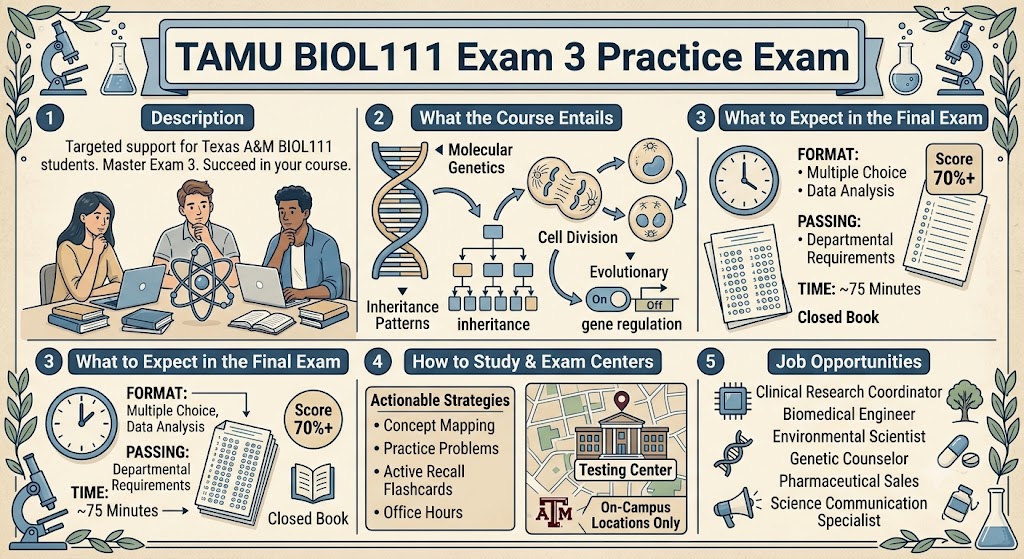
Additional Information
What the Course Entails and Exam Details
The BIOL 111 course is a foundational, four-credit journey into contemporary biology, covering the chemical basis of life, cell biology, and genetics. Exam 3 typically focuses intensively on the mechanisms of heredity and molecular genetics. Key topics you must master include the historical experiments that identified DNA as the genetic material, the precise structure of the DNA double helix, and how DNA is packaged within chromosomes. Students will delve into detailed processes such as DNA replication, the central dogma (transcription and translation), and how gene expression is regulated in both prokaryotes and eukaryotes. Understanding different types of mutations and their potential consequences is also a core requirement.
What to Expect in the Final Exam
The actual BIOL 111 Exam 3, which this practice exam simulates, is a high-stakes assessment administered on the TAMU campus. You should expect a rigorous, multiple-choice format designed to test both your recall of specific biological facts and your ability to apply concepts to solve problems. The exam will likely include sections dedicated to data analysis, where you must interpret genetic experimental results. It is typically a closed-book, 75-minute assessment, and a passing score will be determined by the standard departmental grading scale, often requiring a minimum of 70% to demonstrate proficiency.
How to Study and Exam Centers
Effective preparation goes beyond passive reading. Actively engage with the material by creating concept maps that link DNA structure to its function in replication and protein synthesis. Utilize active recall flashcards for key vocabulary, particularly the scientists and their specific contributions to genetic theory. Solve as many practice problems as possible, especially those involving genetic crosses and tracing the flow of genetic information. Forming study groups can expose you to different perspectives on complex topics. Remember, the BIOL 111 Exam 3 is taken on the TAMU campus, usually in your assigned classroom or a designated departmental testing area, not at external providers like Pearson VUE. Students with accommodation needs should coordinate with the TAMU Disability Resources office well in advance.
Job Opportunities from the Course
Completing BIOL 111 and successfully passing Exam 3 is a vital step on your path toward earning a Bachelor of Science (B.S.) in Biology or a related field. While a single exam doesn't unlock jobs, the degree program it supports opens a multitude of professional career paths in science, healthcare, and research. Following graduation, you could pursue roles such as:
Laboratory Technician
Clinical Research Coordinator
Biomedical Engineer (with additional engineering focus)
Environmental Scientist
Wildlife Biologist
Pharmaceutical Sales Representative
Genetic Counselor (requires graduate school)
Medical, Dental, or Veterinary Professional (requires post-graduate education)
Science Communication Specialist
High School Biology Teacher
Frequently Asked Questions
Reviews
5.0
Based on 0 reviews
Leave a Review
No reviews yet. Be the first to review!