
TAMU BIOL112 Lab Exam 1 Practice Exam
$69.00
- Buy to unlock unlimited access to all Quiz questions and Answers in this Quiz.
- After purchase you can print a PDF of the whole quiz at any point. The PDF will contain the questions and the correct answers.
About this Exam
Welcome to your essential study companion for the Texas A&M University (TAMU) BIOL 112 Introductory Biology II Lab Exam 1.
This guide is not the exam itself, but a comprehensive study resource designed to help you prepare effectively. It is specifically tailored for students currently enrolled in the BIOL112 course at TAMU. Succeeding in this foundational biology laboratory requires strong observational skills, technical proficiency, and a clear understanding of key biological concepts.
This study guide will outline common course topics, detail typical exam formats for lab practicals, and provide actionable study strategies to build your confidence and mastery before you face the real test. Our goal is to empower you to approach your lab exam with clarity and focus
Ready to test your knowledge?
Buy Now to Access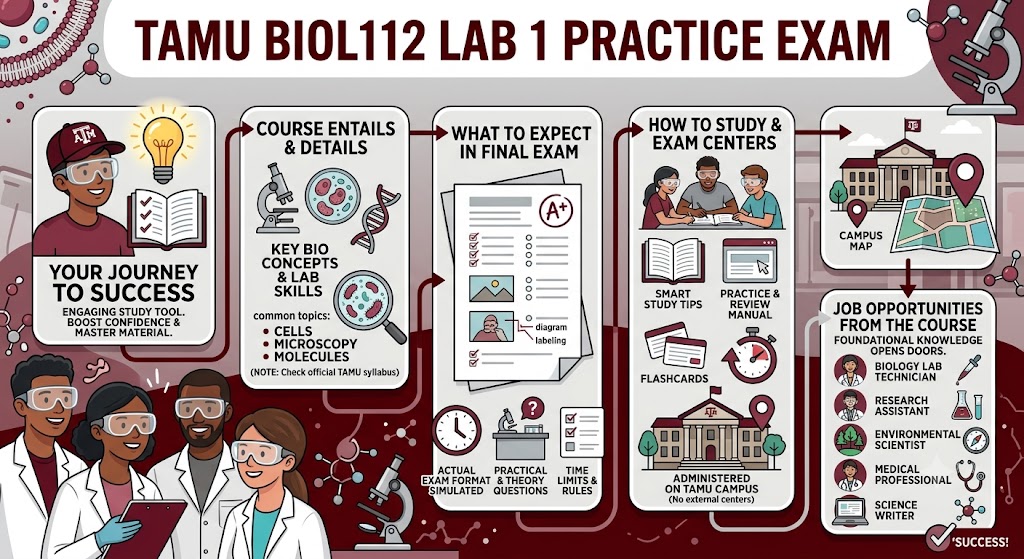
Additional Information
What the Course Entails and Exam Details
BIOL112 Lab at Texas A&M is a rigorous exploration of biological diversity, evolution, and foundational biological processes, supporting the concepts introduced in the corequisite lecture course.
Common foundational topics covered in the first part of this laboratory series, which frequently appear on Lab Exam 1, include lab safety and procedures, fundamental microscopy techniques, identification of prokaryotic and eukaryotic cell types, basic biological molecules, and key concepts of osmosis and diffusion.
Your course syllabus and lab manual are the most critical sources of truth for the exact content you will be tested on. A practice exam, including the material covered in this guide, aims to simulate the types of questions and topics you are likely to encounter. It will help you identify areas where your understanding is strong and where further review is needed. It will not contain actual questions from the final official exam.
What to Expect in the Final Exam
While the format of any specific lab exam can vary by instructor, lab practicals in university settings, including BIOL112 at TAMU, commonly employ distinct assessment methods.
Typically, you can expect a mix of multiple-choice, matching, labeling, and short-answer questions. The defining feature of a lab exam is its practical nature. This may involve identifying specific features from printed or projected images (mock practical), identifying organisms or cellular structures under a microscope, interpreting results from a previous lab activity, or performing simple data analysis. The actual lab exam frequently involves moving between different physical stations.
The specific rules, passing scores (which are usually a percentage required for the entire course or as component grading), and strict time limits will be clearly communicated by your instructor. It is absolutely essential to follow all safety protocols and academic honesty guidelines. Failure to comply can result in immediate dismissal from the exam.
How to Study and Exam Centers
Effective preparation is the key to success in any lab exam. Here are actionable study strategies tailored for BIOL112:
Review your entire lab manual and all pre-lab materials thoroughly. Actively label diagrams, take detailed notes during lab, and draw any structures you observe under the microscope. Utilize high-quality flashcards (either physical or digital, like Anki) to memorize terminology, organism names, and key concepts. Form a study group with classmates to practice identifying materials and explaining concepts to one another. Engage actively with any official online portals, practice quizzes, or study guides provided by your instructors. Use a reliable practice exam to simulate timed exam conditions and assess your knowledge in a realistic setting.
Regarding "exam centers": For your official BIOL112 lab exams, you will not go to an external, commercial testing facility like a Pearson VUE center. These exams are administered directly on the Texas A&M University campus, within the standard lab classrooms or larger lecture halls specifically designated for the exam. Your instructor will provide all precise scheduling, location details, and required materials. Ensure you are aware of your assigned time and location and arrive early to allow for any setup or instruction.
Job Opportunities from the Course
A foundational biology course like BIOL112 is a major stepping stone, particularly for students pursuing degrees in the life sciences, medical professions, and related fields.
While passing a single practice exam or even the actual lab exam itself does not lead to a specific job title, the knowledge and skills you build here are crucial for the following diverse career paths:
Biology Laboratory Technician
Research Assistant (in academia, government, or private sector)
Science Educator (High School or Middle School, with further training)
Wildlife Biologist
Environmental Consultant
Conservation Scientist
Biotechnologist
Pharmaceutical Sales Representative
Scientific Writer/Communicator
Preparation for professional health career
Frequently Asked Questions
Reviews
5.0
Based on 0 reviews
Leave a Review
No reviews yet. Be the first to review!