
TAMU POLS206 Practice Exam 1
$69.00
- Buy to unlock unlimited access to all Quiz questions and Answers in this Quiz.
- After purchase you can print a PDF of the whole quiz at any point. The PDF will contain the questions and the correct answers.
About this Exam
This study guide is designed specifically for students enrolled in the Texas A&M University (TAMU) course POLS206: American National Government. This is a foundational course exploring the essential components, history, and operation of the United States’ political system.
Practice exams are an invaluable tool for students, providing a simulated test environment to gauge understanding, identify knowledge gaps, and become comfortable with the likely format and pacing. This practice exam resource aims to help students reinforce concepts covered in the first section of the course, ensuring they are well-prepared for the actual Exam 1.
Ready to test your knowledge?
Buy Now to Access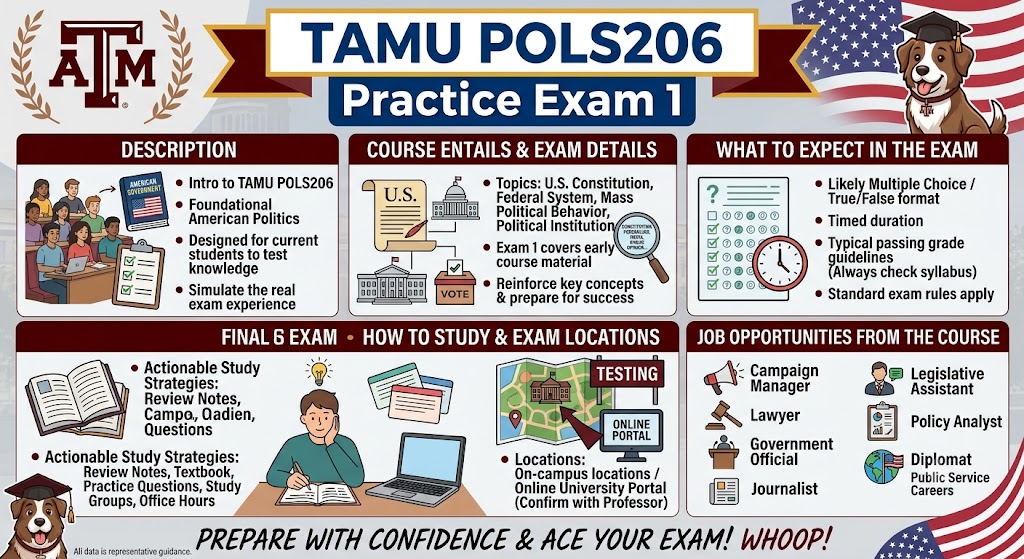
Additional Information
What the Course Entails and Exam Details
POLS206 offers a comprehensive survey of American national government and politics. The course content generally covers the theoretical foundations, historical development, and practical operations of key American institutions, including the Constitution, federalism, public opinion, media, political parties, interest groups, and the branches of government (Congress, the Presidency, and the Judiciary). Students explore both historical context and contemporary political dynamics.
The Exam Details for Exam 1 will specifically focus on the initial chapters or topics covered by your professor. This typically includes foundational elements like the U.S. Constitution, the philosophies of the Founding Fathers (such as John Locke and the authors of the Federalist Papers), theories of democracy (pluralism, elitism, hyper-pluralism), political culture, public opinion, and the role of the media in politics. Always refer to your specific syllabus and professor’s announcements to confirm the exact topic range and format for your Exam 1. The practice material should be structured to mirror these expected topics.
What to Expect in the Final Exam
While the final exam (and early course exams like Exam 1) are university-specific and detail can vary between professors and semesters, students can commonly expect:
Format: Large introductory courses like POLS206 often utilize multiple-choice questions, which may include true/false and conceptual scenarios. Some exams might also include short answer questions, though this is less common for a pure practice test resource for this type of course. The structure of the actual exam and any practice tests provided by your professor are the best guide.
Passing Score: A passing grade (typically a 'D' or 60% or higher at TAMU, depending on course policies) is generally required to progress, with higher grades needed to fulfill degree requirements and major/minor specific criteria.
Time Limits: Exams are typically timed to be completed within a standard lecture period or a slightly extended university exam slot, ensuring fairness and pacing. This reinforces the need for both speed and accuracy.
Specific Rules: All standard TAMU academic integrity and testing rules apply. These may include requirements to have a photo ID, limitations on electronic devices, and specific instructions for answer sheets and exam materials. Clarify all these with your professor or the relevant TAMU academic department before the test.
How to Study and Exam Centers
Actionable Study Strategies:
Review Lecture Notes and PowerPoints: Pay close attention to the concepts highlighted by your professor, examples provided, and key vocabulary.
Thoroughly Read the Textbook: Don't skim. Understand the main arguments, definitions, and supporting evidence presented.
Utilize This and Other Practice Exams: Practice is key. Answer questions under simulated time constraints to build confidence. Analyze the correct answers and understand why other options are incorrect.
Create Flashcards: Ideal for learning key definitions, names (founding fathers, key theorists, politicians), court cases, and constitutional amendments.
Form Study Groups: Explaining concepts to peers and discussing potential exam questions can solidify knowledge.
Attend Review Sessions: Professors or teaching assistants often host specific review sessions before major exams.
Visit Professor's Office Hours: Get direct clarity on challenging concepts.
Exam Centers & Portals:
Unlike standardized certification exams, exams for university courses like POLS206 are usually taken on the TAMU campus or through approved TAMU online portals.
Physical Exams: Typically administered in standard lecture halls or dedicated university testing centers during scheduled class or exam times. Your professor will announce the exact location.
Online/Remote Proctored Exams: In some cases, exams might be conducted through TAMU’s Learning Management System (like Canvas) and may require specific remote proctoring software.
Confirm: Always consult your syllabus or official university communication for the precise method, location, or online portal where your exam will be held. The university's Testing Services Office on the campus can also provide information about potential specific test administration procedures. Do not look for general commercial testing centers like Pearson VUE for this type of university exam.
Job Opportunities from the Course
While POLS206 is an introductory university course, it serves as a critical stepping stone for numerous careers, particularly within and relating to the political sphere, law, communication, and public service. Here are some job titles that a foundation in American government can lead to, often in combination with further study and a full degree in political science, law, public administration, or related fields:
Political Campaign Manager
Legislative Assistant
Lobbyist
Public Policy Analyst
Political Pollster
Campaign Fundraiser
Journalist/News Anchor (covering politics)
Diplomat/Foreign Service Officer
Attorney (after Law School)
Public Relations Specialist (in politics or government)
Non-profit Organizer/Director
University Professor (after advanced degrees)
State or Federal Government Official (elected or appointed)
Civics Educator/Teacher (at various levels)
Intelligence Analyst
Frequently Asked Questions
Reviews
5.0
Based on 0 reviews
Leave a Review
No reviews yet. Be the first to review!