
TCFP Instructor 3 Practice Exam Guide
$69.00
- Buy to unlock unlimited access to all Quiz questions and Answers in this Quiz.
- After purchase you can print a PDF of the whole quiz at any point. The PDF will contain the questions and the correct answers.
About this Exam
The Texas Commission on Fire Protection (TCFP) Instructor 3 certification is a prestigious and advanced qualification designed for experienced fire service instructors ready to transition into a leadership, management, and program development role. This certification validates that an individual possesses the knowledge and skills necessary to manage instructional programs, develop comprehensive curricula, administer training budgets, and provide supervision and mentorship to lower-level instructors. It is the pinnacle of the TCFP instructor certification pathway and is aimed at individuals aspiring to be training chiefs, academy directors, and curriculum managers. A practice exam for TCFP Instructor 3 is an essential study tool, designed to simulate the rigorous cognitive test and ensure candidates are thoroughly prepared for the final state examination.
Ready to test your knowledge?
Buy Now to Access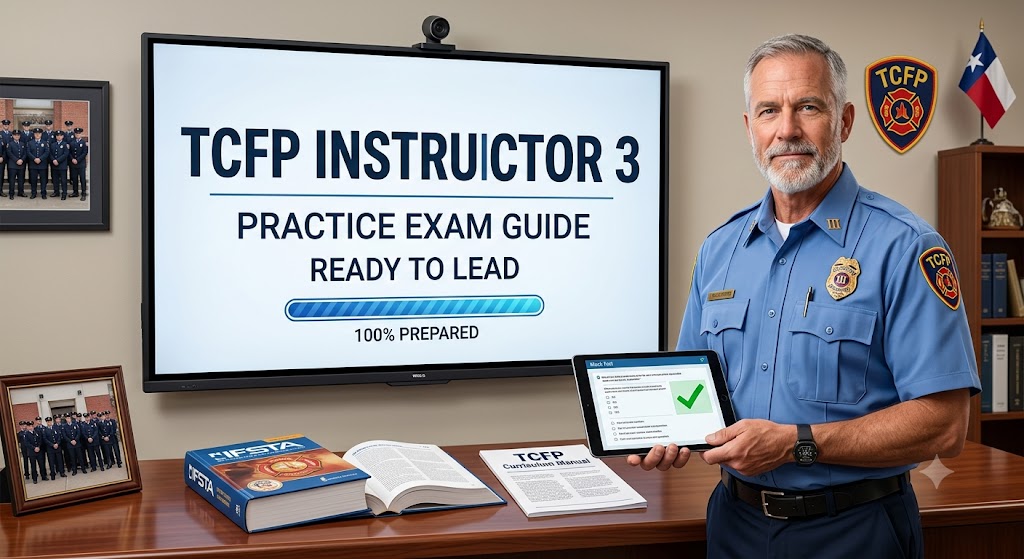
Additional Information
What the Course Entails and Exam Details
To achieve TCFP Instructor 3 certification, candidates must first complete an approved training program that adheres to the NFPA 1041 Standard for Fire Service Instructor Professional Qualifications, specifically for Instructor III. The TCFP curriculum and the final exam cover a wide array of advanced management and educational topics, including:
Instructional Program Management: Planning, developing, and implementing comprehensive fire service training programs that meet organizational goals and regulatory requirements.
Curriculum Development: Designing, writing, and evaluating training syllabi, lesson plans, instructional materials, and assessment tools.
Administration and Resource Management: Managing training budgets, purchasing equipment, maintaining training records, and ensuring appropriate resources for safe and effective instruction.
Personnel Management and Supervision: Supervising, mentoring, and evaluating other instructors; addressing performance issues; and managing instructional staff development.
Evaluation and Testing: Creating valid and reliable evaluation instruments and procedures, and analyzing testing data to improve program effectiveness.
Completing the requisite course is the primary requirement to become eligible for the TCFP Instructor 3 written exam.
What to Expect in the Final Exam
The TCFP Instructor 3 final state exam is a comprehensive cognitive test that evaluates your understanding of the entire NFPA 1041 Instructor III curriculum. While specific details can change, candidates should generally expect the following:
Format: The exam typically consists of multiple-choice questions. For this advanced level, questions often focus on the application of management principles, decision-making, and critical analysis of training scenarios.
Number of Questions: TCFP cognitive exams for this level are generally around 100 questions.
Time Limit: A specific time limit is allotted, often between 2 and 3 hours, which is typically sufficient for well-prepared individuals to complete all questions.
Passing Score: The Texas Commission on Fire Protection requires a minimum score of 70% to pass the cognitive examination.
Practical Skills: While the main state exam is cognitive (written), Instructor 3 courses often require a practical skills project, such as developing a comprehensive training program proposal or a new curriculum for a complex subject. This project is usually completed and assessed during the approved course, but completion is a prerequisite for taking the final written test.
How to Study and Exam Centers
Effective preparation is the key to success on the TCFP Instructor 3 exam. Here are actionable study strategies:
Review the TCFP Curriculum Manual: The foundation of your study should be the official TCFP Curriculum Manual for Instructor 3, which outlines all performance standards and required knowledge.
Master NFPA 1041: Thoroughly study the NFPA 1041 Standard for Fire Service Instructor Professional Qualifications, focusing on the specific job performance requirements for Level III.
Utilize Practice Tests: This is the most crucial step. A high-quality TCFP Instructor 3 practice test will help you familiarize yourself with the type and style of questions, identify knowledge gaps, and improve your test-taking speed and confidence.
Case Studies and Real-World Application: Since the exam is about program management, practice applying concepts to realistic fire service scenarios. Consider how you would design a training program, manage a budget, or mentor a struggling instructor.
Group Study: Discussing complex topics and management strategies with fellow students or experienced instructors can provide valuable perspectives.
Exam Centers and Registration:
To take the TCFP Instructor 3 exam, you must first create an account on the TCFP’s FIDO (Firefighter Online) system. Once you have met all prerequisites (completing the course, having the required lower-level certifications), you can register for an exam date. The TCFP administers exams through a network of approved, proctored testing centers across Texas. These are often located at fire departments, community colleges, and regional training academies. In some cases, the TCFP may offer exams via approved online proctoring services, which can be selected during the registration process in FIDO. Be sure to check your FIDO account for the most up-to-date list of available testing locations and dates.
Job Opportunities from the Course
A TCFP Instructor 3 certification significantly expands your career opportunities, opening doors to key leadership roles within fire service training divisions and educational institutions. This credential positions you as an expert in training management and curriculum development. Specific job opportunities unlocked by this certification include:
Training Chief: A high-level administrative role responsible for managing an entire fire department’s training division, including budgeting, personnel, and program development.
Fire Academy Director: The head of a regional or department-run fire academy, overseeing all aspects of recruit and incumbent training.
Training Program Manager: A leadership position focus on designing, implementing, and maintaining specific, comprehensive training initiatives (e.g., officer development, hazardous materials, technical rescue).
Lead Instructor / Instructor-In-Charge: Supervising other instructors during complex training scenarios or large-scale exercises.
Curriculum Developer: Creating standardized training programs and lesson plans for large organizations or educational institutions.
Chief of Training / Training Division Commander: A command-level officer who directs and integrates training and education with the overall operational goals of the fire department.
Frequently Asked Questions
Reviews
5.0
Based on 0 reviews
Leave a Review
No reviews yet. Be the first to review!