
Texas Adult Drivers Education Course Practice Exam
$69.00
- Buy to unlock unlimited access to all Quiz questions and Answers in this Quiz.
- After purchase you can print a PDF of the whole quiz at any point. The PDF will contain the questions and the correct answers.
About this Exam
The Texas Adult Drivers Education Course is a mandatory step for many first-time driver’s license applicants in the Lone Star State. If you are between the ages of 18 and 24 and have never held a valid driver's license from another state or country, you must complete this state-approved six-hour course before you can take your final on-road driving test. The course is also an excellent option for adults 25 and older. While not required for those over 25, completing the course allows you to waive the mandatory Texas Department of Public Safety (DPS) written knowledge exam, which can save you significant time and effort at the driver license office.
Ready to test your knowledge?
Buy Now to Access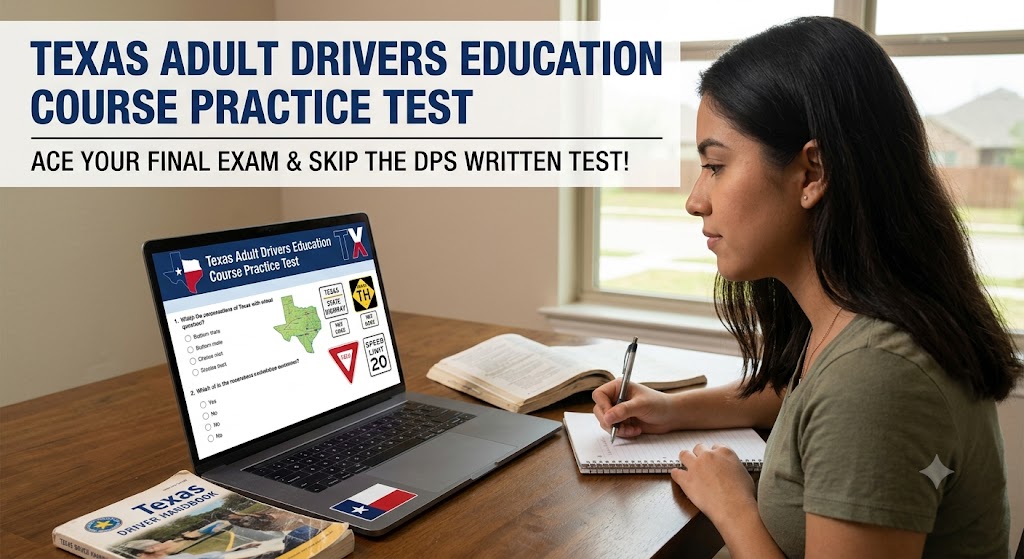
Additional Information
What the Course Entails and Exam Details
This comprehensive course, approved by the Texas Department of Licensing and Regulation (TDLR), is designed to prepare new adult drivers for safe, responsible operation of a motor vehicle. It is widely available 100% online through various authorized schools, allowing you to learn at your own pace. The core curriculum covers vital traffic safety information, including:
Texas Traffic Laws and Rules of the Road
Understanding Traffic Signals, Signs, and Pavement Markings
Defensive Driving Techniques to Prevent Crashes
The Dangers of Distracted Driving, Including the Impact Texas Young Drivers (ITYD) Video
Effects of Alcohol and Drugs on Driving Ability
Basic Vehicle Maneuvers and Controlling Your Vehicle
Sharing the Road with Other Users (e.g., Cyclists, Pedestrians, Trucks)
Emergency Situations and Knowing Your Vehicle’s Safety Features
The course is divided into modules, each culminating in a review. After you complete the full six hours of required material, you will be eligible to take the required final exam.
What to Expect in the Final Exam
The Texas Adult Drivers Education Course Final Exam is a knowledge-based assessment taken immediately after you finish the required course hours. This exam is crucial because, upon passing, you will be exempt from taking the standard DPS written knowledge test. Here is what you can expect:
Format: The exam consists of 30 to 40 multiple-choice questions. These questions are drawn directly from the Texas Driver Handbook and the course material, testing your understanding of road rules and signs.
Passing Score: To pass, you must score at least 70% or better.
Time Limit: While specific time limits can vary by the provider of the course, most online platforms provide a standard window (e.g., 60 to 90 minutes) to complete the test.
Rules: You must take the exam without access to the course material, study guides, or outside help. If you do not pass on your first attempt, state rules generally allow for at least two additional retakes. Many online providers offer these retakes at no extra cost, though some may require a waiting period before attempting the exam again.
Outcome: Once you pass, the course provider will issue you a sealed certificate (ADE-1317), which you must present at your local DPS driver license office as proof you have completed the course and passed the written exam equivalent.
How to Study and Exam Centers
Preparation is key to passing on your first try. While the course itself is comprehensive, additional practice can make you more confident.
How to Study:
Engage with the Course Material: As you move through the six hours, actively take notes, highlight key concepts, and complete all end-of-section quizzes. Don't skip any sections or try to move too quickly through the mandatory ITYD video.
Use Official Resources: The primary source for all traffic rules and signs is the official Texas Driver Handbook. You can download a digital copy from the DPS website. Review it carefully, particularly the chapters on road signs and defensive driving.
Take Practice Tests: Utilizing practice tests is one of the best ways to gauge your readiness. Many online TDLR-authorized schools offer "Practice Exams" as part of their package or for a small fee. Ensure any practice test is specific to Texas Adult Drivers Education to mirror the real exam format.
Review Mistaken Questions: If you take a practice test, focus on the questions you got wrong. Go back to the handbook or course material to understand why the correct answer is correct.
Exam Centers and Where to Take the Exam:
Online Portals: The vast majority of adults in Texas complete the course and take the final exam entirely online. You do not need to visit a physical location to take the final written exam if you are enrolled in a TDLR-approved online adult drivers ed program.
Authorized Schools and Physical Locations: While less common than online courses, traditional "bricks and mortar" driving schools and some community colleges are authorized to offer the 6-hour adult driver education course in a classroom setting. In this scenario, the exam is proctored in the classroom at the end of the course.
What Comes Next: After you pass your exam online and receive your ADE-1317 completion certificate, you will need to take the final step at a Texas DPS Driver License Office. Here, you will:
Submit your application.
Present your identification, residency, and course completion documents (ADE-1317).
Pass a vision exam.
Pay the required fees.
Schedule and pass your behind-the-wheel Driving Skills Road Test. You may take the road test at a DPS office or through an authorized third-party testing school.
Job Opportunities from the Course
Earning a Texas driver’s license through this course, especially for adults 18-24, significantly expands your employment prospects in the state. A standard (Class C) driver's license is either required or considered a significant asset for numerous entry-level career paths, including:
Local Delivery Driver (e.g., Food, Packages, Floral)
Rideshare Driver (e.g., Uber, Lyft, local services)
Non-Emergency Medical Transportation (NEMT) Driver
Courier Services
Parts and Supplies Delivery (e.g., Auto Parts, Construction Materials)
Field Sales Representative
Real Estate Agent
Service Technician (e.g., Plumbing, HVAC, Pest Control, Home Security)
Security Guard (requiring vehicular patrol)
Valet Parking Attendant
Rental Car Agent/Driver
Airport Shuttle and Shuttle Bus Driver (non-CDL required types)
Home Health Aide (requiring client transport)
For positions that involve transporting passengers or cargo over 26,001 pounds, a Commercial Driver’s License (CDL) is required, but a standard license is often the first step in that direction. This course provides the foundational knowledge necessary to succeed in a wide array of driving-intensive industries.
Frequently Asked Questions
Reviews
5.0
Based on 0 reviews
Leave a Review
No reviews yet. Be the first to review!