
Texas Animal Control Officer Practice Exam
$69.00
- Buy to unlock unlimited access to all Quiz questions and Answers in this Quiz.
- After purchase you can print a PDF of the whole quiz at any point. The PDF will contain the questions and the correct answers.
About this Exam
The Texas Animal Control Officer (ACO) certification is a vital credential for individuals dedicated to public safety and animal welfare within the state of Texas.
This program is designed for current animal control personnel, municipal employees, law enforcement officers, and aspiring professionals seeking to begin a career in this rewarding field. The certification process ensures that all officers possess the standardized knowledge, legal understanding, and practical skills required to manage animal-related issues effectively, humanely, and in accordance with complex Texas state laws and local ordinances.
Whether you are aiming to fulfill a mandatory training requirement or enhance your professional standing, this practice exam serves as an essential tool for identifying your strengths and preparing for the comprehensive final assessment.
Ready to test your knowledge?
Buy Now to Access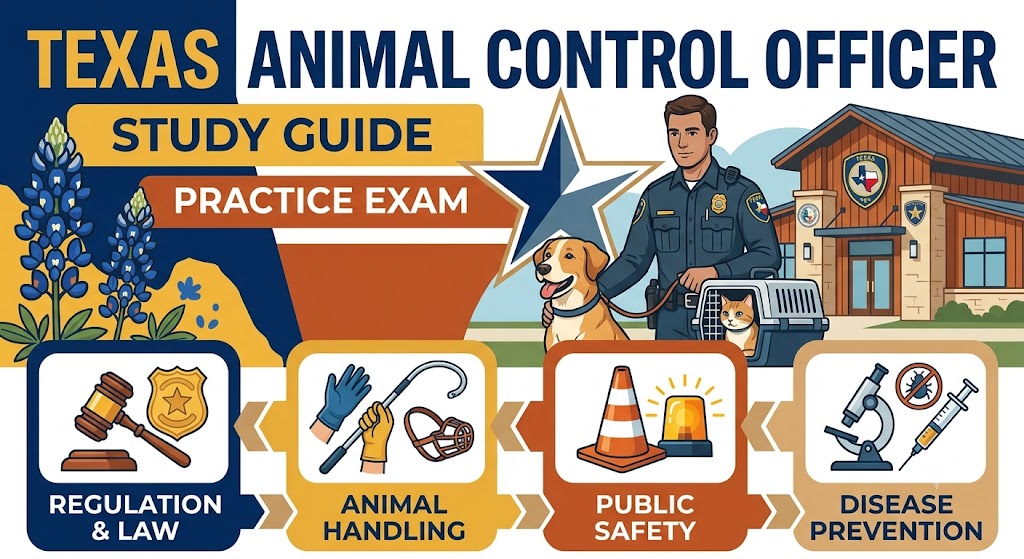
Additional Information
What the Course Entails and Exam Details
The comprehensive training course leading to certification covers a robust curriculum, combining technical knowledge with ethical field practices.
Successful candidates must demonstrate proficiency in several core domains, including:
Texas Animal Law and State Health and Safety Codes: In-depth knowledge of statutes governing animal cruelty, dangerous dogs, rabies control, impoundment, and officer authority.
Public Safety and Zoonotic Disease Control: Protocols for identifying and managing public health risks, including rabies and other animal-to-human transmissible diseases.
Animal Identification and Behavior Assessment: Recognizing domestic and wild species common in Texas, and assessing behavioral cues for safe handling.
Humane Capture and Restraint Techniques: Practical application of various tools, such as catch poles, traps, and muzzles, with an emphasis on prioritizing the welfare of both the officer and the animal.
Investigative Procedures and Documentation: Standards for conducting cruelty investigations, securing evidence, writing accurate reports, and providing credible testimony.
Shelter Operations and Euthanasia Protocols: Understanding the ethical, legal, and safety standards for municipal shelter management and compassionate end-of-life care.
What to Expect in the Final Exam
The final certification exam is a comprehensive evaluation designed to measure your mastery of the topics covered in the accredited training course.
Candidates should expect the following format for the exam:
Format: The primary component of the final examination is generally presented as a proctored, written test.
Question Type: The vast majority of questions are objective multiple-choice and true/false statements. These are designed to test not only recall of facts and legal codes but also your ability to apply that knowledge to real-world scenarios an officer might encounter in the field.
Passing Score Requirements: Candidates typically must achieve a minimum score of 70% to 80% to successfully pass the examination and receive their Basic Animal Control Officer certification from the state.
Time Limits: A specific time limit, often ranging from two to three hours, is strictly enforced.
Specific Rules: The examination is usually a "closed-book" test. Examinees are prohibited from referencing the training manual, personal notes, or mobile devices during the test session.
How to Study and Exam Centers
Preparation is crucial for success on the Texas ACO final exam. Here are actionable strategies to help you study effectively:
Utilize Official Resources: Your primary study material should be the comprehensive Basic Animal Control Officer manual provided during your accredited training. It contains all the definitions, protocols, and legal statutes you will be tested on.
Analyze the Learning Objectives: Every section of your training manual likely begins with learning objectives. If you can clearly explain and apply these concepts, you are well-prepared for the corresponding questions.
Create Flashcards: The ACO exam requires memorizing specific Texas Health and Safety Codes and terminology. Use flashcards to reinforce key definitions, legal section numbers, and mandatory timeframes.
Take Mock Tests: Utilize this Texas Animal Control Officer Practice Exam repeatedly. Simulate testing conditions by timing yourself and taking the test in a quiet, distraction-free environment. Use your results to pinpoint areas where you require further review.
Exam Centers and Locations
The exam itself is usually administered immediately following the conclusion of an accredited Basic Animal Control Officer training course.
These training courses and the corresponding exams are sanctioned by the Texas Department of State Health Services (DSHS) and are often hosted by several types of locations across the state:
Authorized Regional Training Schools: Specific law enforcement academies, veterinary technology programs, or municipal training facilities that are DSHS-approved.
Specific Physical Testing Centers: Many larger municipal or county animal services departments are certified to host the training and testing on-site.
Online Portals (Select Cases): In recent years, some accredited organizations have begun offering the written exam through secure, proctored online portals, though the availability of this option varies. Check the specific DSHS training schedule for current availability.
Job Opportunities from the Course
A Texas Animal Control Officer certification is a prerequisite for numerous satisfying career paths dedicated to animal welfare and public safety. This certification unlocks several specific job titles and opportunities within local government and specialized agencies:
Animal Control Officer (Basic, Intermediate, Advanced, Master levels)
Field Services Officer / Humane Investigator
Animal Cruelty Investigator
Animal Services Supervisor or Manager
Shelter Manager / Shelter Director
Wildlife Management Specialist (Municipal/County)
Rabies Control Authority Officer
Public Health Educator (Zoonotic Disease focus)
Frequently Asked Questions
Reviews
5.0
Based on 0 reviews
Leave a Review
No reviews yet. Be the first to review!