
Texas CDL Special Permits Practice Exam
$69.00
- Buy to unlock unlimited access to all Quiz questions and Answers in this Quiz.
- After purchase you can print a PDF of the whole quiz at any point. The PDF will contain the questions and the correct answers.
About this Exam
Welcome to our comprehensive study guide and practice resource for the Texas CDL Special Requirements written examination. In the Lone Star State, obtaining your Commercial Learner’s Permit (CLP) or Commercial Driver’s License (CDL) often involves more than just a basic knowledge test. A unique and mandatory prerequisite for all new Class A or B CDL applicants in Texas is the "Texas Commercial Vehicle Operation," or more commonly known as the Special Requirements Test.
This practice test and study guide are meticulously designed to help you prepare for and pass this crucial exam, which covers specific technical details and rules from the Texas Commercial Motor Vehicle Handbook. Additionally, this guide briefly encompasses aspects relevant to common specialized endorsements, which are also part of the special requirements needed for many driving roles. If you are aiming for a successful career as a commercial driver in Texas, mastering this knowledge is your essential first step.
Ready to test your knowledge?
Buy Now to Access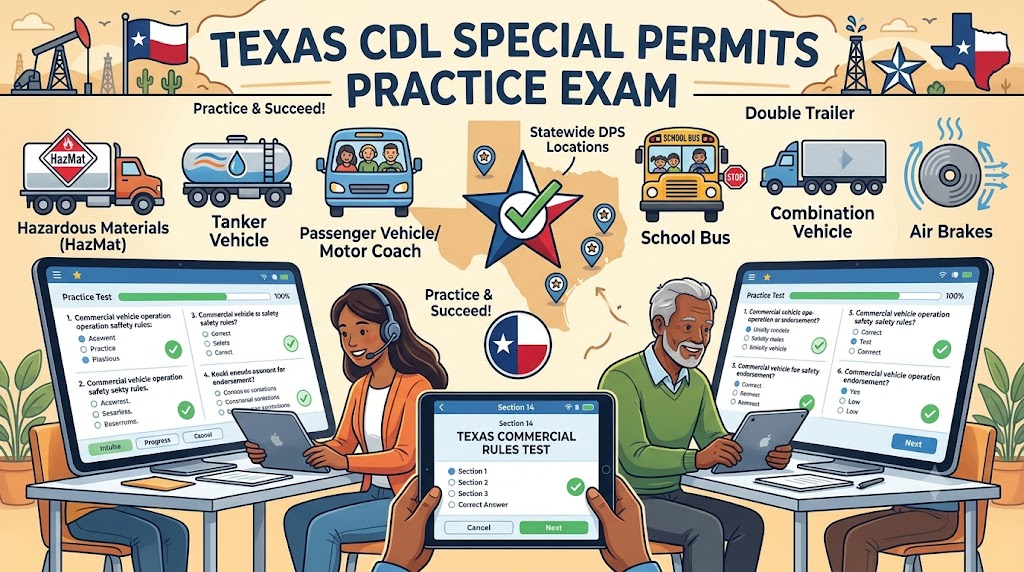
Additional Information
What the Course Entails and Exam Details
This guide focuses heavily on the mandatory Texas Special Requirements Test (Section 14 of the handbook) but also aligns with the areas of general and specific endorsements. The key topics and knowledge areas covered in this process include:
Vehicle Systems and Safety: Deep dives into air brakes, combination vehicles, specific vehicle systems, and essential safety procedures.
Texas Commercial Rules: State-specific laws, regulations, and terminology unique to operating commercial vehicles in Texas, as detailed in Section 14. This test must be passed first by all CDL applicants in Texas.
Safe Operation Practices: Proper braking, speed control, reversing, following distance, and handling emergency situations.
Inspection Procedures: Requirements and best practices for vehicle inspections, including pre-trip and during-trip.
Cargo Management: Safe loading, securing, and transporting of various types of cargo.
Endorsement Topics (Separate Tests): Depending on your desired endorsements, you will also need to study for and pass written tests on and are also considered 'special requirements' in a broader sense.
Hazardous Materials (HazMat - H): Specific handling, transport, and documentation rules.
Tanker Vehicles (N): Surge control, center of gravity, and safety protocols for liquids or gases.
Passenger Vehicles (P): Loading/unloading, passenger relations, and school bus-specific safety.
Double and Triple Trailers (T): Handling, safety procedures, and regulations for multiple trailers.
School Bus (S): Student transport safety, stop procedures, and vehicle specifications.
This guide provides practice and information to prepare you for the mandatory special requirements and to help you navigate the process for optional endorsements.
What to Expect in the Final Exam
All Texas CDL written exams, including the mandatory Special Requirements (Section 14) and any endorsement tests, are computer-based and administered at Texas Department of Public Safety (DPS) Driver License offices. Here’s what you need to know:
Format: All written knowledge tests consist of multiple-choice questions with only one correct answer.
Passing Score: You must achieve a score of 80% or higher to pass each individual written exam.
Special Requirements Test (mandatory):
Questions: Typically 25 multiple-choice questions.
Passing Count: You must answer at least 20 correctly to pass.
Endorsement Tests (varying): The number of questions varies by endorsement (e.g., HazMat: 30 questions/24 pass; Tanker, Doubles/Triples, Passenger, School Bus: typically 20 questions/16 pass).
Time Limit: There is typically no time limit to complete each written test in Texas, although you must have time during your appointment to finish all tests you intend to take.
Location: Only at official Texas DPS offices. Find and schedule an appointment at your local office.
Language: Effective June 1, 2026, all Texas CDL written examinations are administered in English only. Interpreters are not permitted.
Fees: There is an issuance fee ($25 for CLP, $61 for CDL ages 18-84 as of common information), which generally covers the CLP and initial knowledge testing attempts (often multiple attempts permitted within a set period). Confirm the most current fees.
Documentation: You must provide various documents at the DPS office for your written tests, including proof of non-commercial license, identity, citizenship/lawful presence, Social Security number, and potentially medical certification (DOT long form and medical card).
How to Study and Exam Centers
Preparation is key to succeeding in your Texas CDL special requirements exams. Combine our study resources with these proven strategies:
Study the Handbook Intensely: The primary resource is the Texas Commercial Motor Vehicle Drivers Handbook. Spend time understanding the content, particularly Section 14 for the Special Requirements Test, and other relevant sections for endorsements you desire. Focus on definitions, technical specifications, and procedural steps.
Leverage Online Practice Tests: Use reputable online practice exams, like this guide. They simulate the real test environment, help you identify areas needing improvement, and familiarize you with the question style. Aim to score consistently high on practice tests.
Create Flashcards: Make digital or physical flashcards for key regulations, safe operating procedures, vehicle system details, and specialized endorsements knowledge (e.g., specific placard types, safe following distances, air brake procedures).
Break It Down: Study in focused, digestible chunks. Tackle one section or topic at a time rather than trying to cram everything.
Schedule a Study Time: Be consistent. Dedicate specific times each day or week to study and practice.
Discuss with Peers: If possible, study with others preparing for their CDL. Teaching or discussing topics can reinforce your understanding.
Get a Good Night’s Sleep: Ensure you are well-rested before your scheduled exam appointment.
Finding Exam Centers:
In Texas, all CDL written knowledge examinations must be taken at a Texas Department of Public Safety (DPS) office.
Use the official Texas DPS website (https://www.dps.texas.gov/) to locate the nearest Driver License office to you.
You must schedule an appointment online for all driver license services, including written tests. Plan ahead as appointments can fill up.
Job Opportunities from the Course
Earning your Texas CDL, especially with mandatory special requirement knowledge and potential endorsements, opens doors to a wide variety of exciting and vital commercial driving careers. This knowledge and the resulting permit/license unlock opportunities such as:
Local and Regional Truck Driver (for Class A and B CDLs, often with no special cargo endorsements)
Specialized Endorsement Roles:
Hazardous Materials Hauler
Tank Truck Driver
Double and Triple Trailer Driver
Motor Coach Driver
School Bus Driver
Intermodal Truck Driver
Construction Vehicle Operator (often requiring specialized endorsements or Class A for heavy equipment)
Delivery and Distribution Driver (depending on vehicle size and cargo)
Frequently Asked Questions
Reviews
5.0
Based on 0 reviews
Leave a Review
No reviews yet. Be the first to review!