
Texas Class C Surface Water Practice Exam Guide
$69.00
- Buy to unlock unlimited access to all Quiz questions and Answers in this Quiz.
- After purchase you can print a PDF of the whole quiz at any point. The PDF will contain the questions and the correct answers.
About this Exam
The Texas Class C Surface Water license is a crucial professional certification for water treatment professionals seeking to advance their careers in the Lone Star State. This intermediate-level license is required for operators responsible for treating surface water sources, such as lakes and rivers, ensuring the produced drinking water meets all state and federal safety standards. It is designed for operators who have already gained foundational experience (typically holding a Class D license) and are ready to take on more significant responsibilities in plant operations and regulatory compliance.
Ready to test your knowledge?
Buy Now to Access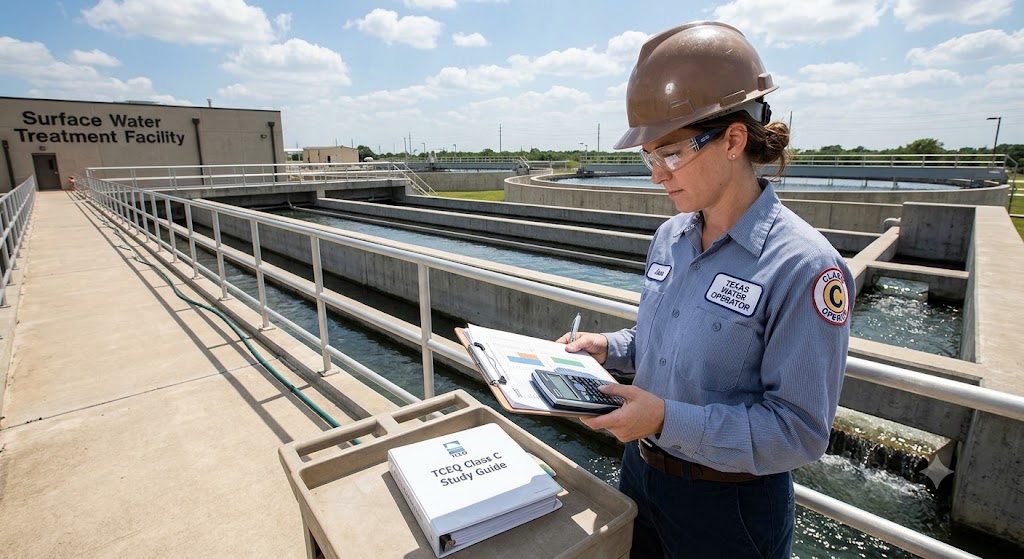
Additional Information
What the Course Entails and Exam Details
To prepare for the exam, candidates typically complete mandatory TCEQ-approved training courses that cover advanced water treatment principles. The core topics addressed in these courses, and consequently on the exam, include an in-depth understanding of surface water treatment processes. This encompasses coagulation, flocculation, sedimentation, filtration, and disinfection techniques.
Additionally, the syllabus covers essential areas such as:
Water Chemistry and Analysis: Understanding parameters like pH, turbidity, and alkalinity.
Regulatory Compliance: Thorough knowledge of TCEQ rules and the Safe Drinking Water Act (SDWA).
Process Control Calculations: Performing vital math for chemical dosages, filtration rates, and detention times.
Equipment Operation and Maintenance: Best practices for managing pumps, chemical feed systems, and online analyzers.
Safety Procedures: Standard practices for handling hazardous chemicals and working in industrial environments.
What to Expect in the Final Exam
The Texas Class C Surface Water exam is a comprehensive assessment designed to test both theoretical knowledge and practical application. It is administered as a computer-based test (CBT).
Candidates can typically expect the following format:
Format: Multiple-choice questions.
Question Count: Usually consists of approximately 100 questions.
Passing Score: A minimum score of 70% is required to pass.
Time Limit: Applicants are generally allotted 3 to 4 hours to complete the exam.
The questions are designed to cover the breadth of the material included in the approved training, with a strong emphasis on practical scenarios and calculations that operators encounter daily.
How to Study and Exam Centers
Effective preparation is key to success on the Class C exam. We recommend a structured study approach:
Utilize TCEQ Manuals: The official Texas Commission on Environmental Quality (TCEQ) study manuals are the primary source of information and should be reviewed thoroughly.
Practice Math Skills: Dedicate significant time to practicing water math calculations, as these are a major component of the exam. Focus on formulas for dosage, flow rates, and volume.
Take Practice Exams: Utilize practice exams and sample questions to familiarize yourself with the question format and identify areas where you need further review.
Review Course Materials: Go back through notes and materials from your required training courses.
Exam Center Information: TCEQ licensing exams are administered by approved computer-based testing (CBT) providers. The most common provider is Pearson VUE, which has numerous testing centers located throughout Texas. Some TCEQ regional offices may also offer testing.
Candidates must first register and receive approval from the TCEQ before they can schedule their exam with the testing vendor.
Job Opportunities from the Course
Obtaining a Class C Surface Water license significantly enhances an operator's employability and opens the door to numerous advancement opportunities within the water industry. This certification is often required for intermediate and supervisory roles in municipal and private water utilities.
Potential job titles and career paths unlocked by this certification include:
Water Treatment Plant Operator (Class C)
Senior Water Operator
Surface Water Plant Supervisor
Water Quality Technician
Lead Operator
Utilities Superintendent
Frequently Asked Questions
Reviews
5.0
Based on 0 reviews
Leave a Review
No reviews yet. Be the first to review!