
Texas CNG Category 3 Practice Exam
$69.00
- Buy to unlock unlimited access to all Quiz questions and Answers in this Quiz.
- After purchase you can print a PDF of the whole quiz at any point. The PDF will contain the questions and the correct answers.
About this Exam
The Texas CNG Category 3 Certification is a professional credential required for individuals and companies operating as "Retail and Wholesale Dealers" of Compressed Natural Gas in the state of Texas.
Issued by the Railroad Commission of Texas Alternative Fuels Safety department, this license authorizes the holder to engage in the commercial sale, storage, transportation for delivery, and dispensing of CNG. Critically, it also allows for the installation, service, and repair of CNG systems, encompassing and expanding upon the authorizations of lower-tier licenses.
This certification is designed for alternative fuels professionals, including fleet managers, service station owners, system installers, lead technicians, and supervisors who work within the heavy-duty transportation, fleet fueling, and commercial alternative energy sectors.
Ready to test your knowledge?
Buy Now to Access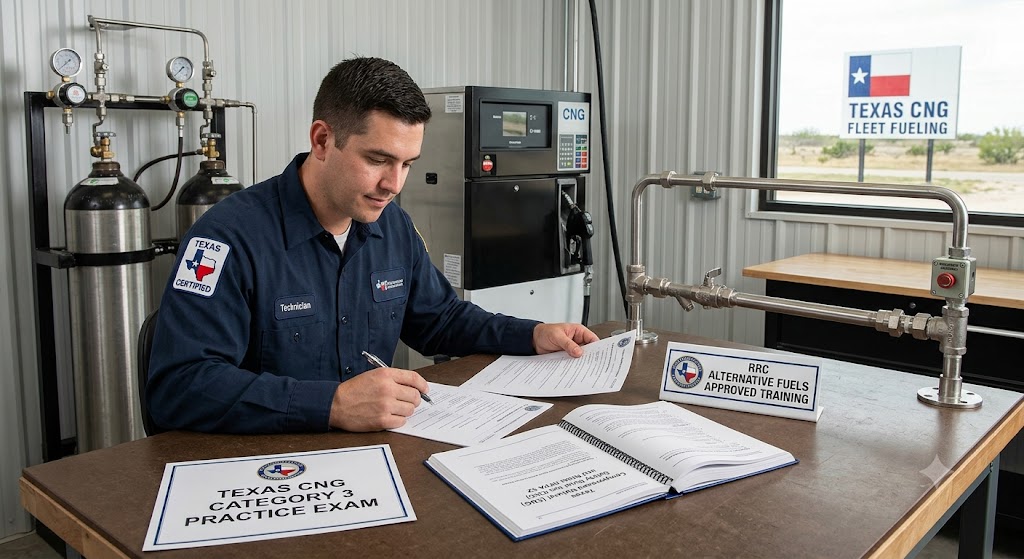
Additional Information
What the Course Entails and Exam Details
Preparing for the Category 3 license involves a deep dive into the regulatory framework and technical standards governing high-pressure natural gas systems.
A standard Category 3 course typically includes 4 to 16 hours of dedicated training. The training must cover the complex requirements of the Texas Administrative Code (TAC), specifically Title 16, Part 1, Chapter 13.
Core topics and skills covered in the curriculum include:
CNG Safety Principles: Comprehensive training on the physical properties of natural gas, ventilation, leak detection, and emergency response procedures.
Texas RRC Licensing Rules: Understanding the categories of license, insurance requirements, management vs. employee levels, and annual renewal processes.
Fuel System Components: Detailed study of ASME and DOT containers, pressure relief devices (PRDs), valves, regulators, and piping specifications (e.g., Schedule 80 steel, 6000 psi fittings).
Installation Standards: Mastering the NFPA 52 (Vehicular Natural Gas Fuel Systems Code) and Texas modifications for cascading storage, automated dispensers, and residential fueling facilities.
Facility Requirements: Critical rules regarding safety distances, fencing height and design, impact protection (guardrails), and electrical equipment classification in hazardous locations.
What to Expect in the Final Exam
The Railroad Commission of Texas requires individuals performing regulated CNG activities to pass a corresponding qualifying examination. It is vital to understand that there are two distinct examination levels for Category 3:
Management-Level Exam: This exam is designed for company representatives and managers. It is a closed-book exam, meaning you must rely solely on your knowledge. The registration fee is approximately $70 per person per attempt.
Employee-Level Exam: This exam is designed for technicians and general staff. It is an open-book exam. The RRC provides the relevant publications and rulebooks to be used during the test. The registration fee is approximately $40 per person per attempt.
Common Exam Features:
Format: The exam typically uses multiple-choice questions designed to test both theoretical knowledge and practical application of the regulations.
Passing Score: A passing score is generally 75% or 80%.
Location: Exams are administered by appointment only at the RRC Alternative Fuels Training Center in Austin, Texas, or they can be taken online via a proctored third-party vendor. Pre-registration is mandatory, usually at least seven business days before the scheduled date.
How to Study and Exam Centers
Preparation is the key to success. Here is a clear strategy to help you pass on your first attempt:
Use the RRC Resources: Your absolute primary study materials must be the official publications of the Railroad Commission of Texas, specifically the latest CNG Safety Rules (TAC Title 16, Part 1, Chapter 13) and the corresponding NFPA 52 standard.
Focus on Specific Numbers: The Category 3 exam is known for testing specific technical thresholds. Prioritize memorizing rules related to pressure (e.g., dot cylinder pressure limits, fitting ratings), distances (e.g., CNG equipment location relative to electrical lines, fencing setbacks), and installation geometry.
Take Approved Training: Enroll in an RRC-approved course. Providers like Cummins Clean Fuel Technologies offer a dedicated "Texas Railroad Commission Category 3 Employee License" course (Course TC01-0003) which is tailored to the exam objectives.
Practice, Practice, Practice: Seek out legitimate practice exams or question banks that mirror the structure and complexity of the Texas-specific test. Utilizing practice exams is proven to reduce anxiety and build testing stamina.
Register with the RRC: All scheduling and registration are handled through the Railroad Commission of Texas Alternative Fuels Safety department website. The physical testing center is located at 4044 Promontory Point, Austin, TX 78744. Ensure your license type and employee/management status are correct before paying fees.
Job Opportunities from the Course
A Texas CNG Category 3 certification signals advanced technical and regulatory expertise in the alternative fuels sector. This license unlocks numerous career paths within commercial fueling, fleet management, and energy infrastructure.
Job titles and career opportunities available to a Category 3 certified professional include:
CNG Retail Dealer/Fueling Station Manager
Alternative Fuels Fleet Operations Supervisor
Lead Compressed Natural Gas System Installer
Senior CNG Service and Maintenance Technician
Alternative Fuel Safety and Compliance Officer
Compressed Natural Gas Transport and Logistics Manager
Frequently Asked Questions
Reviews
5.0
Based on 0 reviews
Leave a Review
No reviews yet. Be the first to review!