
Texas Code of Criminal Procedure CCP Practice Exam
$69.00
- Buy to unlock unlimited access to all Quiz questions and Answers in this Quiz.
- After purchase you can print a PDF of the whole quiz at any point. The PDF will contain the questions and the correct answers.
About this Exam
The Texas Code of Criminal Procedure (CCP) is the foundational set of rules governing how criminal laws are enforced, investigated, and prosecuted within the state of Texas. It dictates everything from law enforcement’s authority for arrest and search to the rules of evidence and trial procedures. This Texas Code of Criminal Procedure CCP Practice Exam is a crucial study resource designed for anyone aiming to work in the Texas criminal justice system. Whether you are aspiring to become a Texas Police Officer, a Sheriff’s Deputy, a State Trooper, or a related legal professional, mastering the CCP is non-negotiable for success in your mandatory licensing exams. This practice test provides a realistic simulation to validate your knowledge, build confidence, and identify areas needing further study before taking official examinations like the TCOLE (Texas Commission on Law Enforcement) licensing test.
Ready to test your knowledge?
Buy Now to Access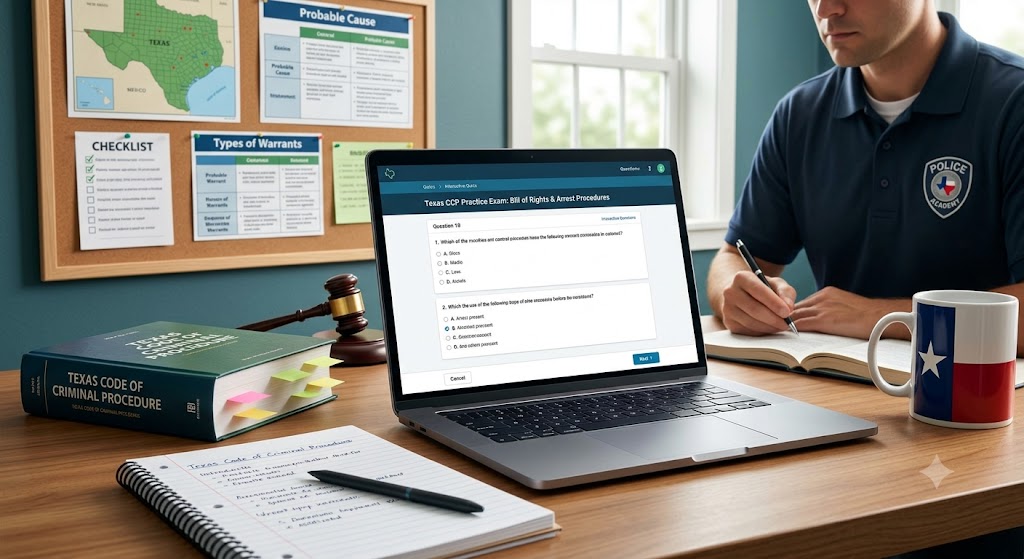
Additional Information
What the Course Entails and Exam Details
The CCP Practice Exam is comprehensive, mirroring the complexity of the official statutes. When utilizing this resource, you should expect in-depth coverage of the core procedural topics required for law enforcement certification in Texas. The material often aligns directly with the Texas Commission on Law Enforcement (TCOLE) objectives. Key areas and skills covered typically include:
Due Process and Bill of Rights (Chapter 1): Fundamental rights and protections for the accused.
Search and Seizure (Chapter 18): Rules for warrants, exceptions to warrant requirements, and the exclusionary rule.
Arrest (Chapters 14 & 15): The legal requirements for both warrantless arrests and arrests made with a warrant.
Bail and Commitment (Chapters 16 & 17): Procedures after arrest, including setting bail.
Grand Jury and Indictment (Chapters 19 & 21): The process of initiating formal charges.
Pretrial Proceedings: Rules regarding motions, discoveries, and pleas.
Trial and Verdict (Chapter 36): Conduct of the trial, presentation of evidence, and jury instructions.
Sentencing and Appeal: Procedural rules for punishing offenders and the appellate process.
Family Violence and Protective Orders (Chapter 5): Specific procedures for handling domestic incidents.
What to Expect in the Final Exam
The final Texas Code of Criminal Procedure CCP Practice Exam is designed to simulate the high-stakes testing environment students will encounter during official licensing or departmental exams. It typically adopts the standard format used by licensing bodies like TCOLE. Students should expect:
Format: Multiple-choice questions that require both knowledge recall and the application of legal principles to specific scenarios.
Simulation: Practice tests often feature scenario-based questions that ask, "Based on the CCP, what action should the officer take in this situation?" This tests practical understanding rather than just rote memorization.
Passing Score: While practice tests may vary, official Texas law enforcement licensing exams generally require a high minimum score, often around 70% to 80%, to achieve passing status. Achieving this on a practice exam is a strong indicator of readiness.
Time Limits: Practice tests usually provide a realistic time limit per section, mirroring the pacing required during the actual 3-to-4-hour official exams.
How to Study and Exam Centers
Actionable Study Strategies
Preparing for the CCP is demanding. Active engagement with the material is essential. Use these proven strategies for your Texas Code of Criminal Procedure CCP Practice Exam:
Break Down the Code: Do not try to memorize the whole CCP at once. Group studies by key chapters (e.g., focus an entire session only on Search and Seizure, Chapter 18).
Use Visual Tools and Mnemonics: Create charts summarizing when warrants are required versus exceptions. Use flashcards for key definitions (e.g., definitions of 'arrest,' 'probable cause,' 'reasonable suspicion').
Simulate Exam Conditions: Take practice exams in a quiet room with the timer running. This is the only way to gauge your true speed and stress tolerance.
Review Mistake Rationales: The value of a practice test lies in review. Do not just check your score. Analyze why you got a question wrong, locate the exact CCP statute that governs it, and understand the official rationale.
Exam Centers and Access
Because this is a practice tool, there is no physical, centralized "exam center" dedicated only to a practice test. The Texas Code of Criminal Procedure CCP Practice Exam is generally accessed in two ways:
Online Study Portals: Most modern study resources are offered via comprehensive online platforms or test prep providers (e.g., specialized police exam prep websites, university criminal justice portals). These offer immediate access, automatic grading, and detailed analytics.
Police Academies/Authorized Schools: Basic Peace Officer Courses (BPOC) offered at licensed academies throughout Texas will provide integrated practice tests within their curriculum.
If you are looking to take the actual licensing exam (TCOLE), you will do so at an authorized academic institution or an official TCOLE testing facility.
Job Opportunities from the Course
Successfully mastering the Texas CCP and validating that knowledge with a strong practice test performance is a critical milestone for many career paths in Texas. While the practice test itself isn't a certification, it is the primary tool used to secure the knowledge required for the following job opportunities:
Texas Police Officer (Municipal Departments)
Texas Sheriff's Deputy (County Departments)
Texas State Trooper (Department of Public Safety)
Texas Game Warden (Parks and Wildlife Department)
Texas Constable Deputy
Municipal Court Bailiff
Criminal Investigator/Detective (following field experience)
Texas Private Investigator (requires CCP knowledge for licensing)
Frequently Asked Questions
Reviews
5.0
Based on 0 reviews
Leave a Review
No reviews yet. Be the first to review!