
Texas Court Reporter Practice Exam Guide
$69.00
- Buy to unlock unlimited access to all Quiz questions and Answers in this Quiz.
- After purchase you can print a PDF of the whole quiz at any point. The PDF will contain the questions and the correct answers.
About this Exam
Welcome to your definitive guide to the Texas Court Reporter Certification, a critical step for anyone aspiring to capture the official record in the Lone Star State. This certification, administered by the Judicial Branch Certification Commission (JBCC), is designed to ensure that court reporters possess the skill and knowledge necessary to produce accurate, verbatim transcripts of legal proceedings. Whether you aim to work as an official court reporter within the Texas court system, capturing testimony in trials and hearings, or as a freelance reporter, covering depositions, arbitrations, and administrative meetings, passing the Texas Certified Shorthand Reporter (CSR) exam is mandatory. This practice guide will help you understand the exam's comprehensive nature and provide the tools you need to succeed.
Ready to test your knowledge?
Buy Now to Access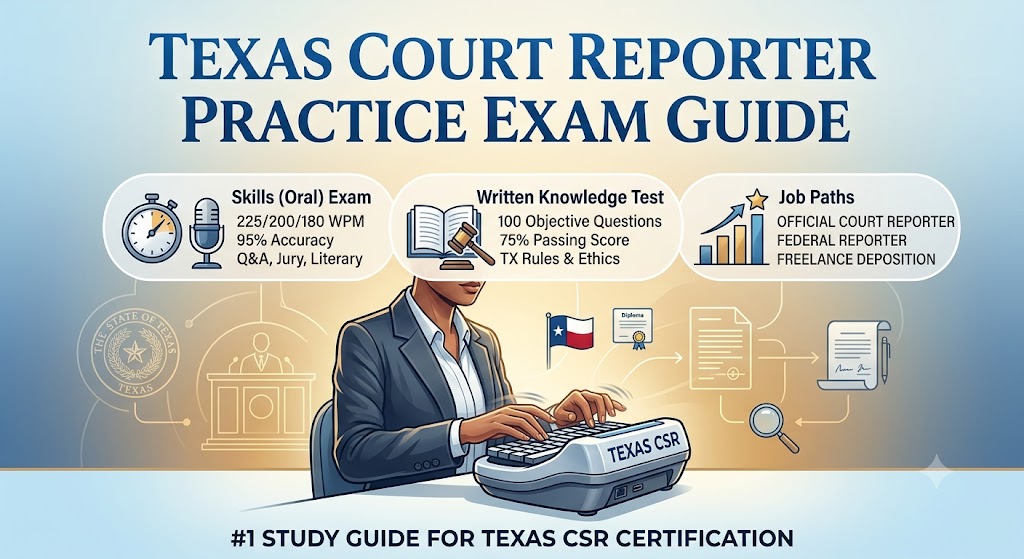
Additional Information
What the Course Entails and Exam Details
Preparing for the Texas CSR exam entails a rigorous program that integrates technical skill with academic knowledge. The core course of study for aspiring reporters focuses on mastering machine shorthand, a method that uses a specialized keyboard to input information at incredibly high speeds. You will dive into the nuances of stenography, developing both speed and accuracy. Complementing this technical training, you will study essential academic subjects: English grammar, spelling, punctuation, and medical and legal terminology. A deep understanding of court reporting procedures, ethics, and the specific laws of Texas, such as the Texas Rules of Civil Procedure and Texas Rules of Appellate Procedure, is paramount. This robust foundation ensures you are prepared to manage a real courtroom environment and produce reliable transcripts.
What to Expect in the Final Exam
The Texas Certified Shorthand Reporter Examination is not a single test but a two-part evaluation that thoroughly assesses your proficiency. It is essential to note that the exam must be passed in its entirety; you cannot carry over passing scores from one leg to another. Here is a breakdown of what to expect:
Part A: The Skills (Oral) Exam
This practical portion demands exceptional focus and technical dexterity. You will be required to take down a multi-segment dictation, with minimum accuracy requirements of 95% for each segment. The segments are structured as follows:
Two-Voice Question and Answer (Q&A): Dictation at a speed of 225 words per minute.
Jury Charge: Dictation at a speed of 200 words per minute.
Literary Material: Dictation at a speed of 180 words per minute.
After the dictation, you will have three hours to complete the transcription. A dictionary is permitted during this skills transcription, allowing you to verify spellings and terminology.
Part B: The Written Knowledge Test
This objective, closed-book exam consists of multiple-choice questions touching upon the theoretical and administrative aspects of court reporting. To pass, you must achieve a minimum score of 75%. The test covers:
Texas Rules and Procedures: Including specifics on formatting transcripts, deadlines, and the duties of official and freelance reporters.
Elementary Court Reporting: General knowledge of the field.
Grammar, Spelling, and Punctuation: Ensuring you can produce high-quality, professional records.
Unlike the skills portion, you may not use a dictionary during the Written Knowledge Test.
How to Study and Exam Centers
Success on the Texas CSR exam is the product of dedicated and strategic preparation. It requires a combination of high-intensity speed building and targeted academic review.
Study Strategies
Speed Building: This is the most crucial skill. Utilize a tiered approach: practice dictation with varying speeds, focusing on increasing your comfort level beyond the required words per minute. Consistent, daily practice on your steno machine is non-negotiable.
Academic Drills: Dedicate significant time to flashcards and practice quizzes for legal terminology, medical terms, and JBCC rules and procedures. Mock exams can simulate the pressure of the test.
Focus on Accuracy: In both speed and academic work, accuracy is king. Use software and peer review to pinpoint and correct recurring errors in your writing and knowledge base.
Exam Centers and Registration
The Texas CSR exam is administered by the Texas Court Reporters Association (TCRA) under the direction of the JBCC. The written knowledge test is often offered online during specific windows. To take the exam, you must submit a completed application for exam registration to the TCRA, along with all required fees and documentation, including fingerprinting for a background check. Exams are held several times a year at designated locations throughout Texas. You will select a specific time slot for testing after your application is processed.
Job Opportunities from the Course
Upon achieving your Texas Certified Shorthand Reporter license, you open the door to a secure and in-demand career. Below are the primary job opportunities and career paths this certification unlocks:
Official Court Reporter:
Positions within Texas Supreme Court, Courts of Appeals, District Courts, County Courts, and Statutory Probate Courts.
Federal Court Reporter:
Positions within the United States District Courts located in Texas.
Freelance Deposition Reporter:
Independent contractors or employees of reporting firms covering depositions, hearings, and arbitrations for law firms.
Realtime CART Provider (Communication Access Realtime Translation):
Providing immediate translation of speech into text for individuals who are deaf or hard of hearing in diverse settings (classrooms, conventions).
Realtime Broadcast Captioner:
Providing live captioning for television broadcasts, including news and sports events.
Scopist or Proofreader:
Specialized roles supporting certified reporters in the preparation and final review of transcripts (can be a stepping stone or a full career).
Frequently Asked Questions
Reviews
5.0
Based on 0 reviews
Leave a Review
No reviews yet. Be the first to review!