
Texas Crammer Licensing Practice Exam
$69.00
- Buy to unlock unlimited access to all Quiz questions and Answers in this Quiz.
- After purchase you can print a PDF of the whole quiz at any point. The PDF will contain the questions and the correct answers.
About this Exam
The "Texas Crammer Practice Exam" is an intensive, simulated assessment tool designed as the ultimate review for candidates preparing for official Texas state licensing exams. It is not a state-mandated test itself, but rather a robust educational resource that mirrors the content, format, difficulty, and time constraints of high-stakes licensing exams.
These practice exams are specifically engineered for individuals who have completed their required pre-licensing education (e.g., the 180 hours for Texas Real Estate Sales Agent or required hours for various Insurance lines) and are now focused on passing the final state exam on their first attempt. They provide a concentrated environment for reinforcing core concepts, identifying weak areas, and building crucial test-taking stamina.
By using a Texas Crammer, you gain a competitive advantage by familiarizing yourself with the exact style of multiple-choice questions you will encounter, allowing you to fine-tune your knowledge and eliminate anxiety. It is the gold standard for final exam preparation.
Ready to test your knowledge?
Buy Now to Access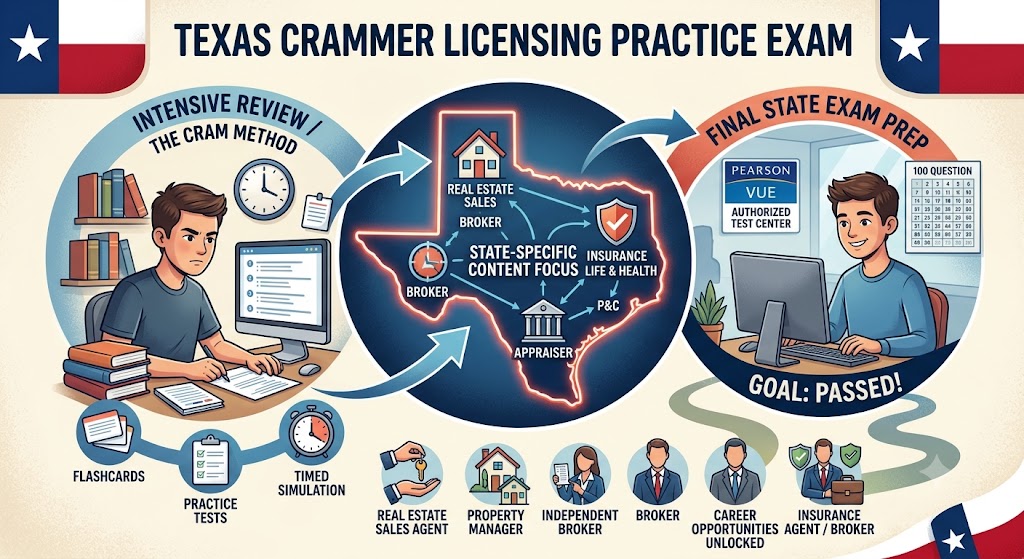
Additional Information
What the Course Entails and Exam Details
While the "Crammer" title often refers to the intensive self-study or a short live webinar, the content it covers directly aligns with the official syllabus for the specific license you seek. Because these tools serve multiple fields, the details vary, with the most common applications being for Real Estate and Insurance licenses.
For a Texas Real Estate license, the Crammer practice will simulate the 125-question state exam, which is split into two sections: National Real Estate Principles and Practices (85 questions) and Texas-Specific Law and Commission Rules (40 questions). A typical practice tool will provide vast banks of multiple-choice questions covering all required education topics, including:
Real Estate Law and Contracts: Understanding the Texas Real Estate License Act (TRELA), promulgated contract forms, addenda, and financing concepts.
Agency and Brokerage: The relationships between agents, brokers, clients, and customers, and fiduciary duties in Texas.
Property Ownership and Valuation: Appraisal principles, highest and best use, and methods of holding title.
Real Estate Finance and Math: Calculating commissions, loan-to-value ratios, and other critical financial computations.
For a Texas Insurance license (e.g., Life & Health, or Property & Casualty), the Crammer will mimic the structure of the specific exam, which is often around 150 multiple-choice questions, covering:
General Insurance Principles: The concept of risk, contract law, and policy structures.
State-Specific Regulations: Rules from the Texas Department of Insurance (TDI), licensing requirements, and marketing practices unique to Texas.
Product Knowledge: Details of specific policies, riders, and provisions relevant to your chosen line (e.g., life insurance types, health plan operations, homeowners and auto coverage).
What to Expect in the Final Exam
When you take the actual state licensing exam, you can expect an environment that mirrors the practice of the Texas Crammer.
Format: The final exams for both Texas Real Estate and Insurance are 100% computer-based, multiple-choice tests. You will have four answer choices for each question, and there are no essays or practical demonstrations.
Passing Score: The Texas Real Estate Commission (TREC) requires a minimum passing score of 70% on both the National and State portions separately. For Texas Insurance exams, the standard is also a 70% score, calculated on the total number of scored questions. (Both exams contain non-scored "pretest" questions).
Time Limits: These are rigorous, timed assessments. The Texas Real Estate Salesperson exam allows 4 hours to complete 125 questions. Texas Insurance exams (like Life & Health) are generally 2.5 hours long for 150 questions. Effective time management, practiced through a Crammer, is essential.
Rules: The exams are closed-book and administered in a secure environment. You must provide valid identification and cannot bring outside materials, such as cell phones or notes, into the testing area. Small handheld calculators (for math) are typically provided at the test site.
How to Study and Exam Centers
Successfully utilizing a Texas Crammer requires a strategic approach. Here are actionable steps to maximize your preparation:
Simulate Exam Conditions: Do not use the Crammer as a casual study tool. Instead, set aside the required time (e.g., 2.5 or 4 hours) in a quiet, distraction-free space and take a full practice exam, adhering to the time limit. This builds the exact stamina and focus you will need on exam day.
Focus on Explanations, Not Just Scores: After each practice exam, your Crammer tool will provide a diagnostic report and, crucially, explanations for every answer (both correct and incorrect). This is the single most valuable step. Study why the correct answer is right and why the other options are wrong to solidify the concept.
Identify and Attack Weakness: Use the diagnostic reports to target specific topic areas where your score is lower. Re-read the corresponding chapters from your pre-licensing education materials, use flashcards, or seek additional resources to bridge these gaps.
Practice Real Estate/Insurance Math: If you are preparing for the real estate exam, dedicate focused time to practicing the various financial calculations, using the calculator provided by your practice tool. For insurance, focus on understanding key definitions, limits, and timeframes.
Schedule the Official Exam: Once you are consistently scoring above 80-85% on full, timed practice exams, you are ready to take the official state test.
Exam Centers: The final licensing exams in Texas are administered through approved professional testing services.
For Real Estate, Insurance, and other state licenses, the exam provider is typically Pearson VUE, a global leader in secure, high-stakes testing. You must create an account on their website, receive your exam eligibility (from TREC or TDI), and schedule your specific exam date and time at one of their authorized physical testing centers located throughout Texas. These facilities ensure security and a controlled environment. A limited number of professional or trade schools may also be authorized for testing, but Pearson VUE is the most common.
Job Opportunities from the Course
Passing a Texas state licensing exam unlocks a wide range of career paths in dynamic industries. Here are specific job opportunities and career growth potential for both tracks.
Real Estate Licensure:
Real Estate Sales Agent: This is the most common entry point, allowing you to represent buyers and sellers in residential, commercial, or land transactions. You can work as an independent contractor under a sponsoring broker.
Real Estate Broker: After gaining a specific amount of experience as a salesperson and completing additional education, you can become a broker, enabling you to manage other agents, open your own brokerage, or operate as an associate broker.
Property Manager: For licensed agents or brokers, property management involves overseeing the daily operations, leasing, and maintenance of residential or commercial properties.
Real Estate Appraiser: Appraisers provide independent assessments of property value. While a separate license, a real estate sales background offers strong foundation.
Real Estate Developer/Investor: Leveraging market knowledge and networking, licensed individuals can find success in development, fixing and flipping, or holding rental properties.
Insurance Licensure:
Insurance Agent (Captive or Independent): Agents sell various insurance policies (life, health, property, casualty, auto, etc.) directly to consumers or businesses. Captive agents work for one carrier, while independent agents represent multiple.
Insurance Broker: Brokers act as intermediaries between clients (often businesses) and multiple insurance companies to find the best coverage options. This usually requires advanced experience and licensure.
Claims Adjuster: While a distinct license, an insurance background provides a foundation for assessing claims and determining settlement amounts on behalf of the insurer.
Underwriter: Underwriters evaluate risks, determine insurability, and set policy terms and premiums.
Frequently Asked Questions
Reviews
5.0
Based on 0 reviews
Leave a Review
No reviews yet. Be the first to review!