
Texas DPS Learner’s Permit Practice Exam
$69.00
- Buy to unlock unlimited access to all Quiz questions and Answers in this Quiz.
- After purchase you can print a PDF of the whole quiz at any point. The PDF will contain the questions and the correct answers.
About this Exam
Welcome to the ultimate starting line for your journey on the Texas roads! The Texas Department of Public Safety (DPS) Learner’s Permit, commonly known as a Class C Instruction Permit, is the essential first step for any teen (15-17) or new adult driver (18+) who wants to learn how to drive safely and legally. This permit is not just a piece of paper; it's your license to practice driving under the direct supervision of a licensed adult. Our study guide is specifically designed to help you confidently master the material and ace the official knowledge test, turning that 'Practice' into 'Pass'. Whether you are a student eager for independence or an adult embracing new skills, this guide will illuminate your path to success.
Ready to test your knowledge?
Buy Now to Access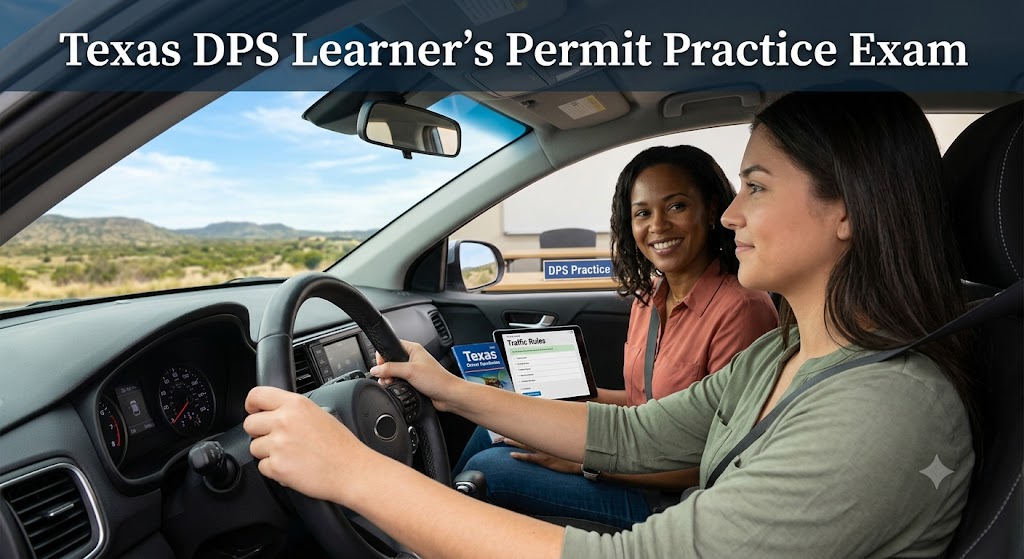
Additional Information
What the Course Entails and Exam Details
The core of the Texas DPS Learner’s Permit exam is based entirely on the information provided in the Texas Driver Handbook. You must thorough review this guide to prepare. The exam evaluates your understanding of the essential rules of the road that keep everyone safe. Key areas covered include:
Texas Traffic Laws and Regulations: Comprehensive knowledge of speed limits, right-of-way rules at intersections, turning procedures, stopping and yielding requirements, and appropriate lane usage.
Safe Driving Practices: Understanding the dangers of distracted driving (texting, phone use), impaired driving (alcohol and drugs), fatigue, and effective defensive driving techniques.
Road Signs, Signals, and Markings: Instant recognition and accurate interpretation of all regulatory, warning, guide, and informational signs, as well as traffic signals and pavement markings.
Vehicle Control and Procedures: Safe vehicle operations, including proper signaling, following distances, parking maneuvers, and responding to emergency vehicles or school buses.
Texas-Specific Laws: Awareness of unique Texas driving laws, such as the Move Over/Slow Down law and Implied Consent.
What to Expect in the Final Exam
While exact formats may vary slightly depending on whether you take the test during a physical driver education course or at a DPS office, you can generally anticipate the following:
Exam Format: The knowledge test is almost universally administered via computer. The structure consists of multiple-choice questions designed to assess your understanding, not just your memorization.
Number of Questions: You can typically expect around 30 to 40 questions in the complete knowledge exam.
Passing Score: To succeed, you must achieve a score of at least 70%. This means you need to correctly answer a minimum of 21 out of 30, or 28 out of 40 questions, depending on the exact test size.
Time Limits: There is generally no specific time limit for the computerized test itself within the appointment window, allowing you the opportunity to read each question and answer carefully. Plan for about 45 minutes to one hour for the appointment process.
Specific Rules: This is a closed-book exam. No handbooks, notes, or outside electronic assistance are permitted during testing. Focus and concentration are key. You will be monitored.
How to Study and Exam Centers
Your preparation strategy is the driving force behind your success. Follow these actionable steps to ensure you are ready for the main event:
Read the Texas Driver Handbook (The Bible): This cannot be overstated. Read the entire handbook at least once, and then revisit key chapters. Do not rely only on practice tests. The official test draws from all areas of the handbook.
Use Practice Exams Consistently: Use our comprehensive practice exams to simulate the testing environment. This helps you become comfortable with question wording and identify areas where you need further review. Look for detailed explanations of why an answer is correct.
Focus on Signs and Markings: Dedicate specific study sessions to visual aids. Flashcards are highly effective for mastering the dozens of traffic signs and road markings.
Create Tricky Question Review: Maintain a list of concepts and rules you find difficult (e.g., specific right-of-way scenarios) and review them frequently.
Don't Cram: Study consistently over several days or weeks leading up to your exam. A well-rested mind performs significantly better.
Where and How to Take the Exam:
In Texas, you have specific options based on your age and the type of driver education you choose:
Texas DPS Driver License Office: For many, the standard method is to schedule an appointment at your local DPS Driver License Office. You must bring the required documents, which typically include: proof of identity, Social Security number, U.S. citizenship or lawful presence, proof of Texas residency, and (for teens) verification of enrollment in high school. You will take the knowledge test in-person on a DPS computer.
Authorized Driver Education (Driver Ed) Providers (Ages 15-17): Teens must complete a driver education course. If you are enrolled in a public school driving program, a commercial driving school, or a parent-taught program, you may be able to take the knowledge test through that provider after completing the required coursework.
Approved Online Courses (Ages 18-24 and Adults): Adults under 25 are required to complete a 6-hour adult driver education course. Many of these approved online courses include the official DPS knowledge test as the final component. Once you pass, you will receive a certificate (ADE-1317) that you can present to the DPS when applying for your permit.
Job Opportunities from the Course
Obtaining a Texas Learner’s Permit is the essential prerequisite that unlocks the subsequent full Class C Driver License. This progression is not just about mobility; it's a vital step toward opening up dozens of career paths and jobs where independent transportation is a core requirement in the state of Texas.
Once you have your permit and subsequently your provisional or full license, you can pursue careers such as:
Delivery Driver (Local, restaurant, retail)
Rideshare and Ridesourcing Driver (after obtaining full license)
Construction and Skilled Trades Apprentice (e.g., HVAC, Electrical, Plumbing)
Medical Courier and Field Technician
Security Guard or Patrol Officer
Valet Parking Attendant
Pest Control or Landscaping Technician
Field Service Representative
Real Estate Agent and Appraiser
Route Sales and Distribution Worker
Truck Driving (starting with Class C before Class A CDL)
Personal or Executive Driver
Home Health Aide requiring patient transportation
And countless roles requiring travel and mobility throughout Texas.
Frequently Asked Questions
Reviews
5.0
Based on 0 reviews
Leave a Review
No reviews yet. Be the first to review!