
Texas Food Safety Managers Practice Test
$69.00
- Buy to unlock unlimited access to all Quiz questions and Answers in this Quiz.
- After purchase you can print a PDF of the whole quiz at any point. The PDF will contain the questions and the correct answers.
About this Exam
The Texas Food Safety Manager Certification is a mandatory requirement for most food service establishments in the state of Texas. It is designed to ensure that at least one person in a leadership or supervisory role possesses an in-depth understanding of food safety principles. This includes understanding foodborne illnesses, their causes, and the specific operational procedures required to prevent them.
This certification is essential for a wide range of professionals, including restaurant managers, kitchen managers, food truck operators, catering supervisors, school nutrition directors, and healthcare food service leaders. By earning this credential, you validate your ability to protect public health and maintain a compliant, safe food service environment. The certification is valid for 5 years from the date of issue.
Ready to test your knowledge?
Buy Now to Access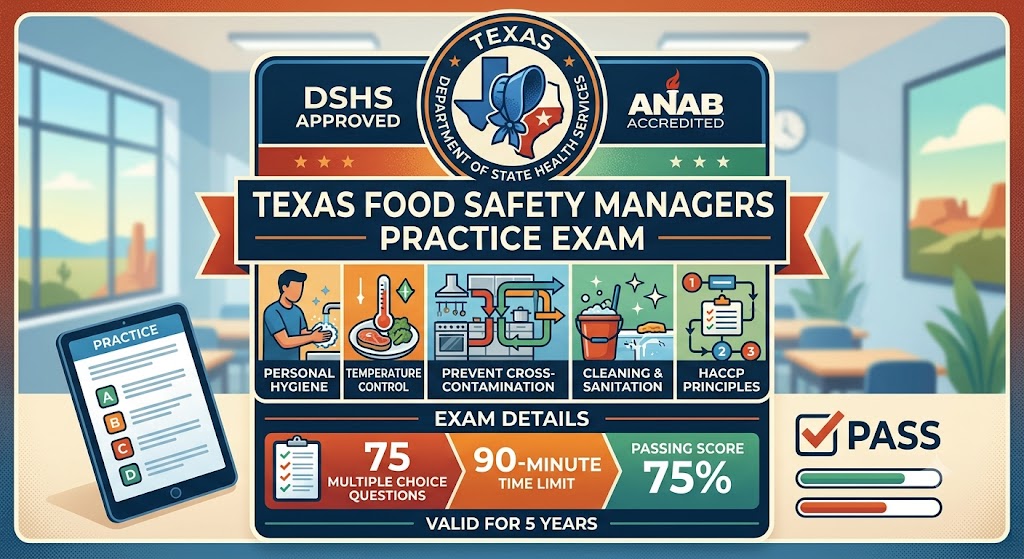
Additional Information
What the Course
Entails and Exam Details
A Food Safety Manager course is a comprehensive program that
covers critical topics for operational safety. While you are not required to
take a formal course before the exam, it is highly recommended to build a
strong foundation of knowledge.
The core topics you must master, and which the exam will
evaluate, include:
- Foodborne
Illness Prevention: Identifying major pathogens (bacteria, viruses,
parasites, fungi) and understanding the "Big 6" illnesses.
- Time
and Temperature Controls: Understanding the Temperature Danger Zone
(41°F - 135°F), proper cooling, reheating, and hot-holding procedures.
- Personal
Hygiene: Establishing rigorous policies for employee health,
handwashing, and preventing contamination.
- Preventing
Cross-Contamination: Implementing operational flows to separate raw
and ready-to-eat foods.
- Cleaning
and Sanitation: Mastering the five steps of cleaning, identifying
appropriate sanitizers, and maintaining equipment.
- HACCP
Principles: Understanding how to develop and implement a Hazard
Analysis and Critical Control Point system.
- Facility
Management: Designing a safe flow of food, managing pests, and
ensuring safe water and sewage systems.
What to Expect in
the Final Exam
The final certification exam in Texas can be either a
state-specific exam or a nationally recognized one. Both have similar
structures but important distinctions.
A national-level exam, accredited by the ANAB-CFP (ANSI
National Accreditation Board - Conference for Food Protection), typically
consists of 75-80 multiple-choice questions. You are generally given 90
minutes to complete it. The passing score is a scaled score, commonly
translated to a minimum of 75%. These national certifications, such as
ServSafe, National Registry of Food Safety Professionals (NRFSP), or
360training/Learn2Serve, have full reciprocity across all of Texas and
most of the United States.
Alternatively, some providers offer a Texas DSHS-Approved
(Texas Department of State Health Services) exam that is valid only
within the state of Texas. These can sometimes be taken 100% online
without a proctor. They have a similar format but do not offer national
recognition. Be sure to confirm with your employer or local health department
which type of certification is required for your role.
How to Study and
Exam Centers
Preparation is key. You cannot rely on common sense alone;
you must understand specific temperatures, times, and rules.
Here are actionable strategies for your study plan:
Use Practice Exams: This
is the absolute best way to prepare. Take a Texas Food Safety Managers
Practice Test multiple times. It exposes you to the types of questions,
difficulty level, and time pressure of the actual exam.
Focus on Weak Areas:
Review your practice test results to identify knowledge gaps. Re-study the core
chapters in your study guide or course material.
Create Flashcards:
Memorize critical numbers, such as minimum internal cooking temperatures (e.g.,
165°F for poultry, 155°F for ground meat, 145°F for whole-muscle meat).
Understand "Why":
Don't just memorize rules; understand why they exist (e.g., why 135°F is
the hot-holding minimum).
Regarding Exam Centers:
- National
Exams (ANAB-CFP): These must be proctored. You can take them in
person at authorized physical centers like Pearson VUE, Prometric,
or through private proctors. Alternatively, many providers now offer remote
proctoring, allowing you to take the national exam online from your
home or office while being monitored via a webcam.
- Texas
State-Only Exams (DSHS-Approved): These are often offered as a 100%
online, unproctored experience through the provider's own portal.
Job Opportunities
from the Course
A Texas Food Safety Manager Certification is a
career-unlocking credential that is universally recognized by employers in the
hospitality and food service sectors. It demonstrates your commitment to safety
and leadership.
Here is a clear list of job titles and career paths that
require or are significantly enhanced by this certification in Texas:
- Restaurant
General Manager
- Kitchen
Manager
- Executive
Chef / Sous Chef
- Food
and Beverage Director
- Catering
Manager
- Food
Truck Owner / Operator
- School
Nutrition Services Director / Manager
- Healthcare
Food Service Director / Manager
- Hotel
Food & Beverage Manager
- Grocery
Store Department Manager (e.g., Deli, Bakery)
- Concession
Stand Supervisor
- Assisted
Living Food Service Manager
By focusing your studies and practicing with resources like
a dedicated practice exam, you are taking a definitive step towards a safer
operation and a more successful career in the food service industry.
Frequently Asked Questions
Reviews
5.0
Based on 0 reviews
Leave a Review
No reviews yet. Be the first to review!