
Texas Home Inspector Practice Exam
$69.00
- Buy to unlock unlimited access to all Quiz questions and Answers in this Quiz.
- After purchase you can print a PDF of the whole quiz at any point. The PDF will contain the questions and the correct answers.
About this Exam
Embarking on a career as a home inspector in Texas is a promising and essential path within the real estate industry. This licensure, regulated by the Texas Real Estate Commission (TREC), ensures that individuals possess the detailed knowledge and practical skills necessary to thoroughly assess the condition of residential properties. Designed for aspiring professionals, this exam is the gateway to becoming a vital part of property transactions in the Lone Star State. It ensures that consumers and real estate agents can rely on trusted, competent inspectors to provide a detailed and objective report on a home's structure and systems. The practice exam and subsequent final state test assess your understanding of diverse inspection topics, ensuring you are well-equipped for this significant responsibility. Proper preparation is key, and utilization of comprehensive resources, including a robust Texas home inspector practice exam, is highly recommended.
Ready to test your knowledge?
Buy Now to Access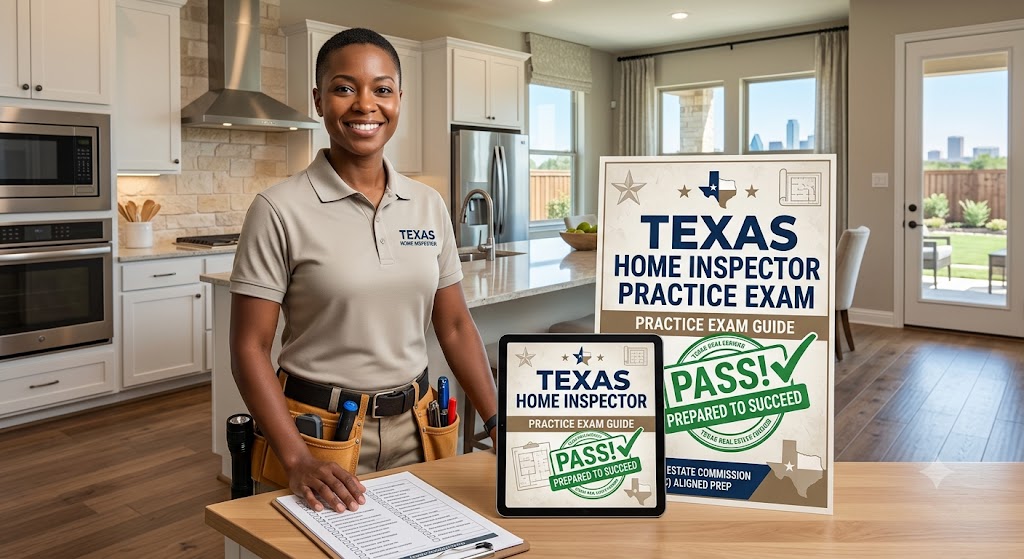
Additional Information
What the Course Entails and Exam Details
To qualify for licensure and the subsequent exams,
prospective Texas home inspectors must first complete extensive qualifying
education from a TREC-approved provider. The specific hour requirements depend
on the level of license sought (Apprentice, Real Estate Inspector, or
Professional Real Estate Inspector), often totaling 154 hours or more. This
education program covers critical modules, including National portion
fundamentals and extensive State-specific requirements:
- Property
and Building Inspection: Multiple modules covering structure, systems
(electrical, plumbing, HVAC, mechanical), exterior components, roof, and
appliances.
- Analysis
of Findings and Reporting: Techniques for assessing inspection data
and constructing clear, accurate reports for clients according to industry
standards.
- Texas
Law and Standards of Practice (SOP): In-depth study of specific Texas
legislation and the official TREC Standards of Practice that dictate how
an inspection must be conducted in the state.
- Business
Operations and Professional Responsibilities: Understanding the
ethical, legal, and operational aspects of running a professional
inspection business in Texas.
- Texas
Practicum: Essential hands-on field experience, often under the
guidance of a licensed inspector, to apply classroom knowledge in
real-world scenarios.
The subsequent official licensing process involves two
primary exams, both of which must be passed: a national exam (often the
National Home Inspector Exam or an equivalent, covering general industry
knowledge) and a separate, rigorous Texas state-specific exam. Rigorous use of
a dedicated Texas home inspector practice exam is crucial to master both areas
and prepare for the specific challenges of each. The practice exams will mirror
these essential areas, testing your recall and application of knowledge across
all these critical domains.
What to Expect in the Final Exam
While the exact structure can vary, the official licensure
exams for Texas home inspectors are typically administered by a test provider
like Pearson VUE, which works with TREC-approved centers. Here is what you can
generally expect:
- Format:
The exams are typically multiple-choice, taken on a computer. Both the
National and Texas State exams are separate tests.
- National
Exam: This comprehensive test can feature approximately 200
multiple-choice questions and has a significant time limit, often around 4
hours. It covers general inspection knowledge applicable across the
country, though some specific provincial requirements could be included,
and pre-test questions are often present.
- Texas
State Exam: This exam is dedicated entirely to Texas specific laws,
regulations, and the TREC Standards of Practice. It consists of fewer
questions (around 30-40, for example), with a correspondingly shorter time
limit, often around 45-60 minutes, focusing intensely on the state's
unique requirements. The practice exam you utilize will have specific
modules dedicated to this content.
- Passing
Scores: Both the National and State exams must be passed individually.
Passing scores are set by the exam administrators and TREC, often
requiring a strong, scaled score (National) and a specific percentage or
scaled score (State), indicating mastery rather than just a minimum
requirement.
- Rules
and Regulations: Strict identification, security protocols, and other
rules will apply at the official testing center. Calculators and reference
materials are usually not permitted. Results are often provided
immediately or within a short period after completion.
Taking numerous, timed practice exams that simulate these
distinct formats is one of the most effective strategies to build stamina,
manage time effectively, and identify specific areas for further study. The
practice exam will typically provide feedback and explanations, allowing you to
learn from each question.
How to Study and Exam Centers
Select a TREC-Approved
Education Provider: Enroll in a rigorous, TREC-approved qualifying
education program that includes all required coursework and the practicum. This
fundamental step ensures your knowledge base aligns with state standards.
Master the Standards of
Practice: Deeply study the official Texas Standards of Practice (SOP). This
document is central to the state exam. Ensure your studies cover the required
core courses for Texas Law and SOP.
Utilize Comprehensive Study
Guides and Materials: Leverage the textbooks, course materials, and study
guides provided by your education provider and other reliable sources. Pay
close attention to national codes and best practices.
Integrate Texas Home Inspector
Practice Exams: Incorporate varied and numerous practice tests throughout
your study plan. Use these to:
- Familiarize
yourself with the multiple-choice format and question styles.
- Take
timed exams to improve your speed and endurance for both portions.
- Pinpoint
weak areas and focus further study there.
- Review
explanations for all questions, especially those you answered
incorrectly, to solidify understanding.
- Aim
for practice scores significantly above the required passing threshold to
build confidence.
Simulate Test Conditions:
Take practice exams under conditions that match the actual test day as closely
as possible: quiet room, no notes, strictly adhering to the time limit.
Official Texas Real Estate
Commission (TREC) Resources: Check the TREC website regularly for the
latest information on exams, policies, and study materials.
Identify and Register at
Official Exam Centers: Once approved by TREC to test, you will register
through their authorized exam provider (e.g., Pearson VUE). You will be able to
search for locations throughout Texas and other authorized physical testing
centers that work with Pearson VUE. Ensure you are familiar with the specific
instructions and acceptable identification for test day. The practice exam
itself is typically available online from multiple educational and test prep
providers, offering the convenience of flexible, on-demand practice.
Remember that thorough preparation, consistent effort, and
multiple attempts at a realistic Texas home inspector practice exam are key to
success on the official licensing test and launching your successful career.
Job Opportunities from the Course
A Texas Home Inspector license unlocks various career paths
within the real estate and building industries in Texas:
- Professional
Home Inspector: The most common path, working independently or for a
larger firm, performing residential inspections.
- Real
Estate Inspector: A mid-level licensure often requiring supervision,
involved in residential property evaluations.
- Municipal
Building Inspector: Working for local or county governments to ensure
construction and existing properties meet building codes.
- Property
Manager Inspection Role: Specializing in assessing the condition and
maintenance needs of rental properties.
- Construction
Quality Control Inspector: Working with builders to inspect homes at
various stages of construction.
- Specialized
Home Inspection Services: Offering niche inspections like commercial
property assessments, energy audits, or specialized system checks (with
additional training and certifications where applicable).
- Expert
Witness: Experienced inspectors may be called upon to provide expert
testimony in property condition and standard-of-practice legal matters.
This licensure not only allows for a range of exciting
career paths but also provides a vital service within the dynamic Texas real
estate market, helping home buyers make informed decisions and contributing to
property safety and stability in the state. Prepare well, master your content,
practice with dedication using a specific Texas home inspector practice exam,
and step forward with confidence into your rewarding career. Good luck!
Frequently Asked Questions
Reviews
5.0
Based on 0 reviews
Leave a Review
No reviews yet. Be the first to review!