
Texas Massage Therapy State Laws Practice Test
$69.00
- Buy to unlock unlimited access to all Quiz questions and Answers in this Quiz.
- After purchase you can print a PDF of the whole quiz at any point. The PDF will contain the questions and the correct answers.
About this Exam
The Texas Massage Therapy State Laws Exam is a specialized jurisprudence assessment designed specifically for individuals seeking a massage therapy license within the state of Texas. It is a mandatory step in the licensure process, ensuring that every practicing therapist possesses a thorough understanding of the legal and ethical framework governing their profession. This exam is not merely a formality; it serves as a critical safeguard for public health and safety.
This evaluation is designed for aspiring massage therapists who have completed their initial education and are applying for their state license. Additionally, it may be required for therapists relocating from other states (endorsement applicants) or those renewing a license after an extended period. By passing this exam, you demonstrate to the state that you are not only skilled in the art and science of massage but are also fully aware of the legal responsibilities that accompany your professional title.
Ready to test your knowledge?
Buy Now to Access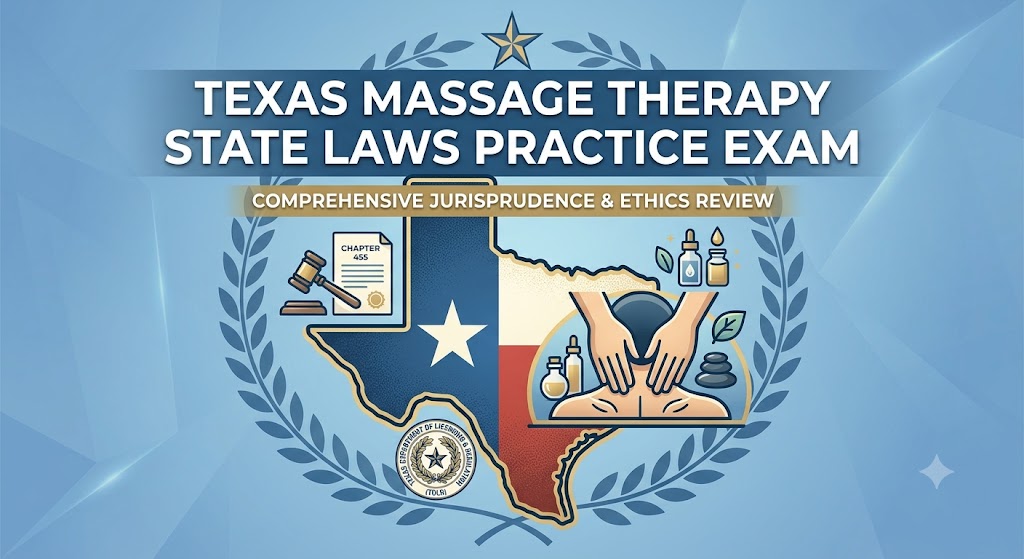
Additional Information
What the Course Entails and Exam Details
This examination focuses exclusively on Texas-specific
legislation, regulations, and administrative codes. It does not cover anatomy,
physiology, or massage techniques themselves; rather, it assesses your
comprehension of the legal parameters within which you will practice.
The core areas of the syllabus include, but are not limited
to:
- Texas
Occupations Code Chapter 455: The statutory definition and regulation
of massage therapy.
- The
Texas Massage Therapy Administrative Rules (Title 16, Texas Administrative
Code, Chapter 117): Specific rules governing licensing requirements,
curriculum standards, continuing education, and general practice
constraints.
- Ethical
Standards and Standards of Conduct: Detailed requirements regarding
professionalism, appropriate practitioner-client boundaries, draping
protocols, and standard operating procedures for massage establishments.
- Regulatory
Framework of TDLR: Understanding the role of the Texas Department of
Licensing and Regulation (TDLR) and its oversight functions.
- License
Maintenance: Rules surrounding biennial license renewal, mandatory
continuing education (CE) requirements, and processes for notifying the
state of address or name changes.
- Disciplinary
Actions: Legal definitions of misconduct, prohibited practices (such
as sexual misconduct or practicing while impaired), the complaints
process, and the potential administrative penalties or suspensions
resulting from violations.
What to Expect in the Final Exam
While the exact structure can be updated by the state, the
Texas Massage Therapy State Laws Exam generally adheres to standard
computer-based testing conventions.
- Format:
The exam typically consists of multiple-choice questions (often around 30
to 50 questions, though this varies). Each question presents a scenario, a
regulatory statement, or a direct knowledge check based on the Texas
rules.
- Time
Limit: You will be provided with a set time limit, typically 60 to 90
minutes. While this might seem brief, the material is specific, and
questions are often straightforward if you have studied the definitions.
- Passing
Score: The required passing score is generally 70%. Your score is
usually calculated instantly upon completion of the exam.
- Open
Book Nature: Unlike typical exams, this jurisprudence exam is often
structured as an open-book assessment. This is a critical detail.
This means you may be permitted to access copies of the relevant statutes
and rules during the exam. Note: You must confirm the official
guidelines provided by the TDLR or the testing agency (like PSI) before
your test date to verify current open-book policies.
- Scenarios
and Interpretation: A significant portion of the test will present
scenarios. For example, you may be asked how a therapist should legally
handle a specific request, or whether a specific advertising claim
violates the regulatory code. Your success depends on knowing where
in the law to find the correct answer, even more than just memorization.
to Study and Exam Centers
Preparation for this exam requires a strategic, analytical
approach rather than rote memorization, especially if it is open-book.
Actionable Study Strategies
Obtain and Print the Rules:
Your primary study material is the official rule set. Download the complete
Texas Occupations Code, Chapter 455, and the complete Title 16 TAC, Chapter 117
from the TDLR website. Print them out.
Highlight and Tab the
Regulations: Go through the rules methodically. Highlight definitions
(e.g., what constitutes a "massage therapist" vs. a "massage
establishment"), definitions of misconduct, and specific licensing
timelines. Create durable tabs on the side of your printouts for key sections
(e.g., "Ethics," "Establishment Rules," "Disciplinary
Actions," "License Renewal"). This organization is crucial for
speed during an open-book test.
Practice Scenario Analysis:
Many practice resources are available. Take practice tests that offer
scenario-based questions. Instead of just trying to remember the answer,
practice finding the exact legal section that supports your answer.
Understand TDLR Authority:
Familiarize yourself with the scope of the TDLR's power—specifically what they
are authorized to regulate, what penalties they can impose, and the proper
procedure for things like appealing a violation.
Utilize Digital Resources:
The official TDLR website is the definitive source for current information.
Check their "Massage Therapy" section frequently for rule updates or
FAQs.
Exam Centers and Procedures
The Texas Massage Therapy State Laws Exam is administered
primarily through official third-party testing organizations contracted by the
state.
- Testing
Agency: The current contract for administering these exams is often
held by PSI Services LLC (PSI). All scheduling, payment, and test
center logistics are managed through their systems.
- Online
Option (If Available): For state laws exams, there may sometimes be an
online, remotely proctored option, often called an "online
jurisprudence exam." Check the TDLR or PSI scheduling systems to see
if this is currently offered.
- Physical
Testing Centers: PSI operates numerous professional testing centers
across the state of Texas (and nationwide). Major locations typically
include Houston, Dallas/Fort Worth, San Antonio, Austin, El Paso, Lubbock,
and Corpus Christi. You must schedule your time slot at a specific, secure
center.
- Requirements:
You will be required to create an account on the testing agency's portal,
show approval from TDLR (if necessary for initial licensure), pay the
examination fee, and select your preferred location and date.
Job Opportunities from the Course
Passing the State Laws Exam is the final regulatory
requirement for full licensure. Once you have received your official Texas
Massage Therapist license, you are legally permitted to work in a wide array of
professional environments throughout the state.
This certification unlocks numerous career paths, including:
- Licensed
Massage Therapist (LMT): The core professional title, allowing
practice in various modalities.
- Spa
Therapist: Working in luxury resorts, day spas, or hotel spas.
- Clinical
Massage Therapist: Practicing within chiropractic offices, physical
therapy clinics, or sports medicine facilities.
- Spa/Clinic
Manager: Overseeing other therapists, managing operations, and
ensuring business compliance with the state laws you have mastered.
- Business
Owner (Solo Practitioner): Launching your own massage practice or
clinic, where a complete grasp of law and ethics is essential.
- Corporate
Wellness Provider: Offering chair massage or stress-management
sessions in office settings.
- Travel
Massage Therapist: Providing in-home or mobile massage services
directly to clients.
- Continuing
Education (CE) Instructor: Developing and teaching advanced courses,
which requires deep knowledge of ethical guidelines.
Frequently Asked Questions
Reviews
5.0
Based on 0 reviews
Leave a Review
No reviews yet. Be the first to review!