
Texas Master Beekeeper's Apprentice Practice Exam
$69.00
- Buy to unlock unlimited access to all Quiz questions and Answers in this Quiz.
- After purchase you can print a PDF of the whole quiz at any point. The PDF will contain the questions and the correct answers.
About this Exam
The Texas Master Beekeeper Program (TMBP) is an educational and apprentice system designed to increase the number of serious and qualified beekeepers in Texas. The Apprentice level is the first of four progressive certification stages: Apprentice, Journeyman, Master, and Master Craftsman. This designation is engineered for both the hobbyist and aspiring commercial beekeeper who seeks to move beyond basic knowledge and demonstrate a verified competency in scientific apiary management. Passing this exam signifies a deep, foundational understanding of bee biology and the practical skills required to maintain colony health in the specific climate and ecological zones of Texas. It is the necessary first step for anyone serious about elevating their commitment to apiculture and the professionalization of their passion.
Ready to test your knowledge?
Buy Now to Access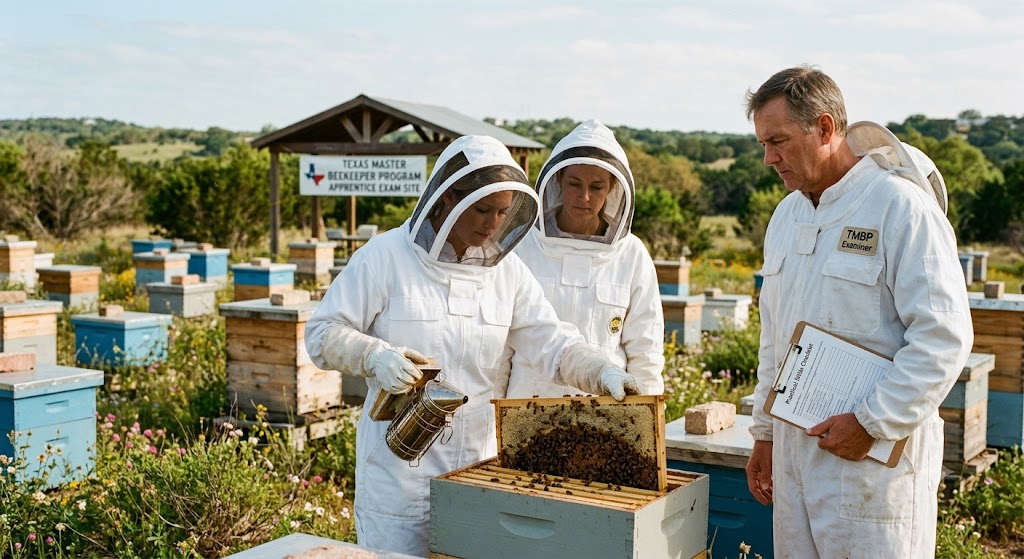
Additional Information
What the Course Entails and Exam Details
This examination is not just a test of generalized bee
facts; it is a rigorous assessment of knowledge specific to Texas environmental
conditions and regulatory framework. Beekeepers preparing for this practice
exam must be prepared to demonstrate mastery over several core competencies.
The primary syllabus focuses include:
- Bee
Biology and Anatomy: Comprehensive knowledge of worker, drone, and
queen life cycles, caste systems, reproductive biology, and essential
anatomical functions.
- Colony
Dynamics and Social Behavior: Understanding advanced communication
(like the waggle dance), seasonal dynamics, thermoregulation, and swarming
triggers and prevention.
- The
Texas Beekeeping Calendar: Managing colonies according to the specific
flow, bloom periods, and harsh climate conditions (e.g., severe heat,
drought management) characteristic of Texas regions.
- Hive
Management and Practical Skills: Proficiency in hive inspection
techniques, proper tool use, reading frames, marking queens, and selecting
appropriate locations (apiary placement).
- Pests,
Parasites, and Pathogens: Diagnosis, prevention, and treatment of
Varroa mites, Small Hive Beetles, American Foulbrood, European Foulbrood,
and Nosema, specifically emphasizing integrated pest management (IPM)
techniques.
- Texas
Beekeeping Rules and Regulations: Familiarity with state statutes
related to transporting bees, treating disease, and pesticide application
protocols managed by the Texas Apiary Inspection Service (TAIS).
What to Expect in
the Final Exam
While the TMBP reserves specific logistical details for
registered applicants, the standardized Apprentice exam format generally
requires candidate focus on two distinct parts:
Part 1: The Written Examination
This section typically consists of multiple-choice,
true/false, and short-answer questions. It is designed to test your
understanding of the theoretical concepts mentioned in the syllabus section
above. It is crucial to have a comprehensive grasp of terminology and
scientific principles. The questions are detailed and assess whether you have
absorbed the educational materials provided by the TMBP, rather than general
knowledge. A time limit is enforced for this section, usually between 90 and
120 minutes.
Part 2: The Practical (Hands-on) Examination
This is the component that often challenges applicants who
have only engaged in theoretical study. You will be required to demonstrate
practical beekeeping skills live before examiners. This often occurs at a live
apiary (such as those managed by the Texas A&M Honey Bee Lab). You must
demonstrate safe hive opening and closing procedures, proper use of the smoker,
frame manipulation, identifying brood patterns, locating the queen (or signs of
a queen), and correctly identifying specific pests or diseases within a working
hive context. Your ability to maintain "apiary etiquette" and stay
calm and controlled around the bees is directly evaluated.
Passing Score and Rules:
A composite score, typically requiring a minimum of 70% or
higher on each section (written and practical), is usually required to
earn the Apprentice certification. All personal safety gear, including a veil,
must be worn for the practical portion.
How to Study and
Exam Centers
Preparation for the Texas Master Beekeeper Apprentice exam
must be multifaceted, combining rigorous study with extensive, supervised
apiary experience.
- Leverage
the Official TMBP Reading List: The foundational knowledge for the
written exam is drawn directly from specific, recommended texts and the
TMBP-provided training modules. Studying these resources in-depth is
non-negotiable.
- Join
Local Texas Beekeeping Associations: This is perhaps the most crucial
strategy. Local clubs provide mentorship (essential for mastering the
practical exam) and offer insights into regional challenges (e.g.,
managing the Brazos Valley vs. the Hill Country). These mentors often hold
practice field days specifically mimicking the TMBP practical exam.
- Utilize
Online Study Groups and Forums: Connect with other TMBP applicants to
discuss complex biology, clarify regulatory statutes, and share field
observations.
- Create
Mock Practical Scenarios: Have an experienced beekeeper watch you
perform a "mock inspection." Request that they grade you on
specific, timed tasks, such as finding a queen, lighting a smoker
efficiently, or diagnosing a specific pest problem.
Exam Center Locations and Administration:
The Texas Master Beekeeper examinations are typically held
in conjunction with official Texas Master Beekeeper Program meetings and
educational workshops. These often occur at state-level events, such as the
major meetings of the Texas Beekeepers Association (TBA) or special testing
days hosted by the Texas A&M Honey Bee Lab.
- No
Commercial Testing Centers: You cannot register for this specific exam
at commercial locations like Pearson VUE or Prometric. All testing is
managed and proctored by TMBP officials.
- Annual
and Semiannual Testing: Exams are only offered on specific dates,
usually coinciding with major TMBP educational events. You must be
pre-registered to attend and test.
- Online
Components: While the written portion has occasionally been
offered via secure online portals under specific proctoring conditions
(particularly during times of restricted travel), the standard and
preferred method for testing includes the in-person event, especially for
the practical demonstration.
Job Opportunities from the Course
Earning the Apprentice certification validates a base level
of professional competency that is increasingly required in both hobbyist
education and agricultural industry sectors.
Here are specific job titles and career paths this
certification helps unlock and validate:
- Apiary
Manager (Small/Medium Operations): Running an independent beekeeping
operation, managing multiple colonies for pollination services or honey
production.
- Contractual
Pollination Specialist: Working with agricultural businesses to deploy
and manage hives during critical crop bloom cycles.
- Beekeeping
Educator/Instructor: Leading basic beekeeping workshops, teaching
youth organizations (e.g., 4-H, FFA), or providing consulting for new
hobbyists.
- Professional
Hive Lease/Service Technician: Setting up and managing hives on
commercial properties or private residences for clients desiring
pollination benefits or agricultural tax valuations (ag exemption).
- Commercial
Beekeeper Crew Member: Serving as a trained and recognized staff
member for large, commercial migratory beekeeping operations.
- State
or Federal Apiary Technician (Entry-Level): Providing foundational
credentials for roles within agricultural regulatory agencies, assisting
with apiary inspections (requires additional state hiring protocols).
- Educational
Content Creator (Specialized Apiculture): Generating
professional-grade educational materials or digital content validated by a
recognized certification.
Frequently Asked Questions
Reviews
5.0
Based on 0 reviews
Leave a Review
No reviews yet. Be the first to review!