
Texas Property and Casualty License Practice Exam
$69.00
- Buy to unlock unlimited access to all Quiz questions and Answers in this Quiz.
- After purchase you can print a PDF of the whole quiz at any point. The PDF will contain the questions and the correct answers.
About this Exam
This article is your essential guide to navigating the Texas Property and Casualty (P&C) Insurance License Practice Exam. Achieving your Texas P&C license is the necessary first step toward a rewarding career in the vast insurance industry. This state-level certification authorizes you to sell, solicit, and negotiate insurance policies that protect individuals and businesses against financial loss from property damage, liability, and personal assets within the state of Texas. This study guide is designed for aspiring insurance agents, customer service representatives, underwriters, and adjusters who are preparing to take the mandatory Pearson VUE state exam.
Ready to test your knowledge?
Buy Now to Access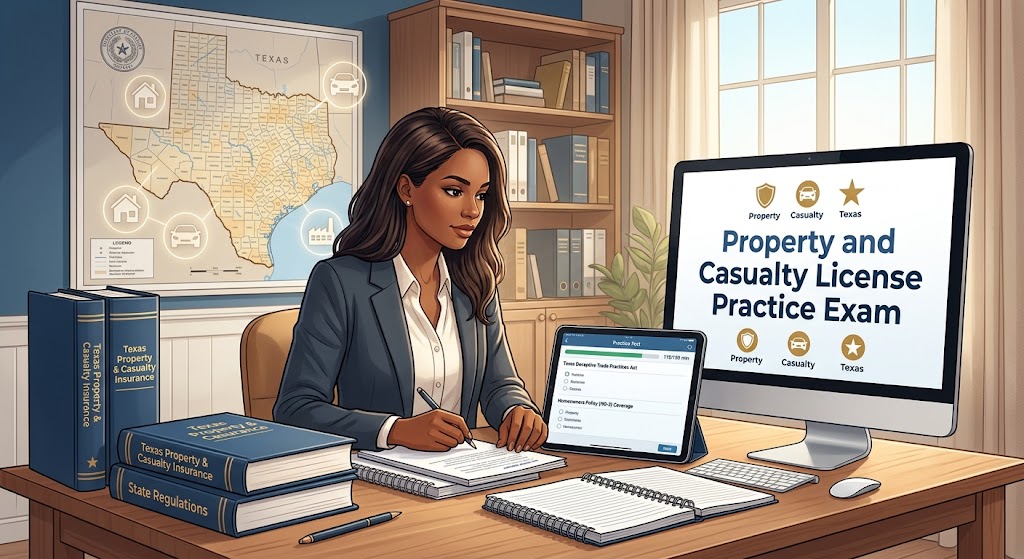
Additional Information
What the Course Entails and Exam Details
Your comprehensive study for the Texas Property and Casualty
license will cover an extensive array of foundational insurance principles.
These practice exams are structured to ensure you are proficient in both
general insurance concepts and the specific regulations governing Texas.
The core curriculum you will master includes:
- General
Insurance Concepts: Fundamentals of risk management, types of
insurers, the law of agency, contract law, and the structure of an
insurance policy.
- Property
Insurance Basics: Key concepts like insurable interest, indemnity,
subrogation, functional replacement cost, and specific perils (named vs.
open peril).
- Casualty
Insurance Basics: Understanding liability, negligence, tort law,
aggregate limits, and split limits (specifically for auto coverage).
- Specific
Policy Types: In-depth knowledge of Dwelling policies, Homeowners
policies (HO-2, HO-3, etc.), Personal Auto policies, and various
Commercial lines (Commercial General Liability, Commercial Property,
Businessowners Policy).
- Texas
State Statutes and Regulations: This crucial section covers Texas
Department of Insurance (TDI) definitions, licensing requirements,
maintenance (CE), disciplinary actions, marketing practices, and specific
Texas endorsements for property, auto, and workers' compensation.
What to Expect in
the Final Exam
The actual Texas Property and Casualty examination is a
rigorous computer-based test administered by Pearson VUE. It is composed
entirely of multiple-choice questions designed to test your understanding,
recall, and ability to apply complex scenarios.
Here is a typical breakdown of the final exam you should
prepare for:
- Exam
Structure: You will encounter two distinct sections within one
sitting: a General Insurance section (applicable nationally) and a Texas
State-Specific section.
- Number
of Questions: The general section typically consists of roughly 100
questions, while the Texas specific section has approximately 50-60
questions. You must pass both sections to earn your license.
- Time
Limit: You are generally allotted approximately 150 minutes (2.5
hours) for the entire examination.
- Passing
Score: The minimum passing score for each section is 70%. It is
critical that you do not overemphasize one section over the other.
- Format:
The test uses a linear computer format, usually meaning you cannot skip
around or change answers after you have committed them (though you should
verify the specific navigation rules with Pearson VUE before starting).
You will receive your score report immediately upon completion.
How to Study and Exam Centers
Preparation is the absolute key to success on the Texas
Property and Casualty exam. While many candidates find the general material
challenging, the dense nature of the Texas state-specific regulations is what
often requires the most focused study.
Actionable Study Strategies:
- Utilize
Practice Exams: The best resource is taking as many Texas Property and
Casualty practice exams as possible. These tests mimic the Pearson VUE
structure and question phrasing, helping you become comfortable with the
format and identify weak areas.
- Flashcards
for Regulations: Texas insurance laws (like CE hour requirements,
disciplinary fines, and grace periods) are specific numbers and rules. Use
digital flashcards to drill these until you know them instantly.
- Study
by Topic: Don't just take practice tests randomly. Focus your study
sessions on one major policy type (e.g., Personal Auto) or a specific
legal section at a time.
- Use
Authorized Material: Use only current pre-licensing educational
materials approved by the Texas Department of Insurance.
- Take
the Pearson VUE Content Outline: This official document is your
roadmap. It lists exactly which topics are covered. Review it against your
study materials to ensure comprehensive coverage.
How to Take the Exam:
- Exam
Provider: The official testing service for the Texas Department of
Insurance is Pearson VUE.
- Registration:
You must create an account on the Pearson VUE website to register for and
schedule your exam. You will also need to register for fingerprints
concurrently through their approved vendor, IdentoGO.
- Testing
Locations: You can choose to take your exam at any authorized Pearson
VUE physical testing center located throughout Texas, or you may register
for an "OnVUE" online proctored exam from your own home or
office, provided your system meets the strict technical requirements.
Job Opportunities from the Course
Successfully obtaining your Texas Property and Casualty
license unlocks diverse and stable career paths within the insurance sector.
This certification is mandatory for any position that requires selling or
negotiating P&C policies.
Here is a list of specific job titles and career paths this
qualification makes available to you in Texas:
<!--[if mso & !supportInlineShapes & supportFields]> SHAPE \* MERGEFORMAT <![endif]--><!--[if gte vml 1]>
- Property
and Casualty Insurance Agent (Producer): Sell, solicit, or negotiate
P&C insurance policies directly to individuals (personal lines) or
businesses (commercial lines) in Texas.
- Insurance
Broker: An agent who works with multiple insurance carriers, acting on
behalf of the client to find the best policy.
- Customer
Service Representative (CSR): Service existing policies, assist
clients with policy changes, process endorsements, and handle billing,
supporting a licensed agent.
- Claims
Adjuster (or Claims Representative): Investigate insurance claims
(e.g., auto accidents or property damage) to determine the extent of the
insurer's liability. (Note: A separate adjuster license is required for
this specific role in Texas, but the P&C agent license is often an
excellent foundational step).
- Insurance
Underwriter: Evaluate risks by reviewing applications for insurance
and determine appropriate coverage limits and premiums.
- Risk
Manager: (Usually for commercial lines) Analyze and develop strategies
for corporate clients to mitigate and manage financial risks.
- Field
Marketing Representative: Work for an insurance carrier, training and
supporting external agents and agencies in selling that carrier's P&C
products.
- Insurance
Agency Owner: With experience, many successful P&C agents choose
to open their own independent or captive insurance agency.
Frequently Asked Questions
Reviews
5.0
Based on 0 reviews
Leave a Review
No reviews yet. Be the first to review!