
Texas Real Estate State Practice Exam
$69.00
- Buy to unlock unlimited access to all Quiz questions and Answers in this Quiz.
- After purchase you can print a PDF of the whole quiz at any point. The PDF will contain the questions and the correct answers.
About this Exam
Embarking on a career in real estate in Texas is an exciting and potentially rewarding journey!To join the ranks of licensed real estate professionals in the Lone Star State, you must first pass the rigorous Texas Real Estate Licensing Exam. This study guide focuses on the specific value of taking a Texas Real Estate State Practice Exam as your ultimate preparation tool.Designed for all aspiring real estate salespersons or brokers who are ready to take that crucial final step toward licensure, this practice exam is an essential bridge.It transforms your academic knowledge, acquired from the required 180 hours of pre-license education, into the practical skills and confidence needed to succeed.A license not only grants you the authority to operate within Texas, a booming real estate market, but also opens doors to a diverse range of opportunities.The Texas Real Estate Commission (TREC) oversees the licensing process, and our practice exam is meticulously aligned with their standards and the content of the actual state licensing examination, administered by Pearson VUE.
Ready to test your knowledge?
Buy Now to Access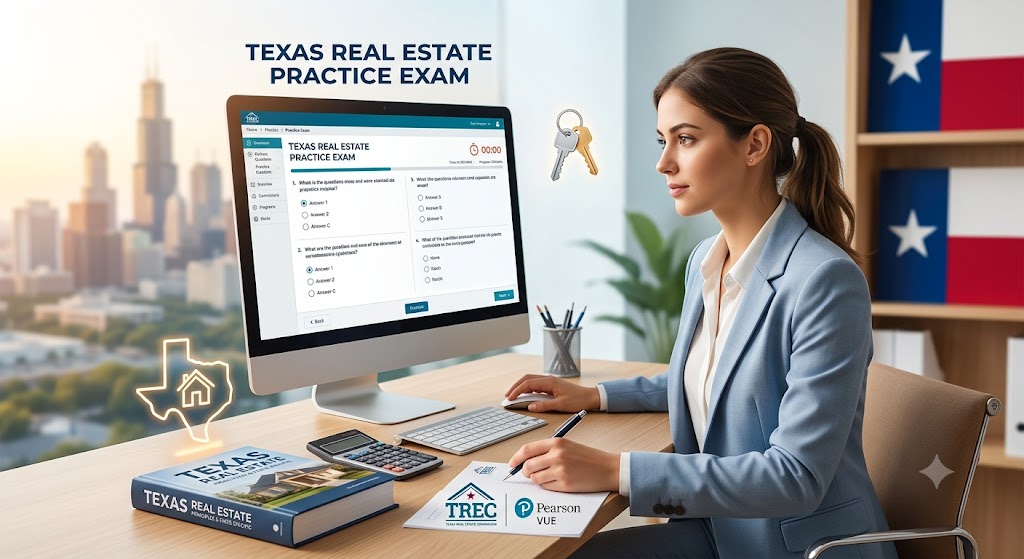
Additional Information
What the Course
Entails and Exam Details
This dedicated practice exam isn't a passive course but an
active, hands-on tool.
It simulates the exact environment and scope of the real
Texas Real Estate Licensing Exam.
While your pre-license education covers comprehensive
principles, this practice exam narrows your focus.
It delves deep into the specific details required to pass.
A good State Practice Exam focuses intensely on the unique
rules and regulations of Texas real estate.
The course of practice through such exams will cover
key state-level topics in detail, including:
- Texas
Real Estate License Act (TRELA): Deep knowledge of the statutes and
rules that govern practice in Texas.
- TREC
Rules and Standards of Conduct: Understanding the ethical and
procedural requirements for license holders.
- Agency
Relationships in Texas: Specifics of fiduciary duties, intermediary
brokerage, and agency agreements in the state.
- Contracts
and Promulgated Forms: Mastering the legal documents and contracts
provided by TREC for use in various transactions.
- Special
Topics: Coverage of specific Texas property law, fair housing nuances,
and real estate finance regulations unique to the state.
The actual final licensing exam for a salesperson typically
consists of two distinct portions within a single timed block.
This includes a National portion covering broad real estate
principles, and a critical State portion focused purely on Texas specifics.
The structure generally includes 80 National questions and a
crucial 30 State-specific questions.
Total time allocated for both portions combined is often 150
minutes, making timed practice exams essential for managing your test stamina
and time.
The practice exam itself is typically structured similarly
to the actual exam to provide a true simulation of the length, difficulty, and
complexity of both portions, ensuring you are prepared for the full experience.
What to Expect in
the Final Exam
When you step into the test center for the official Texas
Real Estate Licensing Exam, you can expect:
- Format:
The exam is entirely composed of multiple-choice questions with four
answer options each, testing conceptual understanding and practical
application.
- Scoring:
A passing score of 70% or higher is required on each of the two major
portions – National and State – independently to be eligible for a
license. You cannot average your scores.
- Time:
You will be given a specific, single time limit (commonly 150 minutes or 2
hours and 30 minutes) to complete both portions of the salesperson exam.
Broker exams are longer. Practice exams with similar timers are vital.
- Rules:
Expect strict procedures at the testing centers:
- Arrival:
You must arrive at least 30 minutes early.
- Identification:
Strict government-issued photo ID requirements are in place.
- Materials:
No personal belongings are allowed in the testing room, and you will
typically be provided with necessary scratch paper, a calculator, and any
allowed references, all of which must be returned.
- Calculators:
Personal calculators are usually not permitted, so you will be using a
test center provided one.
- Retakes:
If you do not pass, you can retake the failed portion(s) after a
necessary waiting period (typically 24-48 hours) and by paying the exam
fee again. Practice exams are key to avoiding costly and time-consuming
retakes!
How to Study and Exam Centers
Preparation is paramount for the Texas Real Estate Exam, and
a proactive study strategy utilizing a dedicated state practice exam is
essential.
Study Strategies:
- Take
Timed Practice Exams: The most critical step. Simulate the actual exam
by taking complete, timed practice exams. This builds test-taking
endurance and helps you manage your time effectively on both sections.
- Identify
Weaknesses: Thoroughly review the results of your practice exams.
Focus your additional study time on the state-specific topics where your
scores are lower, as highlighted in the breakdown above.
- Review
Key Texas Resources: Deep dive into the TREC website resources,
particularly the full Texas Real Estate License Act (TRELA) text and the
promulgated contract forms. Practice filling these forms out.
- Form
Study Groups: Collaborating with other aspiring agents can provide
additional support, clarification, and motivation.
- Practice
with TREC Materials: Use official TREC study materials and sample
questions when available, alongside your pre-license course materials and
state-specific practice tests.
- Rest
and Positive Mindset: Ensure you get sufficient rest in the days
leading up to the exam, and approach the test with confidence and a
positive, encouraging mindset.
Exam Centers and Registration:
The official Texas Real Estate Licensing Exam is
administered by Pearson VUE, an authorized testing provider, on behalf of TREC.
Once you have completed your pre-license education and TREC has approved your
exam eligibility:
- Registration:
Register with Pearson VUE through their online portal or by calling their
toll-free number.
- Testing
Centers: Pearson VUE operates numerous physical, authorized testing
centers across Texas and sometimes in neighboring areas. You can select
your preferred location and schedule your appointment after your
application is processed.
- Authorized
Schools: While most exams are at Pearson VUE centers, some approved
real estate schools may also be authorized to offer the exam. Check with
TREC or your education provider for current details. Always verify
registration and scheduling information directly with Pearson VUE after
receiving your eligibility.
Job Opportunities from the Course
A Texas real estate license, earned by passing this
foundational exam, opens a wide door to exciting and varied career paths in the
real estate industry. While becoming a residential sales agent is a common and
often successful path, the opportunities extend far beyond. Here are some key
potential jobs you can pursue after licensure:
- Residential
Real Estate Agent: Listing, selling, and representing buyers and
sellers in the purchase of residential properties.
- Commercial
Real Estate Agent: Specializing in complex commercial property
transactions, including office spaces, retail, industrial, and investment
properties.
- Real
Estate Broker: After gaining a specified number of years of experience
as an agent, you can pursue a broker's license to manage your own
brokerage, employ agents, and take on greater responsibility (with
additional education and testing).
- Leasing
Agent / Consultant: Focus on helping property owners and managers find
and screen tenants for residential and commercial rentals.
- Property
Manager: Oversee the operations, maintenance, and tenant relations for
various types of real estate properties, ensuring their overall success
and profitability.
- Real
Estate Appraiser: Estimate the market value of properties for various
purposes, including sales, financing, taxation, and insurance (requires
significant additional specialized training and separate licensing).
- Title
Examiner / Officer: Work within the title and escrow industry,
researching and verifying property titles to ensure clear ownership and
facilitating smooth closings (specific title training or certifications
may be beneficial).
- Real
Estate Assistant: Provide administrative support to successful real
estate agents and brokers, gaining valuable hands-on industry experience.
- Real
Estate Paralegal: Work within law firms or real estate companies,
assisting attorneys with complex legal aspects of real estate transactions
and litigation (requires separate paralegal training and education).
- Apartment
Manager / Leasing Specialist: Focus specifically on managing apartment
complexes, handling leasing, tenant services, and on-site property
operations.
- Mortgage
Loan Officer: Help individuals and businesses secure mortgage
financing for their property purchases (requires separate mortgage
licensing/certification through appropriate financial bodies).
- Real
Estate Investor: Use your deep knowledge of the market and regulations
to invest in properties personally or on behalf of investment groups.
Good luck on your journey to becoming a licensed real estate
professional in Texas! Taking a Texas Real Estate State Practice Exam is
a proven strategy to ensure you are well-prepared, confident, and ready to
succeed on test day.
Frequently Asked Questions
Reviews
5.0
Based on 0 reviews
Leave a Review
No reviews yet. Be the first to review!