
Texas Security Guard License Practice Exam
$69.00
- Buy to unlock unlimited access to all Quiz questions and Answers in this Quiz.
- After purchase you can print a PDF of the whole quiz at any point. The PDF will contain the questions and the correct answers.
About this Exam
The Texas Security Guard License, primarily known as the Non-Commissioned (Level II) Security Officer registration, is the essential prerequisite for anyone wishing to work in the private security industry in Texas. This certification, regulated by the Texas Department of Public Safety (DPS) under the Private Security Bureau (PSB), is designed for entry-level professionals who will perform unarmed security duties. It ensures that security personnel possess foundational knowledge in state regulations, legal authority, and essential skills to maintain a safe and secure environment. This license is the foundation upon which individuals can later build, leading to advanced specializations such as Level III (Armed) and Level IV (Personal Protection) certifications.
Ready to test your knowledge?
Buy Now to Access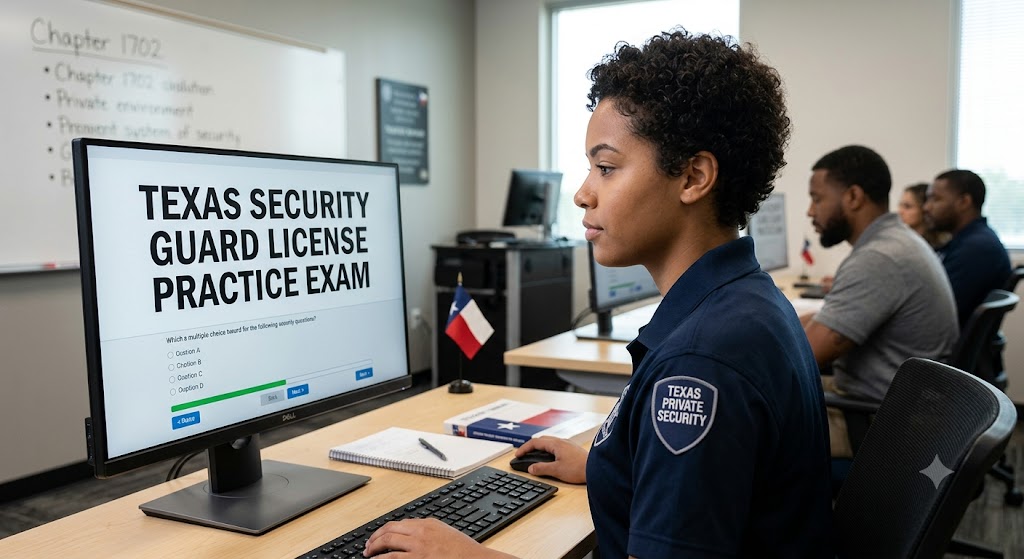
Additional Information
What the Course Entails and Exam Details
To be eligible for the examination, applicants must first
complete the state-mandated 6-hour Level II Training Course. This comprehensive
course is the bedrock of your security knowledge. The curriculum is
meticulously crafted to cover critical topics specified by the Texas
Administrative Code and the Texas Occupations Code, Chapter 1702.
Core Topics and Syllabus:
- Role
and Responsibilities: Understanding the precise duties of a
non-commissioned officer, including observation, reporting, and
maintaining a deterrent presence.
- Texas
Occupations Code Chapter 1702: In-depth familiarity with the laws
governing the private security industry in Texas, including licensing
requirements, company regulations, and statutory limitations.
- Legal
Authority and Limitations: Clearly defining the legal powers of a
private security officer versus a peace officer, including the authority
to detain and limitations on arrest.
- Use
of Force: An essential module covering the legal, ethical, and
practical application of the 'Use of Force Continuum,' emphasizing
de-escalation first.
- Conflict
De-escalation: Techniques for identifying potential conflicts,
communicating professionally, and resolving disputes non-violently.
- Observation
and Reporting: Standard practices for generating accurate, detailed,
and legally sound incident reports.
- Emergency
Response: Initial steps to take during various emergencies, including
fire alarms, medical incidents, and security breaches, focusing on
coordination with official authorities.
The examination itself is administered directly at the end
of the 6-hour course, often by the same authorized training instructor or
entity that provided the curriculum.
What to Expect in the Final Exam
The final examination for the Texas Level II Security
Officer registration is a written test designed to validate your comprehension
of the material covered during the course. Understanding its format is crucial
for targeted preparation.
- Exam
Format: The test is almost universally composed of multiple-choice and
true/false questions.
- Question
Count: While the exact number can vary slightly between different
authorized training entities, the state standard often requires a
comprehensive exam of approximately 50 questions to ensure thorough
coverage of Chapter 1702 and core safety protocols.
- Passing
Score: The Texas DPS requires a passing score of 70% to 80%, depending
on the specific authorized curriculum provided. Students who do not meet
this threshold are typically given a limited number of opportunities
(often three) to retake the exam within a specified timeframe, sometimes
at an additional cost.
- Time
Limits: Candidates are typically given an generous but finite amount
of time, usually 60 to 90 minutes, to complete the exam.
- Authorized
School Administration: A unique and important rule of the Level II
exam is that it is administered and proctored by the DPS-licensed training
school or authorized guard company. There is no central state testing
center for this entry-level certification.
How to Study and Exam Centers
Preparation is the key to minimizing anxiety and ensuring a
successful outcome. Since the Level II exam is not administered in a central
testing facility, your study strategy should focus on reinforcing the specific
training material you will receive.
Actionable Study Strategies:
- Leverage
the Official Study Guide: Your chosen Level II Training School will
provide you with a comprehensive student manual or study guide. This is
your most vital resource; study it religiously, noting specific sections
of the Texas Occupations Code.
- Utilize
High-Quality Practice Tests: Seek out reputable online practice exams
that are specifically tailored to the current Texas Security Guard
License Practice Exam curriculum. Look for platforms that structure
questions identically to the final exam and, critically, provide
references back to the relevant sections of Chapter 1702 for each answer.
- Focus
on the Use of Force Continuum: Pay particular attention to the modules
on legal authority and use of force. Create flashcards for the different
levels of the continuum and the appropriate responses at each stage.
- Scenario-Based
Review: Discuss potential real-world scenarios (e.g., handling an
angry customer, responding to a medical incident) with classmates or
instructors, applying the principles learned in the course to a
resolution.
Exam Centers and Location:
Unlike exams administered at Pearson VUE or Prometric, the Texas
Security Guard Level II exam is taken at the location where you complete your
6-hour training. You must register for a course with a licensed "Class
F" Level III or Level IV Training School, or with an authorized guard
company that provides in-house training. After successfully passing the course
exam, you will receive a certificate of completion (which is not the
license itself). You then submit your application for licensure and the
associated fees to the Texas Department of Public Safety through the Texas
Online Private Security (TOPS) portal.
Job Opportunities
from the Course
Obtaining your Texas Non-Commissioned (Level II) Security
Officer license is an immediate gateway to diverse entry-level employment and
forms the essential platform for career advancement within the security sector.
Unarmed (Level II) Security Career Paths:
- Unarmed
Security Guard
- Non-Commissioned
Security Officer
- Corporate
Security / Concierge Security
- Residential
Security Officer
- Event
Security Personnel
- Loss
Prevention Officer / Asset Protection
- Security
Patrol Officer (Unarmed)
Furthermore, the Level II license is the mandatory
foundation for anyone wishing to pursue advanced opportunities, including Level
III (Armed/Commissioned) certifications, Level IV (Personal Protection
Officer/Bodyguard), or moving into security management and site supervisory
roles.
Frequently Asked Questions
Reviews
5.0
Based on 0 reviews
Leave a Review
No reviews yet. Be the first to review!