
Texas Veterinary Technician Practice Exam
$69.00
- Buy to unlock unlimited access to all Quiz questions and Answers in this Quiz.
- After purchase you can print a PDF of the whole quiz at any point. The PDF will contain the questions and the correct answers.
About this Exam
This comprehensive study guide is designed to help aspiring veterinary professionals prepare for the rigorous path to becoming a Licensed Veterinary Technician (LVT) in Texas. Specifically, it focuses on the essential knowledge and skills required for the state-mandated licensure examinations. This certification is designed for graduates of American Veterinary Medical Association (AVMA)-accredited Veterinary Technology programs, equipping them with the recognized credentials to provide high-quality medical care to animals under the supervision of a licensed veterinarian. Obtaining your Texas LVT license demonstrates a commitment to professional excellence and a high standard of animal welfare.
Ready to test your knowledge?
Buy Now to Access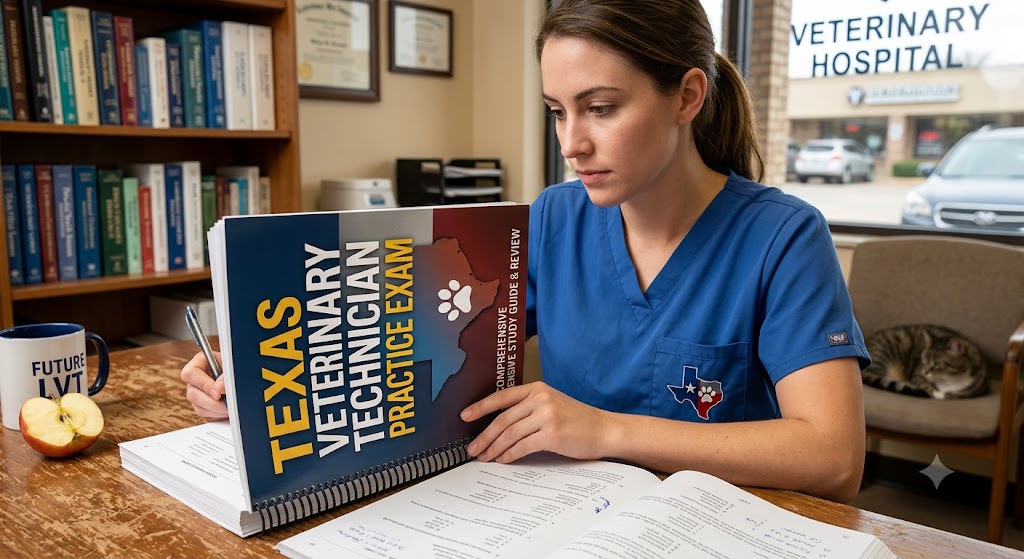
Additional Information
What the Course Entails and Exam Details
To become a Licensed Veterinary Technician in Texas,
candidates must successfully complete two distinct exams: the Veterinary
Technician National Exam (VTNE), and the Texas Licensed Veterinary Technician
Exam (LVTE), often referred to as the State Board Exam. A comprehensive
practice program, like this study guide, will focus heavily on the latter,
which tests specific state laws and regulations.
The underlying education details a deep understanding of
animal anatomy, physiology, pharmacology, surgical nursing, clinical pathology,
and anesthesia. A typical study course, whether academic or a structured
practice guide, covers a broad syllabus of veterinary medicine, including
primary care, emergency and critical care, dentistry, and laboratory procedures
for various species, from companion animals to livestock. The state-specific
portion, the LVTE, focuses on jurisprudence: the rules of the Texas Board of
Veterinary Medical Examiners (TBVME), standard of care, continuing education
requirements, and the specific duties an LVT is authorized to perform,
distinguishing what tasks require general, direct, or immediate supervision.
What to Expect in
the Final Exam
For Texas licensure, candidates must first pass the VTNE, a
national standardized computer-based exam consisting of 170 multiple-choice
questions administered at proctored testing centers. A scaled score of 75% or
higher is typically required to pass the VTNE.
Once you have successfully navigated the national exam, you
can apply to the TBVME to take the Texas Licensed Veterinary Technician Exam
(LVTE). Unlike the VTNE, the LVTE is specifically designed as a jurisprudence
and state laws exam. It is delivered in an online format, which candidates can
take from their own computer at a time and location that suits them. This exam
focuses entirely on the Texas Veterinary Licensing Act and Board Rules, testing
your comprehension of legal and ethical practice in Texas. Details on the exact
number of questions and time limit for the online LVTE are provided by the
board upon approval of your application.
How to Study and
Exam Centers
Effective preparation is key. Actionable study strategies
for the Texas LVT exams involve a dual approach: rigorous review of academic
material for the VTNE and a specific focus on the legal framework for the LVTE.
Utilize comprehensive textbooks from your AVMA-accredited program and invest in
official VTNE practice tests to gauge your readiness and identify areas for
improvement. Create flashcards for critical information, such as drug dosages,
anatomical terms, and laboratory values.
For the LVTE, your primary study materials are the Texas
Veterinary Licensing Act and the Texas Board of Veterinary Medical Examiners
Rules. These can be found directly on the TBVME website. Create a study set
focusing on supervision levels, non-veterinarian permitted services, and
medical record requirements. For the final state exam, remember that it is
taken online via the TBVME's self-service licensing portal, rather than a
physical testing center like Pearson VUE, which is used for the VTNE.
Job Opportunities
from the Course
A Texas Licensed Veterinary Technician designation opens
doors to a diverse range of rewarding careers. Graduates and license holders
can find employment in various sectors, making a significant impact on animal
health.
- Licensed
Veterinary Technician (LVT) in general veterinary practices, including
small animal, mixed, large animal, and exotic medicine.
- Specialty
LVT in referral hospitals focusing on internal medicine, surgery,
oncology, dermatology, or neurology.
- Emergency
and Critical Care Veterinary Technician in 24-hour emergency hospitals.
- Research
Veterinary Technician in academic institutions or biomedical facilities.
- Shelter
Medicine Veterinary Technician at humane societies, animal control
agencies, and rescue organizations.
- Veterinary
Practice Manager or Team Lead.
- Pharmaceutical
or Veterinary Supply Sales Representative.
- Instructor
in Veterinary Technology and Assistant programs.
- Public
Health Veterinary Technician in government agencies.
- Zoo
or Wildlife Rehabilitation Veterinary Technician.
Frequently Asked Questions
Reviews
5.0
Based on 0 reviews
Leave a Review
No reviews yet. Be the first to review!