
The Audiovisual Design and Integration Process Practice Test
$69.00
- Buy to unlock unlimited access to all Quiz questions and Answers in this Quiz.
- After purchase you can print a PDF of the whole quiz at any point. The PDF will contain the questions and the correct answers.
About this Exam
The Audiovisual Design and Integration Process certification is tailored for professionals seeking to validate their expertise in creating and implementing comprehensive AV systems. This includes AV technicians, system designers, engineers, and project managers involved in commercial or residential AV installations. The associated practice test is a critical stepping stone, allowing candidates to assess their readiness for the official certification exam. It focuses on the core principles of designing systems that meet client needs, integrating disparate components seamlessly, and managing the overall project lifecycle efficiently.
Ready to test your knowledge?
Buy Now to Access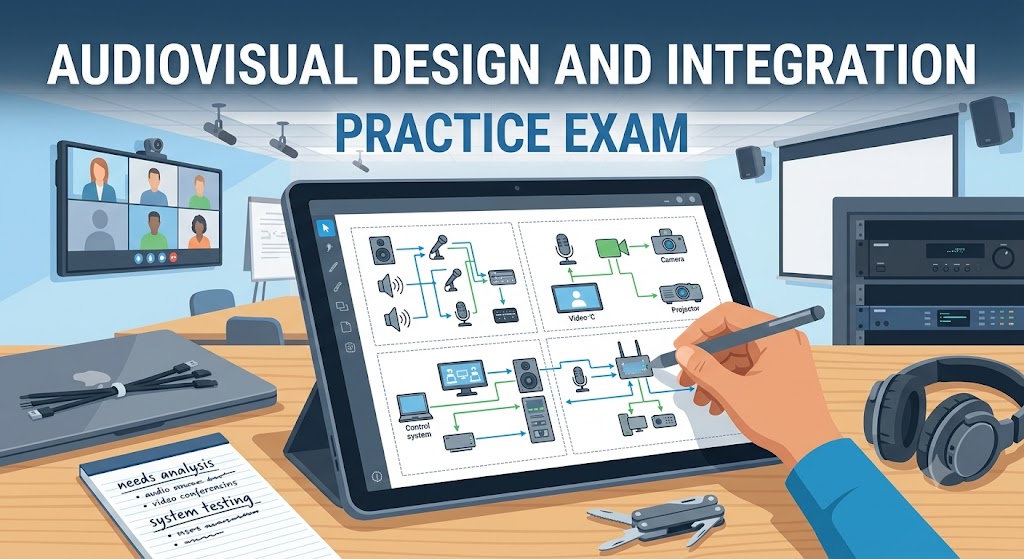
Additional Information
What the Course Entails and Exam Details
The core curriculum and the focus of the practice test
revolve around several key domains that constitute the AV design and
integration workflow. Candidates must demonstrate proficiency in the following
areas:
Needs Assessment and Project Scope: Understanding how
to conduct thorough client interviews to gather requirements. This involves
defining the functionality of the AV system, assessing the physical environment
(acoustics, lighting, spatial constraints), and establishing a clear project scope
and budget.
System Design Principles: Translating client needs
into technical specifications. This section covers the creation of signal flow
diagrams, schematic drawings, and architectural floor plans. Candidates need a
strong understanding of audio systems (loudspeaker placement, amplification,
processing), video systems (display selection, signal distribution, resolution,
aspect ratios), and control systems (user interfaces, automation logic).
Integration and Installation Practices: Focusing on
the practical aspects of building the designed system. Key topics include rack
building, cable management, connector termination standards, signal extension
techniques, and equipment mounting. It also covers basic networking principles
required for networked AV systems (IP addressing, VLANs).
Project Management: Managing resources, timelines,
and budgets effectively. This domain includes understanding project phases
(initiation, planning, execution, monitoring, closing), coordinating with other
trades (architects, electricians, IT), and ensuring compliance with safety
standards and regulations.
Commissioning and Testing: Verifying that the
installed system meets the designed performance specifications. This involves
functional testing of all components, audio and video calibration, user
interface verification, and troubleshooting any issues before final handover.
What to Expect in
the Final Exam
While the practice test is a diagnostic tool, it closely
simulates the format and rigor of the official certification exam.
Understanding the structure can help reduce test anxiety and improve time
management during the actual test.
Exam Format: The exam typically consists of 100 to
125 multiple-choice questions. These questions are often scenario-based,
requiring you to apply your knowledge to solve real-world design or
installation problems. Some advanced formats might include drag-and-drop sequencing
(e.g., ordering project phases) or hotspot questions (e.g., identifying
components on a diagram).
Time Limit: Candidates are usually allotted between 2
and 2.5 hours to complete the exam. This requires efficient pacing; a general
rule is to aim for just over one minute per question, leaving time at the end
to review flagged responses.
Passing Score: The passing score is typically
determined by psychometric analysis and may vary slightly between test
versions, but generally, a score of around 70% or higher is required. The
practice test will often provide a detailed breakdown of your performance by domain,
highlighting areas where you need further study.
How to Study and
Exam Centers
Preparation is paramount. Here are actionable strategies to
enhance your learning and ensure you are test-ready:
Utilize the Practice Test Strategically: Do not just
take the practice test once. Use it multiple times to build stamina and
familiarize yourself with the question phrasing. Analyze the questions you got
wrong; read the explanations provided to understand the underlying principles,
rather than just memorizing the correct answer.
Review Core AV Standards and Guides: Study materials
provided by industry organizations (such as AVIXA's CTS materials) are
invaluable. Focus on standards regarding audio coverage, video display size,
and rack building practices. Review manufacturer-specific training for common
control, audio, and video hardware.
Create Visual Study Aids: Draw out signal flow
diagrams for various scenarios (e.g., a standard conference room vs. a complex
divisible auditorium). Practice reading architectural drawings and identifying
AV symbiology. Create flashcards for technical acronyms, bandwidth calculations,
and acoustic formulas.
Participate in Study Groups or Forums: Engaging with
peers in AV forums or study groups can expose you to different perspectives and
problem-solving techniques. Teaching a concept to someone else is also one of
the most effective ways to reinforce your own understanding.
Where to Take the Exam: The actual certification exam
associated with this practice test is administered through authorized testing
centers. Major certification bodies partner with global providers like Pearson
VUE, which have thousands of physical testing locations worldwide.
Additionally, some organizations offer the option for online proctored exams,
allowing you to take the test from your home or office under strict monitoring
protocols. Check the official certification body’s website for specific
scheduling details and authorized locations.
Job Opportunities
from the Course
Earning a certification in Audiovisual Design and
Integration significantly enhances your credibility and employability in the
thriving pro-AV industry. This qualification validates your technical expertise
and project management skills, unlocking various career paths across multiple
sectors, including corporate, education, hospitality, government, and
entertainment.
Below is a list of job opportunities and career paths this
certification helps support:
- Audiovisual
System Designer: Creates detailed technical designs, schematics, and
layouts for AV installations.
- AV
Integration Specialist/Technician: Focuses on the physical
installation, wiring, and configuration of AV components.
- AV
Project Manager: Oversees the entire lifecycle of an AV project, from
planning to final commissioning.
- Control
System Programmer: Specializes in writing the code that automates and
controls AV hardware interfaces.
- Design
Engineer (AV focus): Responsible for high-level engineering decisions
and custom solution development.
- Audiovisual
Consultant: Advises clients on technology needs and develops
comprehensive AV strategies.
- Technical
Sales Engineer (AV): Uses technical knowledge to support the sales
process for AV manufacturers or integrators.
- Live
Events AV Engineer: Manages complex audio, video, and lighting systems
for concerts, conferences, and broadcasts.
- AV/IT
Support Manager: Manages the ongoing maintenance and troubleshooting
of networked AV systems within an organization.
By dedicating time to study the key domains outlined in this
guide and leveraging the practice test as a critical diagnostic tool, you will
be well on your way to achieving this valuable industry certification and
advancing your career in audiovisual technology.
Frequently Asked Questions
Reviews
5.0
Based on 0 reviews
Leave a Review
No reviews yet. Be the first to review!