
The Basic School (TBS) Phase 3 Practice Exam
$69.00
- Buy to unlock unlimited access to all Quiz questions and Answers in this Quiz.
- After purchase you can print a PDF of the whole quiz at any point. The PDF will contain the questions and the correct answers.
About this Exam
The Basic School (TBS) Phase 3 Practice Exam is a critical, comprehensive evaluation designed for United States Marine Corps officers. As a cornerstone of their initial, post-commissioning training, TBS ensures every officer, regardless of their future Military Occupational Specialty (MOS), possesses the provisional skills required of a rifle platoon commander. Phase 3 specifically builds upon the foundational knowledge and tactical skills acquired in the first two phases, with a primary focus on company-sized offensive and defensive tactics and advanced military leadership. This practice exam is an essential tool for officer candidates to measure their understanding of complex tactical concepts and prepare for the final high-stakes examinations and practical application
Ready to test your knowledge?
Buy Now to Access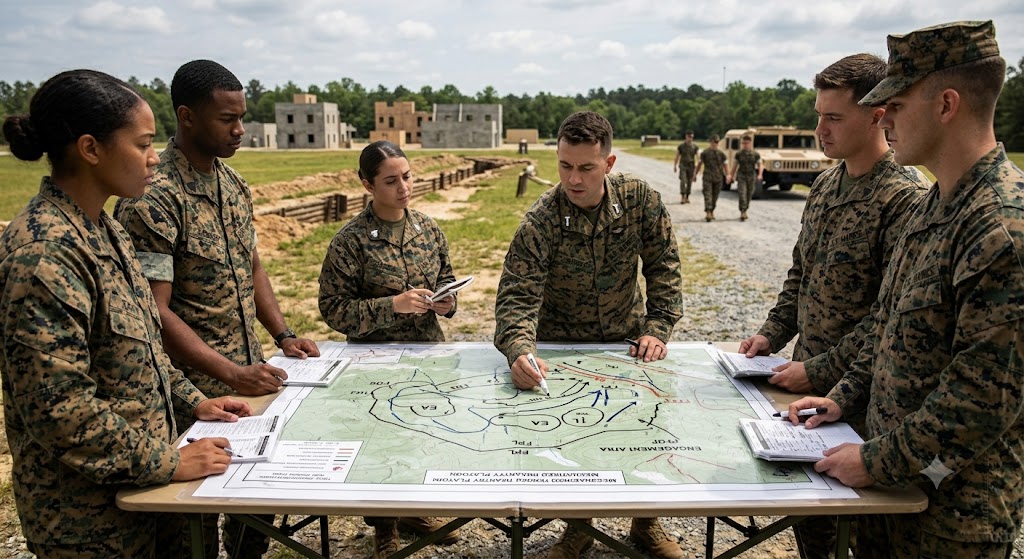
Additional Information
What the Course
Entails and Exam Details
This examination covers an extensive curriculum that
challenges both theoretical knowledge and practical decision-making. Students
must demonstrate proficiency in planning and executing complex infantry
operations.
The core topics and skills include:
- Defensive
Operations: A detailed understanding of defensive methodologies is
paramount. Key areas include the steps of Engagement Area Development (EA
Dev), the utilization of Battle Positions (BP), strongpoints, perimeter
defense, and reverse slope defense. Candidates must master the principles
of mobile, area, and retrograde defense.
- Offensive
Operations: Planning and command of platoon and company-level attacks,
including both hasty and deliberate frontal and flanking attacks. This
section requires a precise understanding of the types of offensive fires:
in support of maneuver, isolation, assault, and consolidation.
- Tactical
Machine Gun Employment: Mastering the "PICMDEEP" principles
(Pairs, Interlocking Fires, Coordination, Mutual Support, Defilade,
Enfilade, Economy, Protection) for both direct and indirect support roles.
- Range
Cards and Fire Plan Sketches: Creating accurate, to-scale range cards
and fire plan sketches is a mandatory practical skill, requiring detailed
annotations of Final Protective Lines (FPL), Principal Directions of Fire
(PDF), and Engagement Areas (EA).
- Patrolling:
Conducting and planning security, reconnaissance, and combat patrols,
including the integration of Listening Posts/Observation Posts (LP/OP).
- Military
Engineering: Battlefield functions in the defense, focusing on
mobility, counter-mobility, survivability, and general engineering,
including obstacle breaching (SOSRA) and reinforcing obstacle principles
(FOCDPIG).
- Weapon
Systems: Precise knowledge of the capabilities, characteristics, and
employment of key organic systems, such as the M2, MK-19, M240, and SMAW.
What to Expect in
the Final Exam
While the exact nature of the final "TBS Phase 3
Exam" is a dynamic assessment that includes both written and extensive
practical components, the practice exam is modeled after the written evaluation
structure. The final examination serves as a gateway and a filter for specific
high-demand MOSs.
You can typically expect:
- Format:
A multi-part examination. The written portion, which this practice exam
simulates, generally consists of complex multiple-choice, true/false, and,
more critically, practical application and sketching questions.
- Time
Limit: The final exam is a significant time commitment, often spanning
several hours, requiring focused endurance.
- Passing
Score Requirements: The minimum passing score is high, and, crucially,
performance in Phase 3 tactics significantly influences a student’s
overall rank and MOS selection. Mastery, not just passing, is the
objective.
- High-Stakes
and Practical: The written exam is followed by, and inextricably
linked to, practical application, including Tactical Decision Games (TDGs)
and live field exercises. You will be evaluated on your ability to lead,
execute, and adapt under pressure.
How to Study and
Exam Centers
Preparation for the TBS Phase 3 exam is demanding and cannot
be left to cramming. A successful study strategy requires a mix of academic
review, practical sketching, and tactical decision-making exercises.
Actionable Study Strategies:
Master the "Big
Books": The primary study materials are the current Marine Corps
tactical manuals. Know them in detail.
Repetitive Sketching: You
cannot master range cards or fire plan sketches without drawing them hundreds
of times. Use blank templates and draw for different tactical scenarios,
focusing on the correct integration of all elements.
Use Practice Exams:
Continuously use practice exams and questions. Review every answer, especially
those you got correct, to ensure you understand the "why" behind the
correct response.
Tactical Decision Games
(TDGs): Use TDGs and case studies to practice rapid, sound tactical
decision-making. Analyze a mission, evaluate enemy and friendly capabilities
(METT-TC), and rapidly develop a plan (SOM) with clear tasks to subordinates.
Study Groups: Discussing
tactical concepts with peers is invaluable. It forces you to articulate your
understanding and exposes you to different perspectives.
Exam Centers:
The Basic School is located solely at Marine Corps Base
Quantico, Virginia. All formal Phase 3 evaluations are administered on-site. The
"TBS Phase 3 Practice Exam" provided by reputable preparatory sources
is an online study aid designed to simulate the academic portion and is
accessible via any secure internet portal.
Job Opportunities from the Course
Passing The Basic School and performing well in all phases,
including Phase 3, is the prerequisite for all Marine Corps officer careers.
The overall performance at TBS determines an officer’s class rank, which
directly impacts their selection of a primary Military Occupational Specialty
(MOS). Phase 3 performance is specifically critical for candidates desiring
roles with significant tactical command responsibility.
Direct Career Paths (MOSs) influenced by TBS Phase 3
include:
- 0302
Infantry Officer: The most common path for those who excel in tactical
leadership, focusing on command, planning, and execution of infantry
tactics.
- 0802
Field Artillery Officer: Managing the command and control of artillery
units, requiring deep understanding of supporting arms.
- 1302
Combat Engineer Officer: Planning and executing engineering support,
including mobility and counter-mobility operations.
- 0203
Ground Intelligence Officer: Leading intelligence sections, requiring
deep understanding of tactical and operational planning.
- 1803
Assault Amphibian Officer: Commanding amphibian assault units in
offensive operations.
Every officer, from a Judge Advocate (4402) to an Aviator (75XX), must first succeed at TBS to demonstrate they are, above all, a provisional rifle platoon commander. Successfully navigating Phase 3 is a testament to an officer's ability to lead, plan, and execute in the most demanding environments
Frequently Asked Questions
Reviews
5.0
Based on 0 reviews
Leave a Review
No reviews yet. Be the first to review!