
The Community Interpreter Practice Test
$69.00
- Buy to unlock unlimited access to all Quiz questions and Answers in this Quiz.
- After purchase you can print a PDF of the whole quiz at any point. The PDF will contain the questions and the correct answers.
About this Exam
The Community Interpreter® is a leading national certification program designed to validate the skills and ethical knowledge required for interpreters working in critical community settings. It is specifically intended for bilingual individuals who facilitate communication in essential, non-diplomatic sectors, including healthcare, social services, education, and legal environments where high-level community support is needed. Achieving this certification demonstrates a commitment to professionalism, impartiality, and accuracy, ensuring that language access is provided effectively in diverse communities. This comprehensive study guide and its associated practice tests are crucial tools for candidates preparing for this rigorous examination.
Ready to test your knowledge?
Buy Now to Access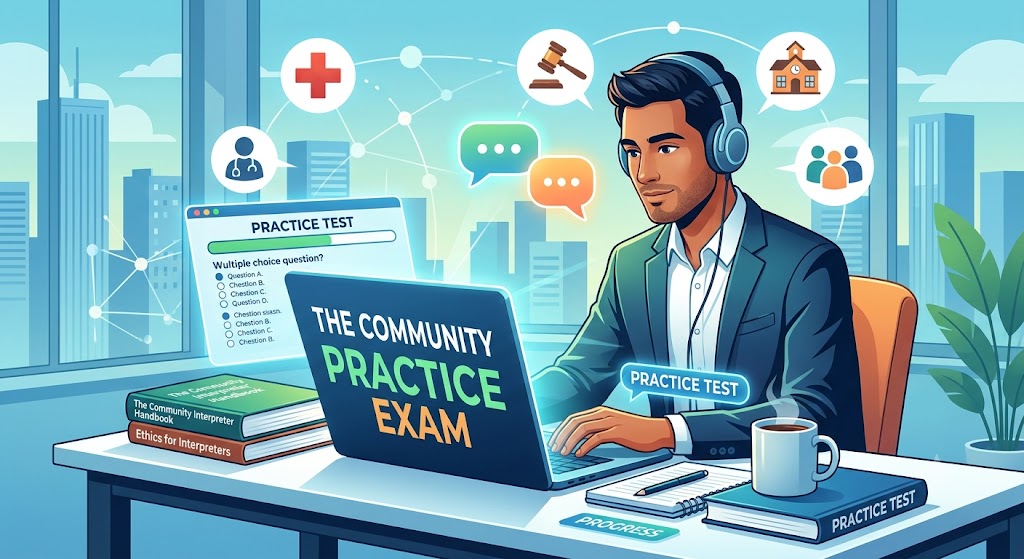
Additional Information
What the Course Entails and Exam Details
To prepare for the final certification exam, candidates are
strongly encouraged to complete a foundational training program, such as the
widely recognized 40-hour or 60-hour The Community Interpreter
certificate course. The course curriculum covers a vast array of topics,
aligning directly with national standards of practice and the specific
knowledge domains tested in the final examination.
The exam details primarily assess your mastery of the
content from your chosen authorized program. Key modules and skills you will be
expected to demonstrate proficiency in include:
- The
Role of the Interpreter: Understanding and applying standard-setting
and boundaries.
- Ethics
& Conduct: Comprehensive knowledge of national codes of ethics,
including impartiality, confidentiality, accuracy, and professionalism.
- Protocols
& Modes: Proper protocols and skills in the three modes of
interpretation: consecutive, simultaneous, and sight translation.
- Cultural
Competence: Strategies for identifying and mediating cultural
misunderstandings.
- Medical
& Specialized Terminology: Mastery of vocabulary for healthcare,
social services, and educational settings.
- Industry
Standards: Adherence to best practices and professional expectations.
What to Expect in the Final Exam
The final exam for The Community Interpreter is a
standardized assessment that determines your readiness to practice in the
field. To ensure success, it is vital to know the specific details and rules
that govern your examination, which may vary slightly depending on the
authorized program you chose.
The exam typically involves a thorough assessment of both
your knowledge and your practical skills. You can common features to include:
- Format:
A mix of assessment methods, commonly including multiple-choice questions
for knowledge-based sections, true/false scenarios, and often a proctored,
recorded oral skills assessment.
- Knowledge
Section: This evaluates your understanding of ethics, protocols, the
interpreter's role, and key terminology.
- Skills
Section: In the oral portion, you will be expected to perform in
real-time interpretation scenarios using consecutive, simultaneous, and
potentially sight translation modes.
- Passing
Score Requirements: Authorized testing organizations set specific
benchmarks for a passing grade, often requiring a minimum score (e.g., 70%
or higher) to receive certification.
- Time
Limits: Candidates are typically given a set amount of time to
complete each section of the exam. For example, a proctored knowledge test
may last between 1.5 to 2 hours, and the oral skills assessment is usually
shorter and more focused.
- Specific
Rules: You must abide by strict proctoring guidelines, which may
include restrictions on testing aids and the requirement for a secure
environment (especially for remote proctoring).
How to Study and
Exam Centers
Preparation is the single most important factor for success
in The Community Interpreter examination. Utilize a multi-faceted approach
combining thorough study with structured practice.
Effective Study Strategies:
- Utilize
Practice Tests: Integrate a resource like a comprehensive practice
test into your study routine to experience the exam format, identify weak
areas, and practice managing your time. These tests are essential for
self-assessment.
- Review
Your Core Course Materials: Go back to the foundation. Study The
Community Interpreter textbook, workbooks, and your original course
notes thoroughly.
- Master
National Standards: Memorize and apply national codes of ethics and
standards of practice (e.g., those from NCIHC, IMIA, or CHIA).
- Terminology
Drilling: Use flashcards, medical dictionaries, and specialized
glossaries (healthcare, legal, social services) in both your languages.
- Practice
Interpretation Modes: Record yourself performing consecutive and
simultaneous interpretation using various resources like news clips,
medical scripts, or recorded scenarios.
Where to Take the Exam:
- The
exam is usually administered by the authorized organization where you
completed your initial training course. Many testing centers across the
country are licensed to provide The Community Interpreter
certification exam.
- Authorized
Schools: Specific physical testing centers, often affiliated with
local hospitals, service organizations, or educational institutions, are
authorized schools where you can schedule your test.
- Online
Portals: Many institutions now offer a secure online testing option
with remote proctoring. You will use a dedicated online portal to access
the exam, requiring a stable internet connection, specific software, and
strict adherence to environmental guidelines.
Job Opportunities
from the Course
A certification from The Community Interpreter is
highly respected and significantly expands career prospects for bilingual
individuals. This credential is often a required qualification for a wide range
of positions.
Completing the course and passing the exam unlocks numerous
specific job titles and career paths in sectors dedicated to community language
access:
- Medical
Interpreter (Hospitals, Clinics, Private Practices)
- Educational
Interpreter (K-12 Schools, Colleges, Parent-Teacher Conferences, Special
Education Meetings)
- Social
Service Interpreter (Child Protective Services, Human Resources, Refugee
Resettlement Agencies, Social Security Offices)
- Community
Legal Interpreter (Law Firms, Immigration Services, Attorney Meetings -
specialized from high-level court interpreting)
- Freelance
Interpreter (Self-Employed, working across various community settings)
- Telephone
or Video Remote Interpreter (VRI) (Operating in any of the above sectors
remotely)
Frequently Asked Questions
Reviews
5.0
Based on 0 reviews
Leave a Review
No reviews yet. Be the first to review!