
The North Carolina Certified Paralegal Examination (NCCP) Practice Exam
$69.00
- Buy to unlock unlimited access to all Quiz questions and Answers in this Quiz.
- After purchase you can print a PDF of the whole quiz at any point. The PDF will contain the questions and the correct answers.
About this Exam
The North Carolina Certified Paralegal Examination (NCCP) is a voluntary certification program administered by the North Carolina State Bar Board of Paralegal Certification. This designation is designed for individuals who want to be recognized for possessing a uniform minimum level of competence to assist lawyers in the state. Achieving certification signifies a commitment to ethical and professional standards and provides a benchmark of legal knowledge tailored to North Carolina law. This practice exam is an indispensable tool for aspiring certified paralegals, serving as a realistic simulation to diagnose strengths and weaknesses, build confidence, and ensure optimal performance on the actual certification test. It is intended for paralegals who have met the state's educational or work experience requirements and are dedicated to advancing their careers within the North Carolina legal landscape.
Ready to test your knowledge?
Buy Now to Access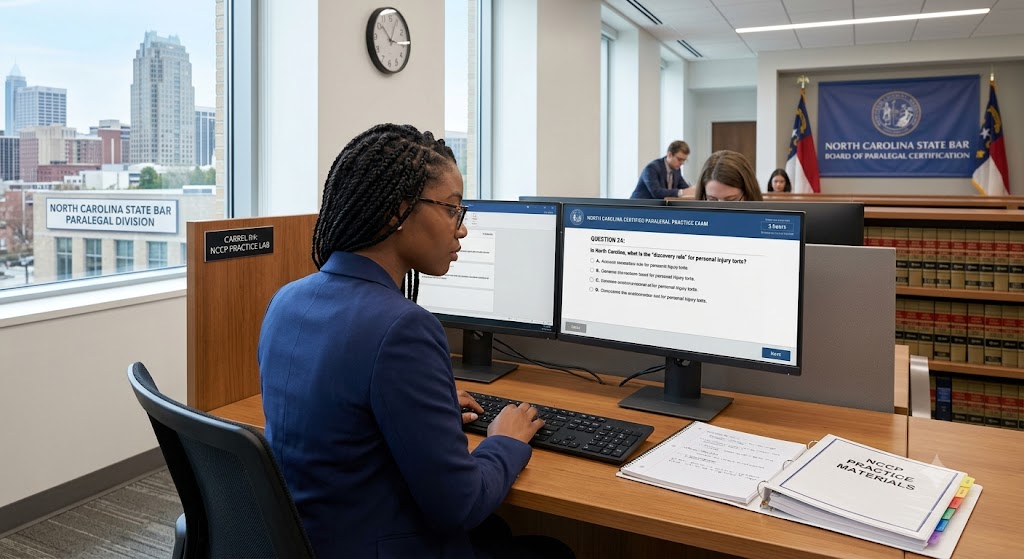
Additional Information
What the Course
Entails and Exam Details
A comprehensive preparation course, and by extension, the
practice exam, covers the critical domains necessary for competent paralegal
work in North Carolina. The material is meticulously structured to align with
the official exam specifications set by the North Carolina State Bar. Candidates
must grasp not only foundational legal concepts but also the nuances and
specific procedural rules of North Carolina's legal system. The primary topics
included are: North Carolina Legal System and Ethics (professional
responsibility); Torts; Contracts; Real Estate and Property Law; Family Law;
Criminal Law and Procedure; Civil Litigation and Procedure; Commercial Law and
Business Organizations; and Estates and Probate Law. Beyond subject matter, the
course entails developing sharp analytical and problem-solving skills, as well
as the ability to effectively communicate legal research and principles.
What to Expect in the Final Exam
The final North Carolina Certified Paralegal Examination is
a demanding assessment. It is now administered using remote proctoring
technology (such as ExamSoft/Examplify), allowing examinees to take the test on
a personal computer under supervision. Candidates can expect a computer-based
format that includes a combination of true/false, multiple-choice, matching,
and short answer/essay questions. The total testing time is typically five
hours, split between two main components: a three-hour Knowledge Exam with 120
multiple-choice questions (of which 100 are scored and 20 are pre-test),
followed by a two-hour Skills Exam focused on legal writing through an essay
response. To earn the Certified Paralegal credential, examinees must achieve a
minimum passing score of 70% on each section. Retake opportunities are
available but are subject to specific waiting periods and additional fees.
How to Study and
Exam Centers
To succeed on the NCCP, a structured, multifaced study
approach is critical. Begin by referencing the official NCCP Exam Study
Guide and specifications provided by the North Carolina State Bar, as these
detail the weighted point values of all tested topics. Actively using this
practice exam is highly recommended to identify knowledge gaps and refine
test-taking strategies under timed conditions. Complement this with official
materials, such as previous continuing legal education (CLE) content on
professional responsibility and NC-specific law, authoritative North Carolina
legal dictionaries, and textbooks. Creating a consistent study schedule,
forming study groups with fellow candidates, and reviewing relevant North
Carolina general statutes and case law are all proactive methods. Since the real
examination is administered via remote proctoring, "Exam Centers" are
effectively any secure, quiet, and reliable environment of your choice that
meets the state's technical and security requirements. For the real exam, registration
and information regarding remote proctoring can be accessed through the North
Carolina State Bar member portal.
Job Opportunities
from the Course
Achieving North Carolina Certified Paralegal status unlocks
diverse career paths and demonstrates to employers a verified standard of
competence. Certified individuals are highly sought after by law firms,
corporate legal departments, and government agencies throughout the state.
Specific job titles that this certification unlocks include:
- NC
Certified Paralegal
- Litigation
Paralegal
- Real
Estate Paralegal
- Commercial
Real Estate Paralegal
- Family
Law Paralegal
- Estate
Administration Paralegal
- Estates
and Probate Paralegal
- Corporate/Commercial
Law Paralegal
- Criminal
Law Paralegal
- Immigration
Law Firm Legal Assistant
- Legal
Support Specialist
- Legal
Administrator
- Government
Agency Legal Analyst
- In-House
Corporate Paralegal
- Judicial
Assistant/Clerk for NC Courts
Frequently Asked Questions
Reviews
5.0
Based on 0 reviews
Leave a Review
No reviews yet. Be the first to review!