
The STABLE Program Practice Exam
$69.00
- Buy to unlock unlimited access to all Quiz questions and Answers in this Quiz.
- After purchase you can print a PDF of the whole quiz at any point. The PDF will contain the questions and the correct answers.
About this Exam
The STABLE Program, which stands for Sugar, Temperature, Airway, Blood Pressure, Lab Work, and Emotional Support, is the most widely recognized educational course focused on the post-resuscitation and pre-transport stabilization of sick infants. It provides crucial training to neonatal and maternal healthcare providers, empowering them with a standardized, systematic approach to care that reduces neonatal mortality and morbidity. This certification is specifically designed for a wide range of perinatal professionals, including registered nurses in labor and delivery, postpartum, and nursery departments, as well as those in emergency medicine. It is also an essential course for physicians (pediatricians, family practitioners, residents), respiratory therapists, and pre-hospital emergency responders such as EMTs and paramedics, who may all be involved in the initial stabilization of a newborn. By standardizing the approach to the 'Golden Hour' of a neonate’s life, the course ensures that the entire care team can effectively organize and deliver prioritized care during a critical window.
Ready to test your knowledge?
Buy Now to Access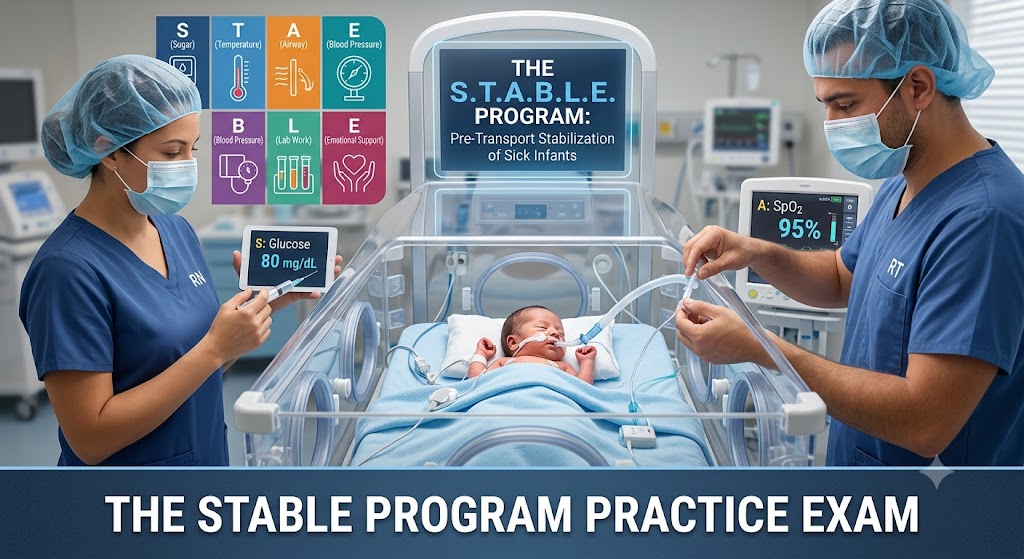
Additional Information
What the Course Entails and Exam Details
The core of The STABLE Program is a mnemonic designed to
help healthcare providers prioritize their actions when caring for a sick or
preterm infant. The curriculum is typically delivered through a comprehensive
Learner Manual, supplemented by in-person, interactive didactic courses (often
over one to two days) or a flexible online course through platforms like
HealthStream.
The modules covered in the course and reflected in the exam
include:
- Sugar
(S): Focuses on recognizing the symptoms of hypoglycemia in the
neonate, understanding safe glucose administration, and maintaining blood
sugar levels for metabolic stability.
- Temperature
(T): Covers methods for maintaining thermal stability, identifying and
managing hypothermia and hyperthermia, and the physiological consequences
of thermal stress.
- Airway
(A): Provides instructions on evaluating and managing an infant’s
respiratory status, including recognizing failure, establishing and
maintaining a safe airway, and appropriate respiratory support
pre-transport.
- Blood
Pressure (B): Teaches providers to recognize the types of shock in
infants and implement early, effective treatment to ensure proper
perfusion and blood pressure.
- Lab
Work (L): Explains how to prioritize and interpret essential lab tests
needed during stabilization, including recognizing the implications of
infection and septic workups.
- Emotional
Support (E): Stresses the critical professional responsibility to
support the family during the crisis of having a sick infant and a
possible transfer to a higher level of care facility.
- Quality
Improvement: This additional section discusses evaluating and
improving the care provided to sick infants.
The certification is intended for all healthcare providers
who must deliver stabilization care for newly born infants.
What to Expect in
the Final Exam
The S.T.A.B.L.E. Program Learner Exam is designed to
validate the knowledge acquired during the course. In its most common format
(e.g., the 7th edition), the exam is modular. This means students are typically
required to complete a post-test after each of the main six modules (Sugar,
Temperature, Airway, Blood Pressure, Lab Work, and Emotional Support).
The exam details are as follows:
- Format:
The questions are multiple-choice, focusing on practical application of
the stabilization concepts and data interpretation.
- Passing
Score: While specific requirements may vary slightly by the
administering body (e.g., in-person class vs. online portal), students
generally need to achieve a passing score of approximately 80% overall, or
on individual modules, to receive the completion card.
- Time
Limits: For the online version, module tests may be timed, though you
generally have sufficient time to complete them within the course
structure. In-person courses typically build in ample time for test
completion.
- Rules:
The exam is usually closed-book, though the entire Learner Manual should
be used for pre-course study. The goal of the practice exam is to prepare
you for these realistic, case-based questions, ensuring you understand the
rationale behind each action. Upon successful completion, providers
receive a S.T.A.B.L.E. Learner completion card, which is typically valid
for two years.
How to Study and Exam Centers
Preparation is the key to success in The STABLE Program.
Because the course focuses on practical, systematic application of knowledge
during a medical crisis, rote memorization is less effective than understanding
the concepts.
How to Study:
- Master
the Learner Manual: The official S.T.A.B.L.E. Learner Manual is the
single most important resource. Dedicate time to reading every chapter
thoroughly before attending a course or attempting the exam. It is
designed to be a working reference guide, not just a textbook.
- Use
Practice Exams: This is where a dedicated STABLE Program Practice Exam
is invaluable. It simulates the types of case-based, practical application
questions you will encounter, allowing you to test your knowledge,
identify weaknesses, and build confidence in your ability to apply the
mnemonic.
- Understand
the Mnemonic: Internalize what each letter of S.T.A.B.L.E. stands for
and the prioritizations it creates. Know the sequence and why it’s
critical (e.g., why correcting temperature is crucial for metabolism, but
Airway must often be addressed concurrently).
- Leverage
Supplemental Tools: Use official supplemental tools like the STABLEize
App, which offers dynamic teaching, calculations, and stabilization
information.
Exam Centers and How to Take the Exam:
You cannot take the final S.T.A.B.L.E. exam at generic test
centers like Pearson VUE. Instead, the certification process is integrated with
the course.
You have two primary options:
In-Person Learner Courses:
These are highly recommended, didactic-interactive courses taught by certified
instructors at hospitals, medical schools, or authorized regional training
centers. The exam is typically administered on-site as part of the course.
Online Learner Courses:
Authorized online versions of the course, such as those through HealthStream, are
available for institutional purchase. Upon finishing the online lessons, you
take the modular exams through the same portal. These can be completed from any
location with an internet connection, subject to the scheduling requirements of
your institution.
Job Opportunities
from the Course
A S.T.A.B.L.E. certification is highly valued by healthcare
facilities and can be a requirement or a significant asset for roles involving
neonatal care. It demonstrates a commitment to evidence-based, specialized
practice in a high-stakes environment.
Career paths and specific job titles that often require or
strongly prefer S.T.A.B.L.E. certification include:
- NICU
Registered Nurse (RN)
- Neonatal
Intensive Care Unit (NICU) Staff Nurse
- Labor
and Delivery Nurse
- Postpartum
/ Newborn Nursery Nurse
- Registered
Respiratory Therapist (RRT), specializing in Neonatal/Pediatric Care (NPS)
- Neonatal
Transport Nurse / Flight Nurse
- Emergency
Department Nurse (working with pediatric/neonatal patients)
- Neonatal
Nurse Practitioner (NNP)
- Physician
Assistant (PA) in Pediatrics or Neonatology
- Physician
(Pediatrician, Neonatologist, Family Practice, Emergency Medicine)
- Certified
Nurse-Midwife (CNM)
- Clinical
Nurse Specialist (CNS) in Neonatal or Perinatal care
For nurses, in particular, S.T.A.B.L.E. is frequently a
mandatory companion to certification in the Neonatal Resuscitation Program
(NRP) for employment in critical care settings.
Frequently Asked Questions
Reviews
5.0
Based on 0 reviews
Leave a Review
No reviews yet. Be the first to review!