
Thermite Welding Practice Exam
$69.00
- Buy to unlock unlimited access to all Quiz questions and Answers in this Quiz.
- After purchase you can print a PDF of the whole quiz at any point. The PDF will contain the questions and the correct answers.
About this Exam
The Thermite Welding Practice Exam is a crucial stepping stone for professionals seeking to gain specialized qualification in the precise art of thermite welding. This complex process involves a chemical reaction, not electricity, creating molten metal to join materials, making it unique and challenging. This practice exam mimics the rigorous challenges of the formal evaluation, allowing candidates to test both their knowledge and practical skills in a simulated environment before taking the high-stakes official test. It is primarily designed for existing welders looking to advance their skill set and enter niche industrial sectors.
Ready to test your knowledge?
Buy Now to Access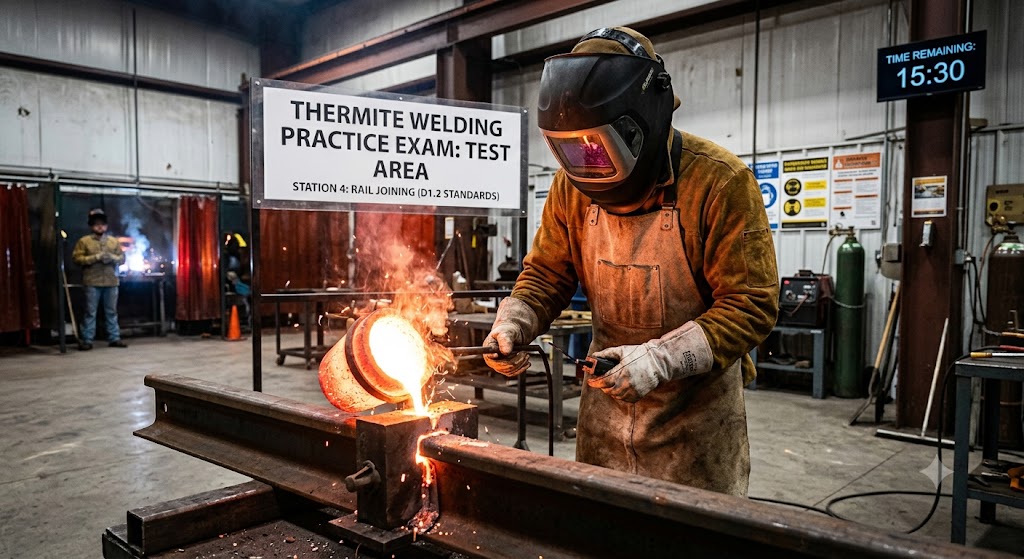
Additional Information
What the Course Entails and Exam Details
A preparation course for the Thermite Welding Practice Exam
comprehensively covers the unique aspects of this critical joining technology.
Students will master the safety protocols for handling hazardous reactants like
iron oxide and aluminum powder, understanding the precise exothermic reaction
that produces molten steel. The course details joint preparation, crucial mold
assembly, setup of the reaction crucible, preheating, reaction initiation, and
the controlled pour. Furthermore, candidates learn post-weld inspection
procedures, including visual assessment and potential non-destructive testing
(NDT) to ensure structural integrity, matching industrial codes such as those
for rail applications. The written and practical exams together evaluate
complete proficiency in all steps.
What to Expect in
the Final Exam
The Thermite Welding Practice Exam typically mirrors the
two-part structure common in official certification: a written examination and
a practical skills evaluation. The written component assesses knowledge of the
fundamental principles, safety standards, and procedure specifications through
a series of multiple-choice questions. In the practical portion, which is
highly critical, candidates must physically demonstrate their ability to safely
set up the equipment, prepare a joint, initiate the thermite reaction, complete
a real weld on a test piece, and often inspect the final product, all within a
specified time frame. A typical passing score for both components is 80%, with
strict adherence to safety protocol being mandatory for successful completion.
Proper personal protective equipment (PPE), including specialty welding
leathers and filters, is always required.
How to Study and
Exam Centers
Success on the Thermite Welding Practice Exam demands both
theoretical understanding and rigorous practical repetition. Start by obtaining
official study guides, procedural standards, and relevant industrial
specifications (e.g., specific railroad standards). Consider enrolling in
specialized welding programs or seeking mentorship from certified thermite
welders. Practice safe handling and setup repeatedly under supervision before
attempting a full reaction. Utilize simulation software if available, but
nothing replaces the hands-on experience of controlling the molten flow. The
formal practical examination usually takes place at authorized specialized
welding schools, dedicated industrial training centers, or potentially on-site
at railroad maintenance facilities equipped with appropriate safety
infrastructure and examiners. The theoretical component may sometimes be taken
through proctored online portals.
Job Opportunities from the Course
Completing a course that culminates in passing the Thermite
Welding Practice Exam opens specialized, high-demand career paths in heavy
industries. Key opportunities include:
- Thermite
Welder
- Track
Maintenance Specialist
- Railroad
Maintenance Engineer
- Specialized
Structural Welder (Heavy Industrial)
- Industrial
Maintenance Casting Repair Technician
These roles are critical in infrastructure, transportation,
and industrial fabrication sectors, offering competitive salaries and stability
due to the essential nature of the work.
Frequently Asked Questions
Reviews
5.0
Based on 0 reviews
Leave a Review
No reviews yet. Be the first to review!