
Tina Jones Gastrointestinal Practice Exam
$69.00
- Buy to unlock unlimited access to all Quiz questions and Answers in this Quiz.
- After purchase you can print a PDF of the whole quiz at any point. The PDF will contain the questions and the correct answers.
About this Exam
The Tina Jones Gastrointestinal Practice Exam is a core component of the Shadow Health Digital Clinical Experience (DCE). It is an advanced, high-fidelity virtual patient simulation designed for pre-licensure nursing students and healthcare professionals. Unlike a standard multiple-choice quiz, this "exam" evaluates your ability to perform a thorough, focused assessment on a virtual patient named Tina Jones, who presents with gastrointestinal complaints. The purpose is to bridge the gap between classroom theory and real-world clinical practice in a safe, interactive environment. Successfully navigating this case demonstrates competency in patient communication, critical thinking, and physical examination techniques.
Ready to test your knowledge?
Buy Now to Access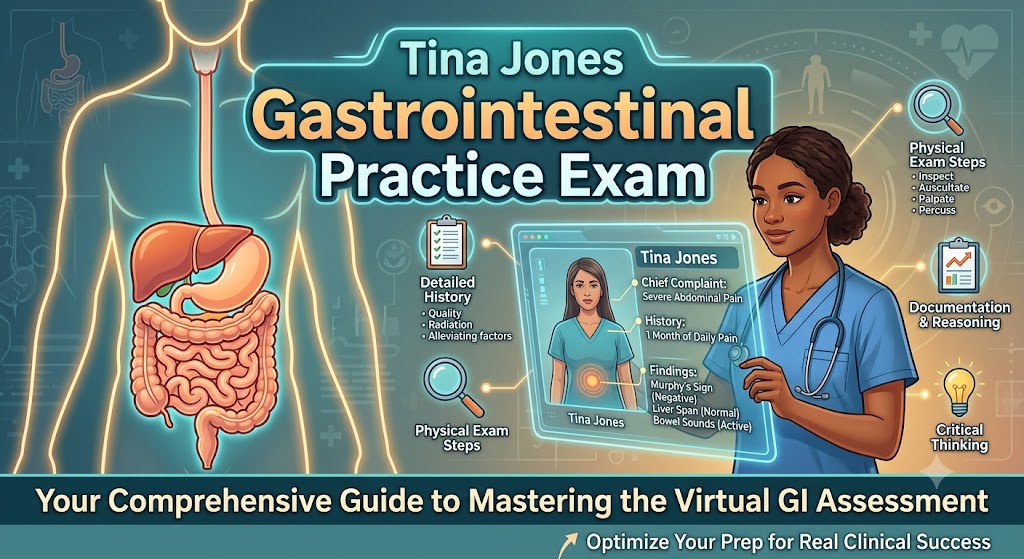
Additional Information
What the Course Entails and Exam Details
This module requires you to apply the knowledge you have gained in your health assessment and medical-surgical nursing courses. The course of study that leads to this practice test focuses on the anatomy and physiology of the gastrointestinal system, as well as common and complex pathologies.
The virtual simulation entails several specific skills and knowledge domains:
Subjective Data Collection (History Taking): You must ask Tina Jones precise, open-ended, and direct questions to elicit a comprehensive health history regarding her present illness. This includes the quality, quantity, frequency, timing, and severity of her pain.
Review of Systems (ROS): Beyond the chief complaint, you must systematically explore related systems (e.g., respiratory, cardiovascular, and genitourinary) to rule out other potential causes of her discomfort.
Objective Data Collection (Physical Exam): You must perform a virtual physical examination in the correct sequence for a gastrointestinal assessment: Inspection, Auscultation, Percussion, and Palpation. Your accuracy in identifying findings is crucial.
Interprofessional Communication & Documentation: The simulation requires you to translate your virtual actions and findings into professional medical terminology, using SBAR (Situation, Background, Assessment, Recommendation) format for reporting to a provider or a peer.
What to Expect in the Final Exam
The "final exam" in the context of the Shadow Health Tina Jones GI case often refers to the comprehensive attempt you submit for grading, which many programs treat as a prerequisite for clinical labs. Here is what to expect from this final evaluation:
Format: The format is a linear, virtual patient encounter. You operate through an interactive panel to 'talk' to the patient and select 'actions' to perform physical exams. A detailed anatomical panel allows you to specify where you are inspecting or palpating.
Scoring: Grading is multi-faceted. The Shadow Health platform generates a score based on a rubric that measures the thoroughness of your questions (subjective data), the correctness of your examination steps (objective data), and the accuracy of your final documentation and interpretation. Your instructor might set a specific threshold for passing, often requiring a score of 80% or 90% or higher.
Time Limit: The final comprehensive assignment is often timed, and your program might limit the total number of attempts you have to achieve the required score. While the initial learning modules might be self-paced, this practice test expects you to work efficiently.
Rules: You are generally expected to complete the case from start to finish in one session. The platform automatically tracks your actions and flags potentially missed questions or exam steps.
How to Study and Exam Centers
The key to success is familiarization and repetitive practice. Here is an actionable study strategy:
Start with the Focused Exams: Before attempting the comprehensive "practice exam," use the focused (learning) segments provided in the Shadow Health platform. These offer guided feedback and allow you to practice individual skills without the pressure of a final grade.
Map the GI Assessment Sequence: Memorize and practice the core assessment sequence: Inspection -> Auscultation -> Percussion -> Palpation. In standard physical exams, palpation is third, but for the abdomen, it is always last. Misordering this will lose you points.
Use the Question Banks: Review the question pools often available for Tina Jones. Note that the system requires natural-language-style input. Practice phrasing questions: "Tina, tell me about your pain," versus "When did the pain start?"
Practice Documentation: Do not overlook the final documentation step. Practice writing structured SOAP or SBAR notes that clearly articulate the subjective and objective data you collected and your resulting nursing diagnosis or recommendation.
Exam Centers: Because this is software-based, there are no specific physical "exam centers" for the simulation itself. You access the Tina Jones GI module online, typically through your university's learning management system (like Canvas, Blackboard, or Brightspace) or directly via a unique access portal provided by Shadow Health when you purchase the product.
Job Opportunities from the Course
While the Tina Jones Gastrointestinal Practice Exam is not a standalone credential, completing it is a vital milestone in your nursing education. Demonstrating competency in complex simulations like this proves to future employers that you are "clinical ready." It directly contributes to the path toward a Bachelor of Science in Nursing (BSN) or another professional nursing license.
The critical thinking and assessment skills it builds unlock career paths in diverse healthcare settings, including:
Medical-Surgical Registered Nurse (RN)
Gastrointestinal Speciality Nurse (GI RN)
Emergency Department (ED) Nurse
Critical Care Nurse (ICU)
Outpatient Clinic Nurse
Home Health Nurse
Public Health Nurse
Frequently Asked Questions
Reviews
5.0
Based on 0 reviews
Leave a Review
No reviews yet. Be the first to review!