
Tissue Engineering Practice
$69.00
- Buy to unlock unlimited access to all Quiz questions and Answers in this Quiz.
- After purchase you can print a PDF of the whole quiz at any point. The PDF will contain the questions and the correct answers.
About this Exam
This Tissue Engineering Practice Exam is designed as a comprehensive preparatory tool for students, researchers, and biomedical professionals aiming to validate their expertise in the field of regenerative medicine. The underlying certification, which this practice test supports, is typically intended for individuals seeking roles in biomedical research, biotechnology product development, and clinical application development. It serves to gauge a candidate's mastery over core principles, methodologies, and the ethical landscape of tissue engineering. Passing the final exam demonstrates a significant level of competence required to contribute to the complex and evolving field of creating functional human tissues for transplantation and disease modeling.
Ready to test your knowledge?
Buy Now to Access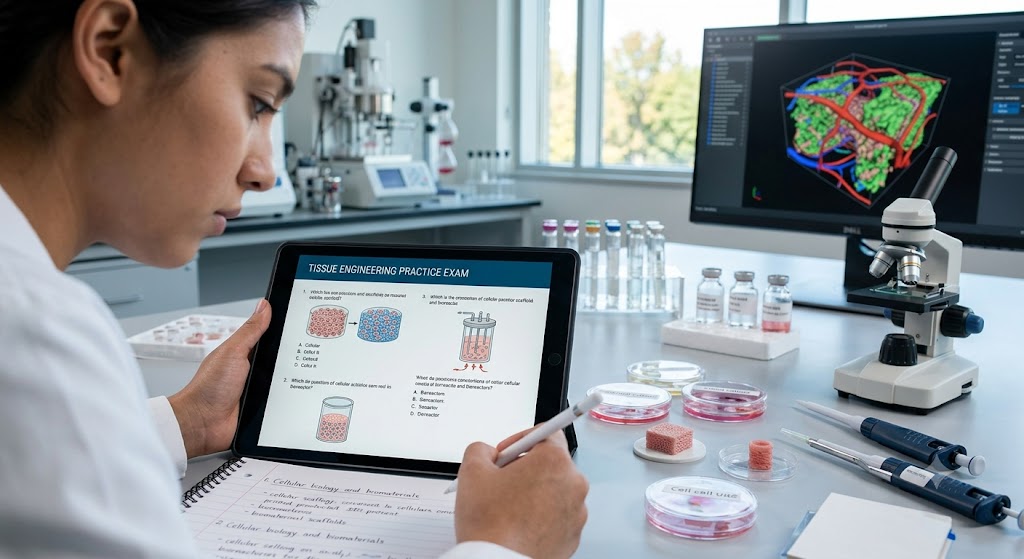
Additional Information
What the Course Entails and Exam Details
A standard comprehensive course in Tissue Engineering covers
a multidisciplinary syllabus that merges biology with engineering principles.
While this is a practice exam, it reflects the breadth of topics typically
included in a robust certification program.
Core study areas covered in the final certification exam
include:
- Cell
Biology Foundations: Stem cell types (embryonic, induced pluripotent,
adult), cell signaling, differentiation, and cell-matrix interactions.
- Biomaterials
and Scaffolds: Properties of natural (e.g., collagen, alginate) and
synthetic (e.g., PLGA, PEG) materials, scaffold fabrication techniques (3D
printing, electrospinning), degradation rates, and biocompatibility.
- Bioreactors
and Systems Engineering: Designing and utilizing bioreactors to
provide controlled mechanical, physical, and chemical environments for
tissue maturation.
- Tissue
Assembly and Vascularization: Strategies for creating complex,
functional three-dimensional tissues, and solutions for vital nutrient and
oxygen transport.
- Clinical
and Ethical Considerations: Regulatory pathways (FDA, EMA), ethical
issues surrounding stem cell use, and manufacturing challenges for
clinical translation.
What to Expect in
the Final Exam
The final certification exam for tissue engineering usually
follows a structured format designed to rigorously test both foundational
knowledge and critical thinking. While specific details can vary slightly
depending on the granting body, you should typically expect:
- Exam
Format: The exam generally consists of 100-120 Multiple-Choice
Questions (MCQs) designed to test recall, application, and analysis of
core concepts.
- Time
Limit: Candidates are usually allotted 120-180 minutes to complete the
exam.
- Passing
Score Requirements: A minimum passing score of approximately 70-75% is
often required to achieve certification.
- Rules:
The final exam is typically administered under proctored conditions, which
may be either in-person at a testing center or online with live
proctoring. Closed-book rules apply unless stated otherwise for specific
sections.
How to Study and Exam Centers
Preparation for a specialized technical exam like tissue
engineering requires a systematic approach. Here are actionable study
strategies:
- Utilize
Practice Exams: Take this practice exam multiple times to familiarize
yourself with the question style, time constraints, and to identify areas
of weakness in your knowledge. Reviewing incorrect answers is crucial.
- Primary
Literature and Textbooks: Supplement practice with recognized academic
textbooks such as "Principles of Tissue Engineering" (Lanza et
al.) and core research papers detailing landmark studies and recent
technological advancements.
- Review
Regulatory Guidelines: Study current FDA and EMA regulatory frameworks
relevant to regenerative medicine products (e.g., cell therapies and
tissue-engineered products).
- Online
Portals: Many professional bodies administer the final certification
through dedicated online learning and testing portals. Ensure your
computer meets technical requirements for proctored online exams.
- Exam
Centers: Where physical testing is required, certifications are often
proctored through authorized physical testing centers, such as Pearson
VUE, or hosted directly by universities and schools with specialized
biomedical departments.
Job Opportunities
from the Course
A certification validated by a tissue engineering course
unlocks a diverse array of professional opportunities across biotechnology,
academia, and medical device sectors. The skills acquired are highly valued in
roles focused on research, development, and regulation of regenerative
products.
The specialized knowledge can lead to career paths such as:
- Biomedical
Research Scientist (Cell Therapy or Regenerative Medicine)
- Tissue
Engineer / Biomaterials Scientist
- Bioprocess
Engineer (Scale-up and Manufacturing)
- Product
Development Manager in Biotech
- Regulatory
Affairs Specialist (for Cell/Tissue Products)
- Clinical
Research Associate
- Biofabrication
Engineer (3D Bioprinting)
- Process
Development Engineer
Frequently Asked Questions
Reviews
5.0
Based on 0 reviews
Leave a Review
No reviews yet. Be the first to review!