
TMAS 1 Practice Exam
$69.00
- Buy to unlock unlimited access to all Quiz questions and Answers in this Quiz.
- After purchase you can print a PDF of the whole quiz at any point. The PDF will contain the questions and the correct answers.
About this Exam
The Testing Management and Assessment System (TMAS) 1 Practice Test is a comprehensive tool designed to prepare candidates for the TMAS Level 1 certification. This certification validates foundational knowledge and practical skills required to effectively design, implement, and manage testing and assessment programs. It is an essential credential for early-career professionals, including test coordinators, assessment specialists, corporate trainers, quality assurance analysts, and educators involved in formal evaluation. TMAS 1 establishes a standardized, rigorous approach to ensuring the reliability, validity, and fairness of any assessment process.
Ready to test your knowledge?
Buy Now to Access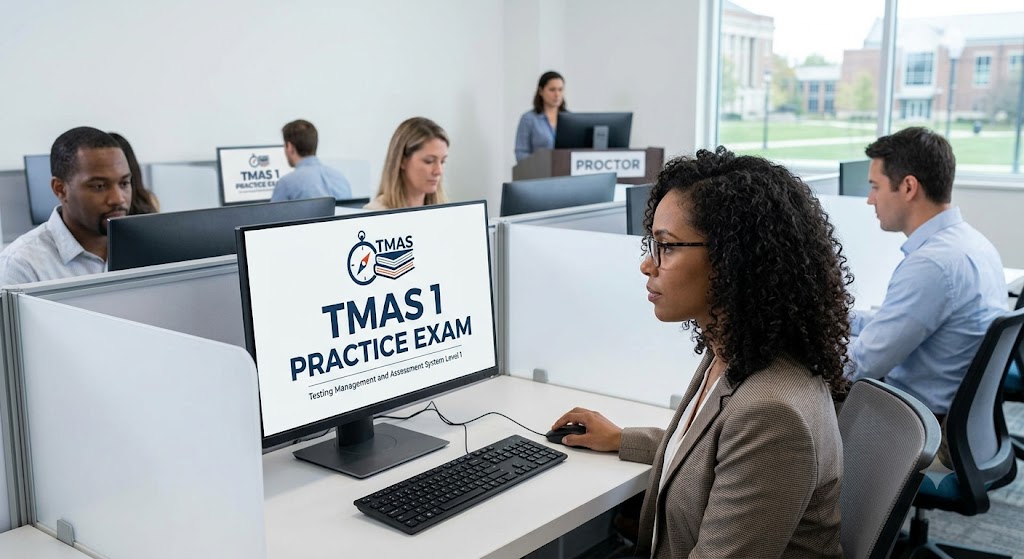
Additional Information
What the Course Entails and Exam Details
The TMAS 1 exam covers a wide array of core principles. It delves deeply into the entire assessment lifecycle, ensuring you understand how to move from initial concept to successful delivery and analysis. The curriculum focuses heavily on:
Foundations of Assessment: Principles of validity, reliability, and fairness in testing, alongside understanding different types of assessment (e.g., formative vs. summative, norm-referenced vs. criterion-referenced).
Test Design and Development: Creating effective test items, including multiple-choice, essay, and performance-based tasks, along with blueprinting and standard setting.
Administration and Management: Techniques for secure and standardized test delivery, proctoring protocols, and managing digital and physical testing environments.
Data Analysis and Reporting: Basic psychometric concepts, interpreting test scores, analyzing item performance, and communicating results to stakeholders.
Legal and Ethical Considerations: Understanding data privacy, intellectual property in assessment, and accessible testing for diverse populations.
What to Expect in the Final Exam
The actual TMAS 1 Final Exam is a rigorous, computer-based assessment. While the specific length and passing score can vary slightly, candidates should prepare for:
Format: A multiple-choice examination, typically containing 75 to 100 questions. Some advanced versions may include scenario-based or short practical application items.
Duration: Candidates are generally given 90 to 120 minutes to complete the test.
Passing Score: The target passing score is usually between 70% and 75%.
Rules: The exam is typically closed-book and non-proctored, though security measures within the online system ensure integrity. A basic calculator function is often provided.
How to Study and Exam Centers
The key to success is a structured study plan that includes both theoretical review and practical application. We recommend:
Interactive Practice: Utilize comprehensive TMAS 1 Practice Tests like this one to familiarize yourself with the question types, pacing, and core knowledge. Practice is the single most effective way to identify and fill knowledge gaps.
Official Study Guides: Review all materials provided with your exam registration. These are the foundation of the test content.
Concept Mapping: Create visual aids to link different concepts, such as connecting "validity" to "test blueprinting" and "content review."
Real-world Scenarios: Try to apply the principles you learn to practical situations you have encountered or can imagine. This helps you understand "how" and "why" techniques are used, not just "what" they are.
The TMAS 1 exam is entirely online. Candidates register via an authorized portal (such as a corporate university, professional association, or a designated testing partner). Once registered, you will receive login credentials and can take the exam from any location with a secure, stable internet connection, without the need to travel to a physical testing center like Pearson VUE.
Job Opportunities from the Course
A TMAS 1 certification serves as a powerful professional differentiator, opening doors to a variety of impactful career paths. Here are just a few job titles unlocked by this credential:
Assessment Coordinator: Manage the logistics and operations of large-scale testing programs within school districts, government agencies, or large corporations.
Corporate Trainer: Use your assessment expertise to design pre-training evaluations, in-course checks, and post-training certifications to measure learning effectiveness.
Quality Assurance (QA) Analyst: Apply your test management skills in a non-traditional setting, ensuring that software, processes, or products meet rigorous quality standards.
Data Specialist (Assessment): Collect, manage, and analyze performance data to inform instructional decisions and organizational strategy.
Learning & Development (L&D) Specialist: Contribute to the creation and validation of competency models and associated assessment tools.
Instructional Designer: Incorporate effective assessment strategies throughout the course design process.
Test Development Associate: Work with subject matter experts to author and review test items and assessment content.
Program Evaluator: Evaluate the overall effectiveness and impact of educational or training programs.
Frequently Asked Questions
Reviews
5.0
Based on 0 reviews
Leave a Review
No reviews yet. Be the first to review!