
Top Lineman Practice Test
$69.00
- Buy to unlock unlimited access to all Quiz questions and Answers in this Quiz.
- After purchase you can print a PDF of the whole quiz at any point. The PDF will contain the questions and the correct answers.
About this Exam
The "Top Lineman Practice Exam" is a essential preparation tool designed for individuals aspiring to reach the highest levels of proficiency as electrical power-line installers and repairers. This comprehensive practice test is a crucial resource for apprentice linemen seeking to advance to journeyman status, as well as for experienced lineworkers aiming to validate their expertise and achieve "top lineman" recognition. It is engineered to simulate the challenging, multi-faceted nature of real-world lineman certification exams and job duties, covering a wide spectrum of technical knowledge, practical skills, and, most importantly, safety protocols. Utilizing this practice test helps candidates identify their strengths, improve on weak areas, and build the confidence necessary to succeed in their career progression and official certification processes.
Ready to test your knowledge?
Buy Now to Access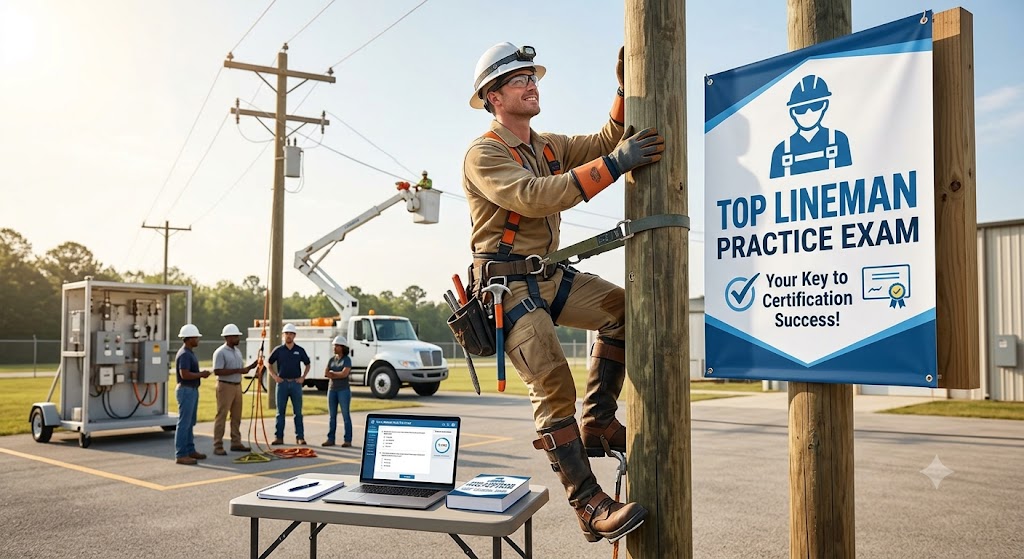
Additional Information
What the Course Entails and Exam Details
Preparing for top-level lineman status or certification is a
rigorous process. While a "practice exam" is not a full-course in
itself, the knowledge required to pass is extensive and mirrors the curriculum
found in advanced lineman training programs. Key topics and skills evaluated by
a top lineman-level test typically include:
- Safety
and Regulations: Extensive knowledge of OSHA regulations, company
safety rules, proper use of Personal Protective Equipment (PPE), first
aid, CPR, and emergency rescue procedures (including pole-top and bucket
truck rescue).
- Electrical
Theory and Principles: Understanding alternating current (AC) and
direct current (DC) circuits, Ohm's Law, power factor, transformers,
grounding, and voltage regulation.
- Blueprint
Reading and Diagrams: The ability to interpret complex electrical
blueprints, circuit diagrams, and utility maps to understand system
layouts.
- Construction
and Maintenance: Mastery of techniques for overhead and underground
line construction, installing poles, crossarms, insulators, transformers,
switches, and other equipment. Knowledge of maintenance schedules and
troubleshooting.
- Tool
and Equipment Proficiency: Expert use and maintenance of lineman hand
and power tools, climbing gear, aerial lifts, digger trucks, tensioning
equipment, and various diagnostic instruments like multimeters and
live-line testers.
- Hot
Line Work (if applicable): Understanding principles and methods for
working on energized lines using appropriate techniques and insulating
equipment.
- Climbing
Skills: High proficiency in climbing wooden poles and transmission
towers safely and effectively.
- Communication
and Teamwork: Essential soft skills for safety and efficiency in a
high-risk environment.
- Regulatory
Compliance: Understanding other relevant industry and environmental
standards.
The practice test itself is structured to test this range, often
through a blend of multiple-choice questions for theory and scenario-based
questions to assess practical decision-making, occasionally including elements
that simulate the analysis of physical tasks.
What to Expect in
the Final Exam
While actual lineman certification exams can vary by state,
union, utility company, or testing body, a "top lineman" standard
generally involves multiple phases. A candidate should prepare for:
- Written
Exam: This is often the first, rigorous hurdle. It typically consists
of numerous multiple-choice or short-answer questions (100-150+) covering
all the theoretical knowledge listed in section 2.
- Format:
Digital or paper, timed (e.g., 2-4 hours).
- Passing
Score: A high passing score is usually required, often 70-80% or
more.
- Practical/Skills
Assessment: This critical phase directly evaluates hands-on
proficiency. Candidates will be required to demonstrate essential tasks in
a simulated or real training yard.
- Tasks:
Climbing poles (timed, for technique and safety), framing poles,
installing crossarms, rigging, making connections, conducting simulations
of live-line work (or using hot sticks/rubber gloves in appropriate
settings), and, most critically, demonstrating rescue procedures.
- Scoring:
Evaluated based on strict adherence to safety protocols, efficiency, and
correctly completing the assigned task. Faster times don't always mean a
higher score; safety and correct procedure are paramount. Points can be
deducted or the candidate instantly failed for serious safety violations.
- Oral
Interview/Panel: In some settings, a panel interview may be part of
the final evaluation, especially for moving to journeyman status, to
discuss experience, judgment, and commitment to safety.
Crucially, the "Top Lineman Practice Exam" is
designed to prepare you specifically for the written knowledge and the logical
decision-making components of these final assessments, giving you the edge
needed to proceed confidently to the practical tests. All final exams will
have stringent rules regarding appropriate footwear, gear, and, without
exception, a zero-tolerance policy for safety violations during any practical
phase. Ample time is provided for written questions, but you must move
methodically and clearly. Practical assessments are not always a race; safe and
correct execution within reasonable time limits is the goal.
How to Study and
Exam Centers
Effective preparation is the key to achieving a "top
lineman" score on both the practice test and actual certifications.
How to Study:
Consistent Practice:
Dedicate regular study time. Take the "Top Lineman Practice Exam"
multiple times, treating each attempt like a real test day to build stamina and
identify weak areas. Review all correct and incorrect answers and their
detailed explanations.
Focus on Weakness: Pay
close attention to sections where you consistently struggle. Re-read the
relevant material in your training books, reference manuals (OSHA guidelines,
company rules), and online resources.
Utilize Multiple Resources:
Don't rely solely on one source. Use training manuals, standard industry
textbooks, official safety guides (like OSHA 10/30 materials), and recognized
online lineman training platforms.
Hands-On Training: For the
practical skills, nothing beats real-world experience. If you are an
apprentice, make the most of your on-the-job training. In a training program,
practice climbing, rigging, and equipment installation techniques as frequently
as safely possible under guidance. Simulate rescue scenarios.
Form a Study Group: Collaborating
with fellow apprentices or experienced lineworkers can provide diverse
perspectives, peer support, and a way to quiz each other.
Maintain Physical Fitness:
Lineman work is highly physical. Ensure your climbing, lifting, and dexterity
skills are sharp. Physical condition can directly affect your performance and
safety in the practical tests.
Focus on Safety: Make
safety protocols second nature. In written questions and practical scenarios,
prioritize the correct safety procedure above all else.
Time Management: Use the
timed feature of practice tests to learn how to pace yourself through a long
exam.
Exam Centers & Official Testing:
The "Top Lineman Practice Exam" is a practice
resource, typically accessed via an online portal. However, for actual official
lineman certifications (like journeyman status), exams and training occur
through several channels:
- Utility
Companies: Large utility providers often have their own comprehensive
internal training programs, apprenticeship pathways, and certification
processes, including written and practical exams.
- Union
Training Centers: Groups like the International Brotherhood of
Electrical Workers (IBEW) and National Electrical Contractors Association
(NECA) operate Joint Apprenticeship and Training Committees (JATC) with
rigorous training and certification standards.
- Community
Colleges and Trade Schools: Many public and private educational
institutions offer lineman training certificates and degrees, leading to
initial certifications and providing the pathway to advance. These often
host written and practical testing components.
- Authorized
Testing Providers: Some generic knowledge certifications or components
might be delivered through standard testing centers (like Pearson VUE),
but the full physical/practical lineman certification is almost
always tied to a physical training facility or employer. Check with
your specific employer, union local, or state regulatory body for details
on official, recognized exam centers and procedures.
Job Opportunities from the Course
A successful lineman career, particularly when one has
trained and validated their knowledge to a "top" or journeyman
standard, unlocks a wide array of rewarding and well-compensated career paths.
While job titles can vary, achieving proficiency is key for these roles:
- Apprentice
Lineman: This is the common entry point, involving extensive
on-the-job and classroom training. Higher knowledge and scores, as
demonstrated by preparation resources, can often expedite advancement.
- Journeyman
Lineman: The ultimate goal for many. Journeymen are fully certified to
work independently (or lead crews) on energized and de-energized lines,
often commanding the highest salaries. This status is achieved after a
formal, rigorous apprenticeship.
- Utility
Worker: A broader title that can encompass various tasks within a
utility company, including line work, often as part of a crew.
- Substation
Technician/Electrician: Focused on the specialized equipment and
systems within electrical substations, a critical role related to power
distribution.
- Power
Line Repairer: A title often associated with maintenance and
troubleshooting existing line infrastructure.
- Telecommunications
Lineman: Similar in skill and safety requirements, focusing on the
installation and maintenance of communication lines (fiber optics, phone,
coaxial cables). Some aspects of electrical lineman knowledge can
translate or require dual expertise in shared infrastructure situations.
- Transmission
Line Mechanic: Specializing in the large, high-voltage towers and
lines that transport power over long distances.
- Foreman/Crew
Leader: With experience and demonstrated expertise (often validated by
top-level performance and leadership skills), journey-level linemen can
advance to lead crews and projects.
A career in linework is not just a job, but a respected and
vital public service with significant growth potential, competitive pay, and
strong benefits. Diligent study and successful completion of assessments are
paramount to unlocking these rewarding opportunities safely and effectively.
Frequently Asked Questions
Reviews
5.0
Based on 0 reviews
Leave a Review
No reviews yet. Be the first to review!