
Total Productive Maintenance (TPM) Practice Test
$69.00
- Buy to unlock unlimited access to all Quiz questions and Answers in this Quiz.
- After purchase you can print a PDF of the whole quiz at any point. The PDF will contain the questions and the correct answers.
About this Exam
The Total Productive Maintenance (TPM) certification validates a professional's comprehensive understanding of proactive and preventative maintenance strategies within an industrial or manufacturing setting. TPM is a holistic approach to equipment maintenance that strives to achieve perfect production: no breakdowns, no small stops or slow running, no defects, and a safe working environment with no accidents.
This certification is designed for a broad audience, including plant managers, maintenance technicians, production supervisors, manufacturing engineers, and anyone involved in operational excellence or continuous improvement initiatives. It is ideal for individuals looking to demonstrate their mastery of the TPM pillars and their ability to improve machine availability, performance, and overall equipment effectiveness (OEE).
Ready to test your knowledge?
Buy Now to Access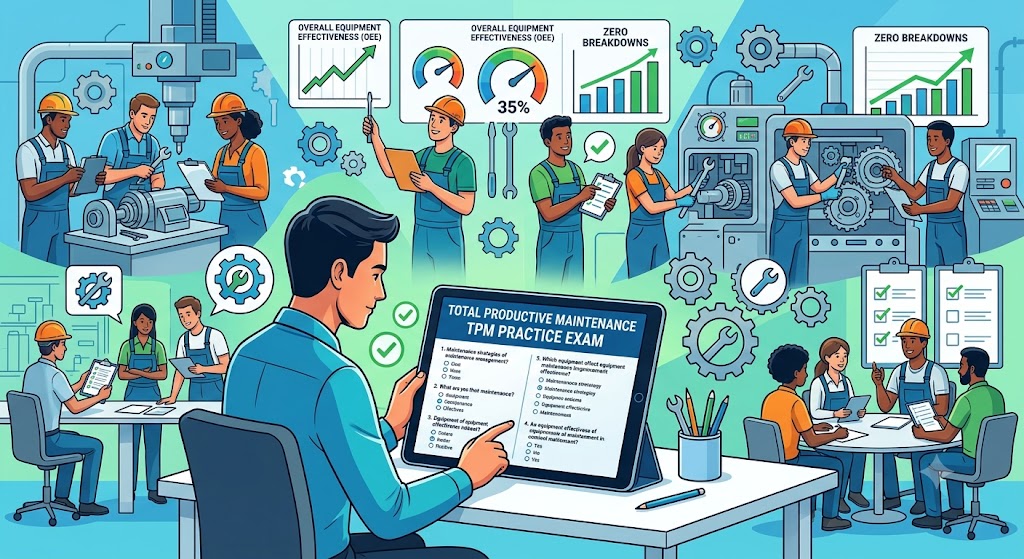
Additional Information
What the Course Entails and Exam Details
This comprehensive course covers the foundational knowledge
and practical skills necessary to implement and sustain a successful TPM
program. Students will delve into the core philosophy of TPM, learning how it
integrates production and maintenance to maximize equipment effectiveness.
The syllabus typically covers the following key domains:
- TPM
Pillars and Philosophy: Understanding the eight pillars of TPM,
including Autonomous Maintenance, Planned Maintenance, Quality
Maintenance, Focused Improvement (Kobetsu Kaizen), Early Equipment
Management, Education and Training, Office TPM, and Safety, Health, and
Environment.
- Overall
Equipment Effectiveness (OEE): Mastering the calculation and analysis
of OEE, including the availability, performance, and quality rates, to
identify areas for improvement and measure the impact of TPM initiatives.
- Loss
Analysis and Reduction: Learning to identify and eliminate the
"six big losses" that contribute to equipment-related
inefficiencies.
- Implementation
Strategy: Developing a structured approach for planning, launching,
and sustaining a TPM program within an organization, including overcoming
cultural resistance.
- TPM
Tools and Techniques: Gaining proficiency in using various TPM tools,
such as the 5S system, visual management, and autonomous maintenance
checklists.
What to Expect in
the Final Exam
The Total Productive Maintenance (TPM) Final Exam is a
rigorous assessment designed to evaluate your theoretical knowledge and
practical application of TPM principles. The exact format may vary slightly
depending on the certifying body (e.g., SME, ASQ, or other specialized
organizations), but generally includes the following characteristics:
- Format:
The exam typically consists of multiple-choice questions, which may
include scenario-based questions that require analyzing a manufacturing
situation and selecting the appropriate TPM tool or strategy. Some
advanced certifications might also include a case study or practical
application component.
- Number
of Questions: The number of questions can range from 50 to 100 or
more.
- Time
Limit: Expect a time limit, often between 90 minutes and three hours,
depending on the number and complexity of the questions.
- Passing
Score: The passing score usually varies by institution, often ranging
from 70% to 80%.
- Specific
Rules: Check with your specific testing authority regarding specific
rules, such as whether it's an open-book exam, allowed calculators, and ID
requirements. Online proctored exams will have strict environmental and
behavioral rules.
How to Study and
Exam Centers
Preparation is crucial for success on the TPM exam. Here is
a breakdown of actionable study strategies and how to locate testing centers:
Actionable Study Strategies:
- Leverage
Recommended Resources: Thoroughly study the official training manuals,
textbooks, and any reading lists provided by the certifying body.
- Engage
in Hands-on Practice: The best way to learn TPM is by doing. If
possible, volunteer for TPM implementation projects within your
organization or identify opportunities to apply TPM tools like 5S or OEE
calculations in your current role.
- Form
Study Groups: Collaborating with peers preparing for the same exam can
provide valuable insights, support, and opportunities for discussion and
peer-to-peer teaching.
- Utilize
Practice Exams: Take as many practice exams and quizzes as possible.
These will help you understand the types of questions to expect, manage
your time effectively, and identify areas where you need additional study.
- Attend
Workshops and Seminars: Consider attending TPM-focused workshops,
seminars, or webinars led by industry experts. These can offer practical
advice and real-world examples.
Exam Centers:
Where you take the exam depends entirely on the organization
granting the certification. Here are the common pathways:
- Online
Portals: Many certifications are now offered through online proctoring
services, allowing you to take the exam from the comfort of your home or
office, provided you meet certain technical and environmental
requirements.
- Testing
Centers: Some organizations partner with established testing center
networks like Pearson VUE or Prometric, which have physical locations
globally.
- Authorized
Schools or Organizations: In some cases, organizations, community
colleges, or professional associations offer training courses culminating
in the exam.
Always check the official website of your specific
certification body for the most current information regarding registration,
study materials, and testing locations.
Job Opportunities
from the Course
A TPM certification can significantly enhance your career
prospects in manufacturing and production. The skills acquired are highly
transferable and in-demand by organizations striving to improve efficiency,
reduce costs, and achieve operational excellence.
Here is a list of specific job titles and career paths that
a TPM certification unlocks:
- TPM
Coordinator or Facilitator
- Maintenance
Manager or Supervisor
- Production
Manager or Supervisor
- Manufacturing
Engineer
- Operations
Manager
- Continuous
Improvement (CI) Specialist
- Operational
Excellence Leader
- Process
Engineer
- Plant
Manager
- Consultant
(specializing in manufacturing efficiency and asset management)
Achieving this certification demonstrates a commitment to
professional growth and equips you to make significant contributions to any
production organization.
Frequently Asked Questions
Reviews
5.0
Based on 0 reviews
Leave a Review
No reviews yet. Be the first to review!