
Transformers Test 1 Practice
$69.00
- Buy to unlock unlimited access to all Quiz questions and Answers in this Quiz.
- After purchase you can print a PDF of the whole quiz at any point. The PDF will contain the questions and the correct answers.
About this Exam
Welcome to your comprehensive study resource for the Transformers Test 1 Practice Exam. This simulation is meticulously crafted for students and aspiring technicians in electrical engineering, industrial electronics, and power distribution sectors. It is designed to validate your foundational knowledge of transformer principles before challenging the official, high-stakes certification or academic exam that serves as a gateway to technical roles in the energy sector. By engaging with this practice test, you are actively preparing to demonstrate your competence in a critical area of power management.
Ready to test your knowledge?
Buy Now to Access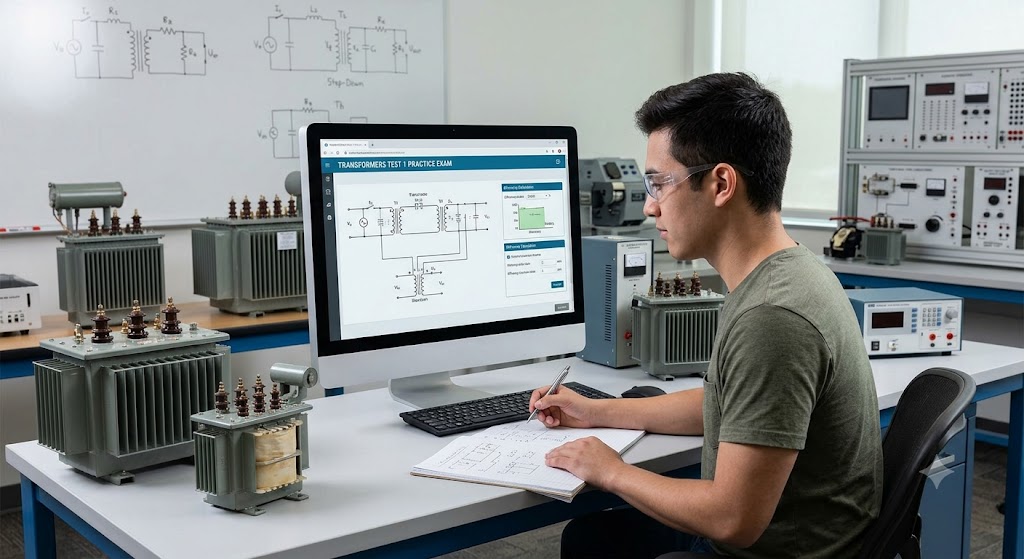
Additional Information
What the Course Entails and Exam Details
This practice exam serves as a direct mirror of common
introductory transformer certification curriculums. The core competencies
covered in this practice test include a thorough understanding of Faraday's Law
of Electromagnetic Induction as it applies to transformers, ideal transformer
voltage and current relationships, and the calculation of efficiency. You will
be expected to master turns ratio calculations and distinguish between various
transformer types, including step-up, step-down, and isolation transformers.
The syllabus also emphasizes polarity testing, dot convention, and fundamental
power calculations essential for real-world application.
What to Expect in the Final Exam
While actual testing parameters are defined by specific
certifying bodies (such as academic institutions or industry organizations), this
practice simulation is modeled after standard professional testing formats.
When you challenge the full Transformers Test 1 module, you can typically
expect a timed examination, often between 60 to 90 minutes. The format usually
consists of 40 to 60 multiple-choice questions designed to assess both
theoretical comprehension and practical application through scenario-based
problems and calculations. Most standard technical certifications require a
passing score of 70% or higher to demonstrate proficiency in the material.
How to Study and Exam Centers
Effective preparation is key to success. We recommend
starting with a detailed review of your primary course textbook, focusing
heavily on formula derivation and application examples. Create comprehensive
flashcards for transformer-specific terminology and key principles like the dot
convention. Form study groups to discuss complex power calculation scenarios.
Most importantly, use this practice test repeatedly under timed conditions to
improve your speed and accuracy. Remember, this specific simulation is
typically accessed through online educational portals, learning management
systems (LMS) within educational institutions, or authorized training partner
websites, rather than traditional physical testing centers.
Job Opportunities from the Course
Mastery of the concepts validated by this practice exam and
the subsequent final certification opens diverse career paths in power
engineering and industrial systems. Potential job titles and career
opportunities include:
- Electrical
Technician (Power Systems Focus)
- Field
Service Engineer
- Industrial
Maintenance Mechanic
- Power
Distribution Operator
- Junior
Electrical Design Engineer
- Utility
Line Worker (Technical Specialist)
- Energy
Management Consultant
Successful completion of transformer certification
demonstrates to employers that you possess the technical acumen necessary for
roles critical to the stability and efficiency of the electrical grid and
modern industrial infrastructure.
Frequently Asked Questions
Reviews
5.0
Based on 0 reviews
Leave a Review
No reviews yet. Be the first to review!