
Transport Canada Commercial Helicopter Practice Exam
$69.00
- Buy to unlock unlimited access to all Quiz questions and Answers in this Quiz.
- After purchase you can print a PDF of the whole quiz at any point. The PDF will contain the questions and the correct answers.
About this Exam
The Transport Canada Commercial Helicopter Practice Exam is a critical stepping stone for aspiring aviators seeking to transition from recreational flying to a professional career in the helicopter industry.
This guide focuses on preparing candidates for the written examination required by Transport Canada for the Commercial Pilot License - Helicopter (CPL-H).
The qualification is designed for individuals who have already built a solid foundation in aviation knowledge and wish to gain the advanced expertise needed for commercial operations across diverse helicopter sectors in Canada and internationally.
Ready to test your knowledge?
Buy Now to Access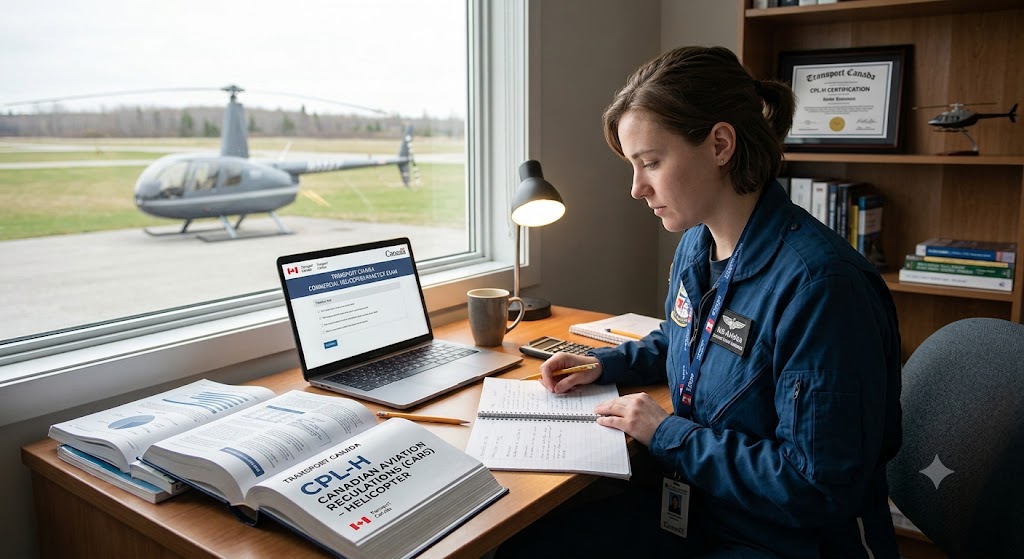
Additional Information
What the Course
Entails and Exam Details
Preparing for the CPL-H written exam involves an in-depth
study of five core pillars of aviation.
Candidates are expected to master advanced concepts in Air
Law, including intricate Canadian Aviation Regulations (CARs) that govern
flight rules and operational procedures specific to the commercial helicopter
industry.
Meteorological knowledge is enhanced to interpret complex
weather patterns and assess risk in challenging Canadian climates.
Navigation expertise includes navigating without GPS,
advanced cross-country planning, and practical applications of electronic aids.
General Knowledge covers complex helicopter systems, turbine
engine operations, flight principles, and performance planning.
Finally, strong emphasis is placed on Flight Operations and
Human Factors, exploring emergency procedures, risk management, the effects of
fatigue, and decision-making crucial for any commercial captain.
What to Expect in
the Final Exam
The final Transport Canada Commercial Pilot License -
Helicopter (CPL-H) written examination is a challenging, computer-based
assessment typically consisting of multiple-choice questions.
It is a time-limited exam, often spanning several hours,
designed to simulate pressure and prioritize efficient knowledge recall.
While the overall passing score is set by Transport Canada
(frequently requiring at least 60% overall), candidates must often achieve a
minimum passing score (such as 60%) in each of the primary sections to earn the
license.
The exam demands rigorous theoretical understanding and
strategic preparation.
It is administered in a controlled testing environment to
maintain integrity and standard.
How to Study and Exam Centers
Effective preparation requires a multi-faceted approach.
Utilize official Transport Canada study guides, such as the Study
and Reference Guide for Written Examinations for the Commercial Pilot License
Helicopter (TP 11954E).
Attend a structured ground school program offered by an
authorized flight training unit.
Actively taking high-quality practice exams, such as the one
described by this title, is indispensable; treat these practice sessions as
real exams to refine time management and identify knowledge gaps.
Form study groups with fellow candidates to discuss complex
topics.
To schedule the official written exam, candidates must
contact Transport Canada regional offices, local Civil Aviation offices, or
authorized private invigilators, which include specific flying schools and
aviation centers designated to administer TC exams across the country.
Check Transport Canada's website for the most current
information regarding online examination options or specific physical center
locations.
Job Opportunities
from the Course
Earning the Transport Canada Commercial Pilot License -
Helicopter unlocks numerous and varied career paths within the Canadian and
global aviation industries. Specific job opportunities include:
- Commercial
Helicopter Pilot (Charter and Tourism)
- Aerial
Work Pilot (Surveying, Photography, Mining Support)
- Utility
Helicopter Pilot (Construction, Powerline Patrol, Firefighting)
- Emergency
Medical Services (EMS) / Air Ambulance Pilot
- Corporate
and Executive Helicopter Transport Pilot
- Certified
Flight Instructor (Helicopter)
- Search
and Rescue (SAR) Pilot
- Offshore
Oil and Gas Transport Pilot
Transport Canada Commercial Helicopter Practice Exam
This brief practice session simulates the format of the
official written exam. Choose the best answer for each question. Answers
are provided below.
Meteorological Knowledge: What is the primary
indicator of the maturity stage of a thunderstorm?
A) The appearance of an anvil top. B) The onset of rain at
the surface. C) The presence of frequent lightning. D) The formation of a roll
cloud.
Air Law:
According to Canadian Aviation Regulations (CARs), what is the minimum fuel
reserve required for a day VFR helicopter flight?
A) 20 minutes at normal cruising speed. B) 30 minutes at
normal cruising speed. C) 45 minutes at normal cruising speed. D) Enough fuel
to reach an alternate airport, plus 20 minutes.
General Knowledge (Systems): In a typical turbine
engine helicopter, what is the primary purpose of the "free power
turbine"?
A) It drives the engine compressor sections. B) It directly
drives the main and tail rotor systems. C) It governs the engine speed under
varying loads. D) It converts exhaust gas energy into rotational shaft power.
Navigation: You are planning a 120 NM cross-country
flight. Your groundspeed is calculated at 90 knots. How long will the flight
take (excluding climb and descent)?
A) 1 hour 10 minutes B) 1 hour 20 minutes C) 1 hour 30
minutes D) 1 hour 45 minutes
Theory of Flight:
What is "translating tendency" in a single-rotor helicopter?
A) The tendency of the helicopter to drift sideways in the
direction of tail rotor thrust. B) The increase in lift as the helicopter
transitions from a hover to forward flight. C) The upward pitching of the nose
as airspeed increases. D) The unstable oscillation that occurs at high
airspeeds.
Frequently Asked Questions
Reviews
5.0
Based on 0 reviews
Leave a Review
No reviews yet. Be the first to review!