
Transport Layer Protocols and Functions in Networking Practice Test
$69.00
- Buy to unlock unlimited access to all Quiz questions and Answers in this Quiz.
- After purchase you can print a PDF of the whole quiz at any point. The PDF will contain the questions and the correct answers.
About this Exam
This article provides a comprehensive study guide focused specifically on the Transport Layer protocols and functions in networking. While not a standalone certification itself, this practice exam covers critical knowledge areas often found within larger networking certifications like Cisco CCNA, CompTIA Network+, or specialized university curriculum modules. Mastering the Transport Layer is fundamental for any serious networking professional. It is designed for students, aspiring network engineers, and system administrators who need to validate their understanding of end-to-end communication, reliability, and data flow control before facing comprehensive exams. This guide aims to solidify your understanding of TCP, UDP, and their essential functions in a practice scenario.
Ready to test your knowledge?
Buy Now to Access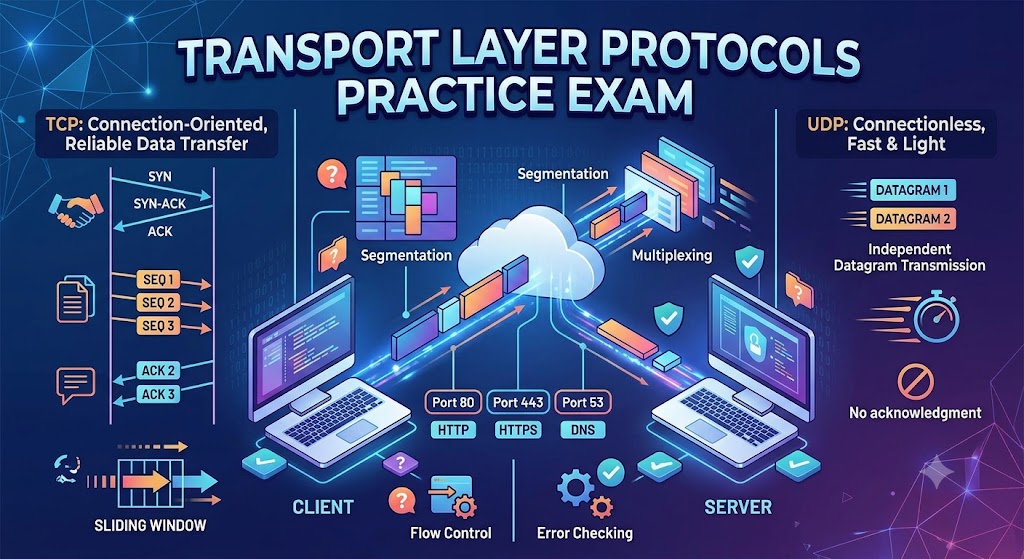
Additional Information
What the Course Entails and Exam Details
This specialized practice exam focuses deeply on the layer
responsible for process-to-process delivery of data. You must demonstrate
proficiency in several core concepts:
- Understanding
Transport Layer Functions: You will be tested on the purpose and
operation of the Transport Layer, including segmentation, reassembly,
error checking, and multiplexing of data streams using port numbers.
- TCP
vs. UDP Deep Dive: A major component of the exam is contrasting
Transmission Control Protocol (TCP) and User Datagram Protocol (UDP). You
must understand the characteristics, strengths, and weaknesses of both
connection-oriented (TCP) and connectionless (UDP) communication.
- TCP
Mechanisms: Expect detailed questions on TCP's reliable data transfer
mechanisms, including the three-way handshake (connection establishment),
sequence numbers, acknowledgments (ACKs), and the connection termination
process (four-way handshake).
- Flow
and Congestion Control: You will need to explain how TCP manages
traffic, including sliding window mechanisms for flow control and
algorithms for congestion avoidance (e.g., slow start, congestion
avoidance, fast retransmit, fast recovery).
- Port
Numbers and Applications: The exam will test your knowledge of common
well-known port numbers (e.g., HTTP:80, HTTPS:443, DNS:53, FTP:20/21) and
how they relate to specific applications and services.
What to Expect in the Final Exam
Since this is a comprehensive study guide for practicing
Transport Layer concepts, a "final exam" for this specific, narrow
topic usually functions as a self-assessment tool within a larger course or as
a standalone practice test. Here is what to expect in that context:
- Format:
These tests are almost exclusively multiple-choice, multiple-answer, or
drag-and-drop scenario questions. They often use network diagrams and ask
you to predict traffic behavior.
- Passing
Score: There is typically no official, universal passing score for a
self-assessment practice test. Your goal should be achieving 85% or higher
consistently, demonstrating a true mastery of the content, rather than
just barely meeting a minimum.
- Time
Limit: Expect time limits similar to official exams. For a 50-60
question practice block focusing solely on Transport Layer, you should aim
to complete it within 60 to 90 minutes.
- Rules:
There are no strict external rules (like non-disclosure agreements) unless
provided by your specific educational platform. However, for honest skill
assessment, you should treat it as a closed-book, quiet-environment test.
How to Study and
Exam Centers
Effective preparation for this deep dive requires hands-on
practice. Here are specific strategies:
- Analyze
Traffic with Wireshark: This is non-negotiable. Don't just read about
TCP handshakes or sequence numbers. Download Wireshark, capture your own
web browsing (HTTP/HTTPS) or a file transfer (FTP), and inspect the
actual TCP headers, flag settings (SYN, ACK, FIN), and sliding window
updates. Seeing the raw data is the best way to understand the concepts.
- Master
the Contrasts: Create a detailed comparison table. List TCP vs. UDP,
focusing on reliability, ordering, flow control, overhead (header size), and
common use cases (e.g., Voice over IP, video streaming vs. web browsing,
email).
- Practice
Scenario-Based Logic: Don't just memorize definitions. Look for
practice questions that give you a complex network topology or a
communication failure and ask you to determine if TCP windowing issues,
packet loss, or incorrect port configurations are the cause.
- Use
Simulation Tools: Utilize labs within network simulators (like Cisco
Packet Tracer or GNS3) to build small networks and observe how changing
configurations impacts Transport Layer operations. For example, set up a
TCP connection and observe how traffic is shaped.
Exam Centers and Access: This set of specific Transport
Layer knowledge isn't administered in dedicated, physical testing centers
(like Pearson VUE) as a standalone test. To access these practice resources:
Enroll in Comprehensive
Networking Courses: Look for reputable online platforms (Coursera, edX,
Udemy), IT academies, or college networking programs that offer modules on the
OSI model or TCP/IP. These courses almost always include these specific
practice tests.
Use Dedicated IT Practice Test
Providers: Search for providers that focus on IT certification preparation.
Many offer test banks and simulators dedicated solely to mastering specific
domains, including networking fundamentals.
Job Opportunities
from the Course
A strong command of Transport Layer Protocols and Functions
is not just for passing tests; it is a foundational skill required for numerous
IT career paths. Here are common job opportunities that heavily depend on this
knowledge:
- Network
Engineer: Must understand TCP windowing and congestion control to
optimize network performance and troubleshoot connectivity issues.
- Systems
Administrator: Uses knowledge of port numbers and TCP states to
configure firewalls, manage server connectivity, and diagnose application
performance problems.
- Network
Security Analyst: Relies heavily on analyzing Transport Layer traffic
(e.g., identifying port scans, unusual TCP flags) to detect and
investigate security threats.
- DevOps
Engineer: Requires a understanding of how applications communicate
over the network (e.g., managing microservices via APIs over HTTP/TCP) for
deployment and monitoring.
- IT
Support Specialist (Tier 2/3): Uses knowledge of reliable vs. unreliable
transport and port numbers to troubleshoot application-level connectivity
problems for end-users.
Frequently Asked Questions
Reviews
5.0
Based on 0 reviews
Leave a Review
No reviews yet. Be the first to review!