
Trauma and Crime Scene Cleanup Practice Test
$69.00
- Buy to unlock unlimited access to all Quiz questions and Answers in this Quiz.
- After purchase you can print a PDF of the whole quiz at any point. The PDF will contain the questions and the correct answers.
About this Exam
This study guide is designed to prepare students for a certification exam in trauma and crime scene cleanup, a vital and specialized sector of the bioremediation and restoration industry.
This course and its final examination are essential for individuals seeking to enter this field, which requires handling hazardous materials with precision and compassion.
Technicians in this field operate at the intersection of public safety and emotional recovery, restoring spaces affected by traumatic events such as crimes, accidents, and unattended deaths.
Successful completion of a certified course, followed by a practice exam, confirms that an individual possesses the necessary technical skills, regulatory knowledge, and safety protocols to operate effectively and safely in these challenging environments.
Ready to test your knowledge?
Buy Now to Access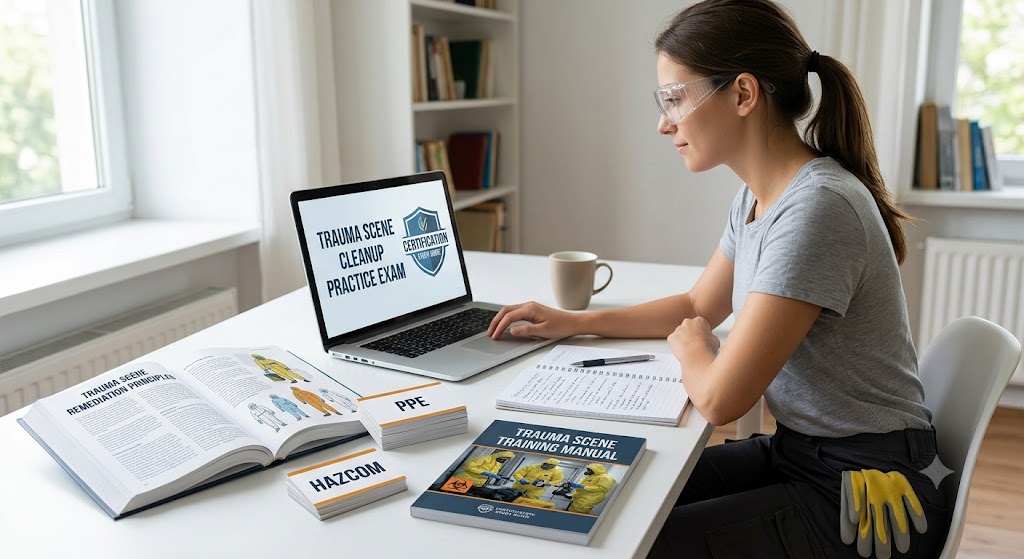
Additional Information
What the Course
Entails and Exam Details
The course for trauma and crime scene cleanup provides a
blend of rigorous theoretical knowledge and practical application.
Key focus areas include the proper use of personal
protective equipment (PPE), rigorous bloodborne pathogen (BBP) training, and
hazard communication standards (HazCom) set by OSHA.
You will learn structured techniques for structural and
contents remediation, vehicle and industrial equipment decontamination, and
odor control.
An essential component of the training covers the correct
application of biocides and antimicrobial agents, as well as the legal
guidelines for the storage, transport, and disposal of regulated medical waste
(RMW).
The ultimate goal of the course is to ensure that a
technician can establish a safe, deodorized, and decontaminated environment,
restoring the property for use.
What to Expect in the Final Exam
While individual certifying bodies like IICRC or various
state agencies have specific structures, a final exam for trauma and crime
scene cleanup typically involves a comprehensive multiple-choice written test.
This exam is designed to validate your understanding of
critical safety, regulatory, and procedural concepts rather than your hands-on
dexterity.
Questions are often scenario-based, requiring you to apply
your knowledge of hazard assessment, PPE selection, and waste segregation to
realistic cleanup challenges.
In many programs, the exam may be administered immediately
following a mandatory training course, often with a set time limit, and
requires a passing score of 70% or 75% for certification.
Using this practice exam is the best way to simulate the
final written test experience and identify your strengths and weaknesses.
How to Study and
Exam Centers
Effective preparation for this specialized exam goes beyond
passive reading. To excel, you must adopt an active study strategy.
Your primary resources are the training manual and
regulatory guidelines from OSHA, the EPA, and your local Department of Public
Health.
Create flashcards for chemical properties, safety acronyms,
and regulated waste types. We strongly recommend completing multiple practice
tests to build your confidence and test-taking speed.
Official exams are often taken at authorized testing centers
or approved schools that offer the prerequisite training courses.
These can be physical locations or online portals, depending
on the training provider and the specific certification you are pursuing.
Job Opportunities
from the Course
Earning a certification in this field opens the door to a
unique career path. Job opportunities are available with specialized biohazard
cleanup companies, restoration firms, and some government or public safety
agencies.
Below is a list of job titles and career paths this course
and certification can unlock:
- Crime
Scene Cleanup Technician
- Trauma
and Biohazard Technician
- Bioremediation
Specialist
- Infectious
Disease Decontamination Specialist
- Hoarding
and Gross Filth Cleanup Specialist
- Forensic
Cleaner
- Meth
Lab Remediation Technician
- Odour
Removal Specialist
- Fire
and Water Restoration Technician (often a complementary certification)
- Restoration
Project Manager
Frequently Asked Questions
Reviews
5.0
Based on 0 reviews
Leave a Review
No reviews yet. Be the first to review!